Cillian Murphy’s Small Things Like These Brings Ireland’s Magdalene Laundries Into Focus
Small Things Like These turns a quiet act of defiance into a portrait of how a community learns to live alongside cruelty. Cillian Murphy plays Bill Furlong, an Irish coal merchant whose comfortable family life rests on a kindness he received as a child. When he encounters a young woman imprisoned by the local convent, that debt of care becomes impossible to ignore.
Directed by Tim Mielants, who worked with Murphy on “Peaky Blinders,” the 2024 film adapts Claire Keegan’s 2021 novella. Murphy also produced it. The film earned a 94% score on Rotten Tomatoes and grossed $15 million against a reported $3 million budget, though its subdued pace and intimate scale have kept it from wider discussion.

A personal history meets a town’s silence
Set in New Ross in the 1980s, the story finds Bill running a modestly successful coal business with his wife, Eileen, and their five daughters. His own childhood still shadows him: born outside marriage, he never knew his father. His mother, Sarah, might have faced a Magdalene Laundry if her employer, the widowed Mrs. Wilson, hadn’t given them shelter and treated them as family.
The laundries were institutions run by the Catholic Church in Ireland until 1996. Women deemed to have transgressed sexual norms, including those who became pregnant outside marriage, were confined and made to work. One of these institutions stands in Bill’s town. People know enough to keep their distance.
Bill’s work gives the film a pointed visual language. He handles coal all day and scrubs his hands at home; the women in the laundries are also made to work with their hands, under the claim that labor will cleanse them. When Bill finds Sarah Redmond locked in a shed, he chooses to bring her home. Her name echoes his late mother’s, tying the moment to the childhood that might have ended very differently.
The rescue doesn’t turn Bill into a conventional hero. As Murphy told GQ in 2024, it’s “not a classically heroic act.” The film instead stays with the cost of breaking an unspoken rule. As Bill walks through town with Sarah, neighbors stare. The crowd slips out of focus, leaving him to move forward without their approval.
A faithful adaptation with a wider purpose

The movie keeps close to Keegan’s spare, somber book, trusting Murphy’s restrained performance and the audience’s patience. The convent’s Mother Superior, played by Emily Watson, exerts authority through courtesy and implication. She barely needs to raise her voice; Bill struggles even to meet her eyes.
Eileen Walsh’s casting adds another layer. She plays Bill’s wife, who tells him, “If you want to get on in this life, there are things you have to ignore.” Walsh previously played Crispina, a woman confined in a Magdalene Laundry, in Peter Mullan’s 2002 film “The Magdalene Sisters.” That film helped bring public attention to the institutions’ history.
Murphy has said the project grew partly from his work on “Oppenheimer.” He passed the script to co-star Matt Damon, who had recently launched Artists Equity with Ben Affleck. Murphy told GQ that the studio’s filmmakers and writers understood the project and gave the team room to make the film they wanted.
History carried through a small decision
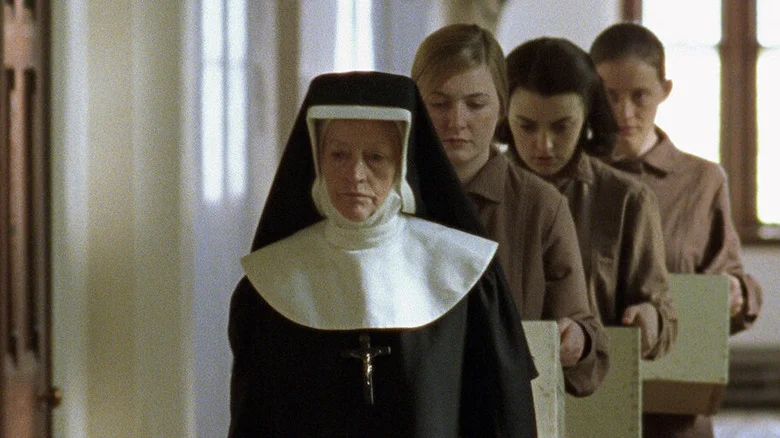
For Murphy, dramatized stories can reach audiences who may not read official reports or academic work. “They will consume books and films, and I think it’s a gentler way to confront it,” he told GQ, referring to the continuing public reckoning over the laundries. The film’s ending offers a measure of hope without suggesting Bill’s choice can undo the harm around him.
Keegan’s novella was selected for Oprah’s Book Club in December 2024, shortly after the film’s theatrical release. At roughly 120 pages, it can be read in one sitting; the movie asks for a similar commitment to stillness. Its final note is captured in the book’s reflection that Bill would pay for taking Sarah, yet had never known happiness like it. That tension is the film’s clearest point: in a town built on looking away, one small act can change what a person is willing to see.