Thomas Mann in Exile: Drift, Decency, and a Politics That Changed
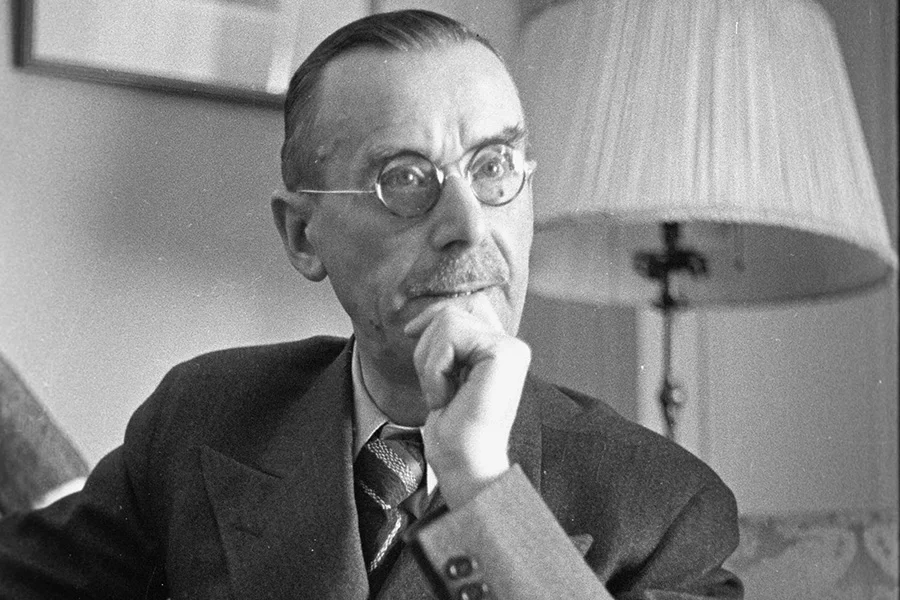
For thirty years, Colm Tóibín has kept returning to Thomas Mann and the sprawling family around him. He read Buddenbrooks as a teenager. In 1996, he was asked to review three large biographies of Mann for the London Review of Books, and he has written about the writer many times since. His 2021 novel The Magician carried that long attention into fiction, tracing Mann from his childhood in Lübeck through his years in Munich and Italy, his Nobel fame, his wartime exile in France and the United States, and his death in Switzerland at eighty.
Tóibín's Mann is a patriarch who seems to drift through his own life, watching himself go by when he isn't absorbed in his work. The children called him Der Zauberer, the magician. That nickname suits the Mann that emerges in our conversation, a man who could make a whole household appear to run itself while he kept to his four hours of writing each morning. My read is that the most interesting thing about Mann isn't his consistency. It's how far his politics moved while his habits stayed exactly the same.
A study that could be a small Germany
Tóibín first saw the Manns' house in Pacific Palisades, Seven Palms, in 2005. He had won the Los Angeles Times Book Prize, and the trip from Dublin didn't tempt him much until he made a deal: get me into Thomas Mann's house, and I'll come. The house had been home to the Manns from 1942 to 1952, and its owners rarely let visitors in. That week they had admitted David Rieff, whose mother, Susan Sontag, had been a guest there in the forties. They let Tóibín in too.
What stayed with him was the study, set apart from the main house. Close its door, he says, and the California light disappears, and you have something close to a little Germany. Mann had carried his desk from Munich to Princeton and then to California, when the belongings of refugees moved through the night in a much less dignified way. The Manns' relocation was far more stylish than most. Tóibín's point is that the separate study was never only about privacy. It was a statement. Mann was saying, in effect, that in the middle of all this, one person was keeping his decency and his connection to tradition intact, and that person was him.
It's easy to mock the line, "Wherever I am is German culture," but Tóibín takes it seriously as a survival strategy. Routine was the armor.
Money, gardeners, and the cost of being a writer
Tóibín is blunt about the practical side of that life. Mann needed four hours in the morning and then needed domestic life. Bohemian parties didn't appeal to him. He and Katia took their walks, went out in the evening only when they had to, and hurried home. Their days revolved around the children coming and going. There were gardeners and servants, and in Munich there was a chauffeur. Maintaining all of it consumed time and energy.
Money sits at the center of this picture. Alfred A. Knopf turned Mann into an author whom, in Tóibín's telling, every civilized American household felt it had to own, and the books sold in enormous numbers. Doctor Faustus was a Book-of-the-Month Club selection. That commercial success helped finance the household that Mann felt he needed to write at all, and it gave him an American audience that his German readership, cut off by the war, couldn't provide.
The children had all the fun
Generational tension runs through The Magician. Mann was the son of a senator, and for a man of his background, becoming a writer was itself a risk. His children came of age in the Weimar years, and Erika and Klaus expressed their sexuality openly and committed to antifascism early. Tóibín points to a letter in which Mann tells them, more or less, that they're having all the fun and he envies it.
That line tells you something. Mann's relationship to his own homosexuality was guarded, indirect, and turned inward, and Tóibín thinks it was shaped by a strange, self-watching gaze. There was a wildness in his imagination that his suits never matched. The children lived with a freedom he could describe but rarely allowed himself.
The same family produced one of the more absurd episodes of the era. W. H. Auden married Erika to help her obtain British citizenship, and Christopher Isherwood, the family's self-styled "pimp," arranged it. Tóibín says the two men found the Manns tedious. When someone asked Auden who the most boring writer in the world was, he answered, "My father-in-law." Tóibín found a 1939 Life photo spread of the family in Princeton and felt it was a kind of lie: a tidy portrait of a household that was anything but tidy.
A pact with the reader
Tóibín's approach to fiction about real people depends on a contract. If he writes that Mann had six children, Mann had six children. If he says Mann wasn't in Germany in 1933, he wasn't, and if he says Mann went into East Germany with his wife in 1949, he did. Facts are fixed. The dialogue is his to invent, and that raised the question of voice. How do you render German speech a century old in English without it sounding stiff? Tóibín chose the sharp, interrupting English of the 1920s.
He borrowed a model from Hemingway's Lady Brett Ashley. Erika, and to a degree Katia, talk in a quick, glamorous way, as if they're holding a cigarette and wearing a red hat. Mann barely speaks. He withholds, he's tactful, and he isn't inclined to say what he thinks. Tóibín's goal is to put the reader in the room with that silence. Information doesn't interest him for its own sake, but once he uses a real man's name, he has to honor the facts attached to it.
That principle extends to the sexuality question. Biographers have read Death in Venice partly as Mann's way of coming out to his brother. Tóibín's view is that Aschenbach is Mann in some senses, but the book is also a kind of joyful game with secret selves, revealing some things and hiding others. When he took the book to Germany, a journalist at the Frankfurt Book Fair asked how it felt to be "queering Thomas Mann." Tóibín's answer was that he hadn't written the diaries. He also pointed out that the material is visible across the work, in Doctor Faustus and in the Hanno thread of Buddenbrooks. What struck him was how hard it was for some Germans to accept that a national figure who stood for decency in a bad time could also hide his sexuality. He thinks that reluctance says something about Germany still.
Drift, and the trip back
The Mann family's story is full of decisions that were never fully made. Klaus published Mephisto, which was banned in Germany well into the sixties, and two years after Mann's own Faust novel, Doctor Faustus, Klaus took his own life. Tóibín reads the title choice as a careless act rather than a deliberate one. Mann reached for the Faust myth as if it belonged to him, and the book that carried it became the one Germany celebrated as a great novel about music, while his son's book had a much harder afterlife.
Mann's 1949 trip to Germany is the clearest case of drift. He had vowed not to return, and then he went. Tóibín argues that Mann believed language had no border, that the German he kept in his study could travel with him. He also says that idea was naive, since words are used differently in East and West. Mann's reasons were partly pragmatic. He didn't want Brecht or his brother Heinrich to call him a stooge for having accepted American demands that he avoid the East. Meanwhile the American government was preparing to deport Erika, who had neither citizenship nor a green card. If she left, her parents would go with her. The trip was a choice made by default, and then Mann got stubborn about it.
Tóibín's conclusion is that drift matters enormously to a novelist. A decision you didn't really make, and then defended, can lead you into something foolish.
Change, not consistency
Mann's political record is uneven. He spoke out during the First World War, but his position looked out of step. He didn't formally repudiate Hitler until 1936, and that came only after Erika threatened to break contact with him. Katia drafted the statement. Mann kept being pushed onto the world stage without ever settling on a coherent position.
Then came the 1940s, and Tóibín thinks Mann became something else. His speeches across America, given with Roosevelt's approval, looked ahead to a democratic victory and did not treat Germany as a lost cause to be punished. Mann argued that democracy was built into German culture and would flourish. Tóibín says for two or three years Mann was almost a political thinker. The contrast with 1914 is striking. In that year, Mann was a monarchist. The gap between the Reflections of a Nonpolitical Man and the speeches of 1942 is, to Tóibín, the real story.
He is also honest about how easy it is to miss what's coming. One wonders how a figure so embedded in German culture could fail to see Hitler coming, and Tóibín notes that plenty of people today fail to see the next turn in their own politics for the same reason: the possibility seems ludicrous until it isn't. What matters, in his view, is that Mann changed.
Tóibín's final point about Mann is the one I keep thinking about. Mann kept diaries and wrote Death in Venice, and Tóibín suspects he needed to be known and seen. That's an odd need for a man so skilled at invisibility. The novelist who spent a lifetime observing his own drift wanted, all along, to be the one watching.
Andrew Marzoni is a writer, editor, and musician.