Helen Garner to Receive the 2027 Hadada Award for Lifetime Achievement
Helen Garner’s writing has made private life a subject of public consequence. Across fiction, journalism and essays, she has examined families under pressure with a candor that reshaped how domestic experience could be rendered in Australian literature. In 2027, she will receive the Hadada Award for lifetime achievement.
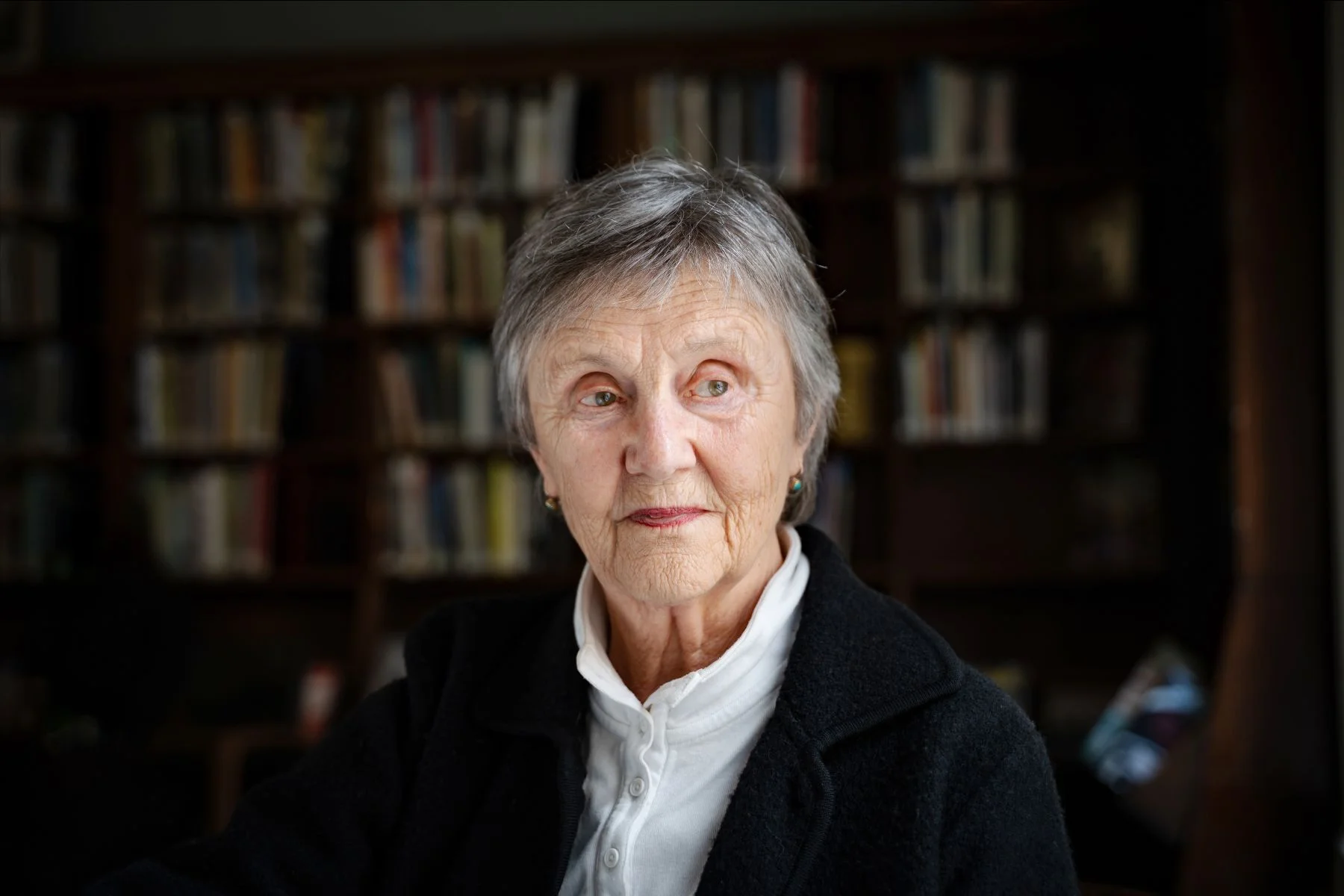
Photograph by Darren James.
Garner’s debut novel, Monkey Grip, grew out of a turbulent stretch of her life in early 1970s Melbourne. She and her two-year-old daughter lived in communal houses shared mainly by single mothers. Amid the noise of the household, Garner read Proust and Tolstoy, kept a diary and began a relationship with a man addicted to heroin. As the relationship developed, she sensed its shape as a story taking form around her.
“Story is a chunk of life with a bend in it, and I could feel this one coming,” she told Thessaly La Force in The Art of Fiction No. 255. “I suddenly thought, Maybe I could write about this while it’s still happening, as it’s coming into its bend.”
Turning lived experience into literature
Published in 1977, Monkey Grip won the National Book Council Award’s first prize and unsettled some critics with its portrayal of unconventional households, sex and female desire. Critics who dismissed it as a published diary underestimated the work involved in shaping personal records into literature. Garner later challenged that assumption, writing in 2002: “As if there were no work involved in keeping a diary in the first place.”
Her diaries have since appeared in three volumes covering 1978 to 1998. The practice of close observation that runs through them also informs her fiction, where family life often becomes the setting for larger questions about freedom, care and obligation.
Born in Geelong, Victoria, in 1942, Garner was the eldest of six children. Reading offered a private refuge in a crowded home. “In a big family you’ve got to find a way of getting away from everybody to a place where you can quietly exist, and that’s what reading was for me,” she told La Force. “It was my way of being absent.”
That attention to family dynamics recurs in novels such as The Children’s Bach (1984), where an old friend’s bohemian family disrupts a couple’s ordered routines, and The Spare Room (2008), which follows a narrator caring for a friend seeking alternative cancer treatment. The latter confronts the strain of care without softening its frustrations.
Family, care and public scrutiny
Garner has also brought her close observational style to nonfiction about criminal trials. Joe Cinque’s Consolation (2004) examines the killing of a young man by his girlfriend. This House of Grief (2014) follows the case of a father who drove himself and his three children into a dam, killing the children. In both books, family relationships sit at the center of events with consequences far beyond the home.
“The thing is, despite being told that my concerns were too domestic, I’ve always known that the family is where everything is played out,” Garner said. That view helps explain the reach of her work: the household is not a retreat from public life, but one of the places where its hardest conflicts become visible.
Over five decades, Garner has received the Windham-Campbell Prize, the Melbourne Prize for Literature and a Walkley Award, and has been inducted into the Victorian Honour Roll of Women. The Hadada joins a list of past recipients that includes John Ashbery, Anne Carson, Deborah Eisenberg, Jamaica Kincaid, N. Scott Momaday, Edward P. Jones and James Salter.
Garner is scheduled to receive the award on April 6 at the Spring Revel, an annual gathering of writers and artists. Her recognition reflects a body of work that keeps returning to the intimate scenes where character, care and consequence meet.