Nontoxic Cookware Explained: What PFAS Means for Your Nonstick Pans
If you've shopped for nonstick pots and pans in the past decade, you've probably heard "nontoxic cookware" pitched with growing enthusiasm. Plenty of shoppers search for the best nontoxic options without knowing which toxins they're supposed to avoid. So what makes cookware "toxic," and why do "safe" or "healthy" pans claim to be better?
The answer starts with PFAS, short for per- and polyfluoroalkyl substances. This family of synthetic chemicals repels liquids, which made it useful in everything from waterproof jackets to nonstick pan coatings. The health concerns scientists raised took decades to reach the public in any meaningful way, and that lag is a big part of why the topic feels so confusing now.
Where the "toxic" reputation came from
Most traditional nonstick pans are coated in polytetrafluoroethylene, or PTFE. Brands that label their cookware "nontoxic" are often positioning it as a safer alternative to that coating, and the word does plenty of selling work. To understand why old nonstick pans earned the "toxic" tag, you need the history of PTFE.
PTFE was discovered accidentally in 1938. Chemical company DuPont trademarked it as Teflon in the early 1960s. In the second half of the 20th century it was a genuine shake-up for home cooking, offering a surface that released food without oil. By the turn of the century, Teflon was everywhere, showing up in a staggering number of American kitchens on skillets, baking dishes, and muffin tins.
PTFE is only one member of the PFAS family, though. Around 1951, DuPont began using another PFAS, PFOA (perfluorooctanoic acid), in its Teflon manufacturing process. Over time it became clear that PFOA could reach the human body through gaseous fumes or chipped coatings. The documented effects include increased risk of certain cancers, birth defects, ulcerative colitis, and thyroid disease. Under sustained pressure from public health and environmental advocacy groups, manufacturers phased PFOA out by 2013.
Is today's nonstick still a concern?
Mostly, the modern version is a different product. Traditional nonstick is now made with PFOA-free PTFE, which is typically also free of PFOS, another harmful PFAS. You'll find it sold under names like T-fal, Dura-Slide, or hard-anodized aluminum. PTFE itself is considered less harmful than other PFAS, but that doesn't close the question.
Thousands of PFAS compounds remain unregulated, and research into the chemical class as a whole is still ongoing. A "PFOA- and PFOS-free" label tells you two specific chemicals are absent. It doesn't tell you the pan is free of every potentially risky PFAS.
What "nontoxic" came to mean
The idea of nontoxic cookware took hold with consumers when GreenPan released the first PFAS-free ceramic nonstick frying pans in 2007. The term isn't necessarily the first of its kind, but that's the moment it stuck. Since then, "nontoxic cookware" has come to mean "PFAS-free nonstick cookware."
That shorthand isn't wrong, exactly. But it's worth being skeptical about how neatly the phrase now works as a buzzword. Read "nontoxic" as a specific claim about a specific coating, not a guarantee about everything in the pan.
The best nontoxic cookware
We tested dozens of nonstick and "nontoxic" pans to find the ones worth buying. Here are our picks by category:
- The best ceramic nonstick pan: GreenPan Valencia Pro
- An "I-can't-believe-it's-not-Teflon-or-ceramic" nonstick pan: Misen Carbon Nonstick Frying Pan
- The best stainless-steel cookware: All-Clad D3 Stainless Steel Skillet
- The best nontoxic cookware set: All-Clad D3 Stainless-Steel 7-Piece Cookware Set
- The best cast-iron skillet: Lancaster Cast Iron Skillet
- The best enameled cast-iron Dutch oven: Staub Cocotte
- The best carbon steel skillet: De Buyer Blue Carbon Steel
"Nontoxic" isn't a material category, and that's where the confusion starts. Ceramic nonstick is the usual reference point. It's made from silica, applied through a process called the sol-gel process. But any cookware made without harmful chemicals like PFAS qualifies. That includes pans you probably already own: stainless steel, cast iron, and carbon steel.
Ceramic nonstick comes closest to the slickness of old-school Teflon. It's also a coating, and coatings wear out. They degrade and chip over time. That's why we'd rather you get comfortable with bare stainless, cast iron, and carbon steel. Technique does most of the work. Get the pan hot enough, use enough fat, and let the food release on its own. Do that and food won't stick to these either, and the pans will outlast any coating by a wide margin.
The best ceramic nonstick pan: GreenPan Valencia Pro
If you're going to buy a coated pan anyway, I'd buy a ceramic one. I've personally given up on coated nonstick. Every version I've used, at every price, starts losing its slickness within a few years and then needs replacing. Still, I get the appeal, and ceramic is the better option of the coated bunch. These pans usually have a stainless steel or aluminum body lined with a silica-based coating. That coating is what makes them slick, at least for a while. The exact formulation varies from brand to brand, which is why we've tested lots of ceramic nonstick pans over the years to see which ones actually deliver.
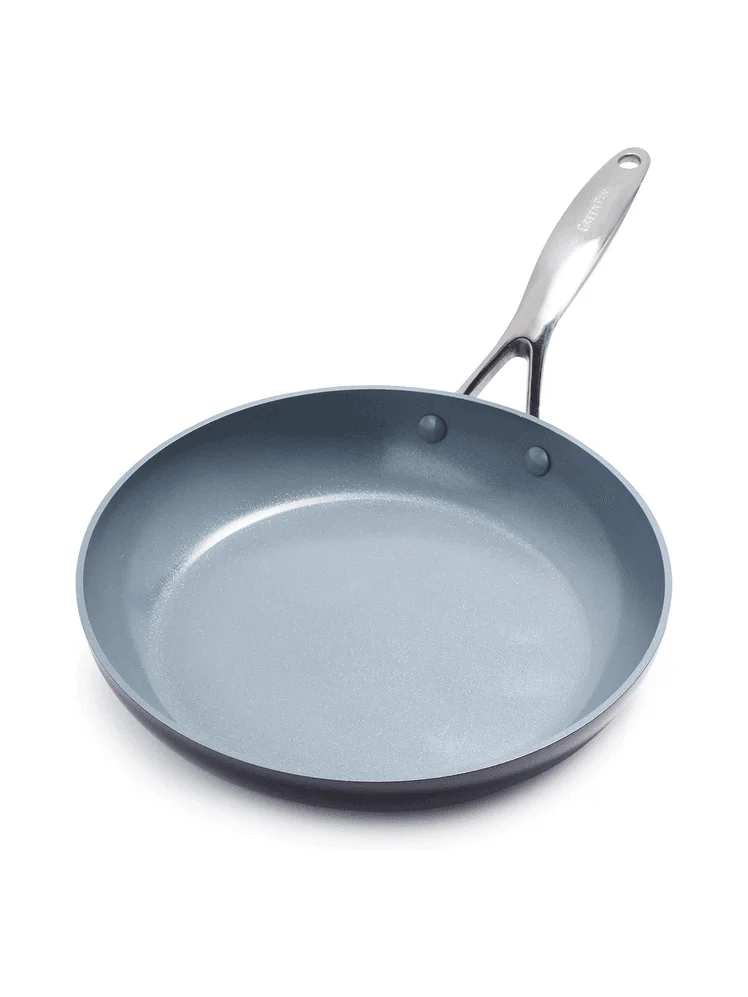
GreenPan made the first ceramic nonstick pans to reach the market, back in 2007, and its products keep landing near the top of our nonstick testing. Our favorite from the line is the Valencia Pro, and the reasons are practical. It has enough heft to feel durable, yet it's light enough to move around the stove without effort. It's also cheap enough that replacing it in a few years doesn't sting. And it's more scratch-resistant than some earlier GreenPan models we've tried. It works on induction, too.
Here's the thing: the Valencia Pro's strengths are mostly about how it behaves day to day, so the spec sheet and pros-and-cons list tell the rest of the story. On the plus side, it's rated for high heat, has a comfortable handle, conducts heat well, is induction compatible, and goes in the oven. The downside is the one that applies to every nonstick pan: the ceramic coating wears down after a few years. Nothing about the Valencia escapes that.
The specs are straightforward. It comes in 8", 10", and 12" sizes. It's induction compatible and oven-safe up to 600ºF. It's dishwasher-safe, but hand-washing is the better move if you want the coating to last. Metal utensils are theoretically fine, but wood or silicone will treat the surface better. The warranty runs one year.
A budget option: If you don't cook on induction and want to spend less, GreenPan's Paris Pro line performed much like the Valencia in our testing. You give up induction compatibility, and that's the whole trade.