Forrest Gander's Next Two Books Pair a Sierra Nevada Novel With a Career-Spanning Poetry Selection
Forrest Gander has two books coming within three weeks of each other. Milkweed publishes his novel The Weight of a Frozen Moment on April 6, 2027, and New Directions follows on April 27 with Dune Lines: New and Selected Poems. Putting a new novel and a selection drawn from forty years of his poetry in the same season is an unusual move. Read together, they look like two halves of one argument about how people stay connected to each other and to the land that shaped them.
A novel built on two sisters and a mountain range
The Weight of a Frozen Moment starts in a small intentional community in California's Sierra Nevada. Two sisters, Maya and Mira, grow up sharing discoveries, secrets, and the sense that their lives are running on parallel tracks. Then adolescence pulls Mira away, first gently and then for good. Maya has to rebuild herself on her own. Grief and a family tragedy push her toward a trip to Karnataka, where she marks the anniversary of their father's death, and her attachment to the mountains where she grew up deepens throughout.
Gander is a Pulitzer Prize winner, and his poetic restraint shows up in the prose. He pays close attention to the natural world, and the terrain here doesn't sit in the background. It pulls on the story. The Sierra Nevada works as a witness, an anchor, and finally the ground where the sisters find their way back to each other. The book's setting, the Sierra Nevada foothills above the Yuba River Canyon and the Tahoe National Forest, does a lot of the emotional work.
The novel's central idea is that separateness and closeness aren't opposites. The book's title hints at it: a frozen moment holds weight because it's still and full of what came before. Gander's sisters are separate people who remain inseparable, and the book treats that tension with more grace than sentimentality.
A cover built from a 1935 lithograph
The cover of The Weight of a Frozen Moment was designed by Mary Austin Speaker, and her process tells you a lot about the book's mood. She avoids cover art that looks too polished or too digital, and she prefers older work made by hand. The image she chose is a lithograph of Latourelle Falls, printed by the Wesley Andrews company in 1935. Its colors are slightly off, and the forest pushes in from the edges.
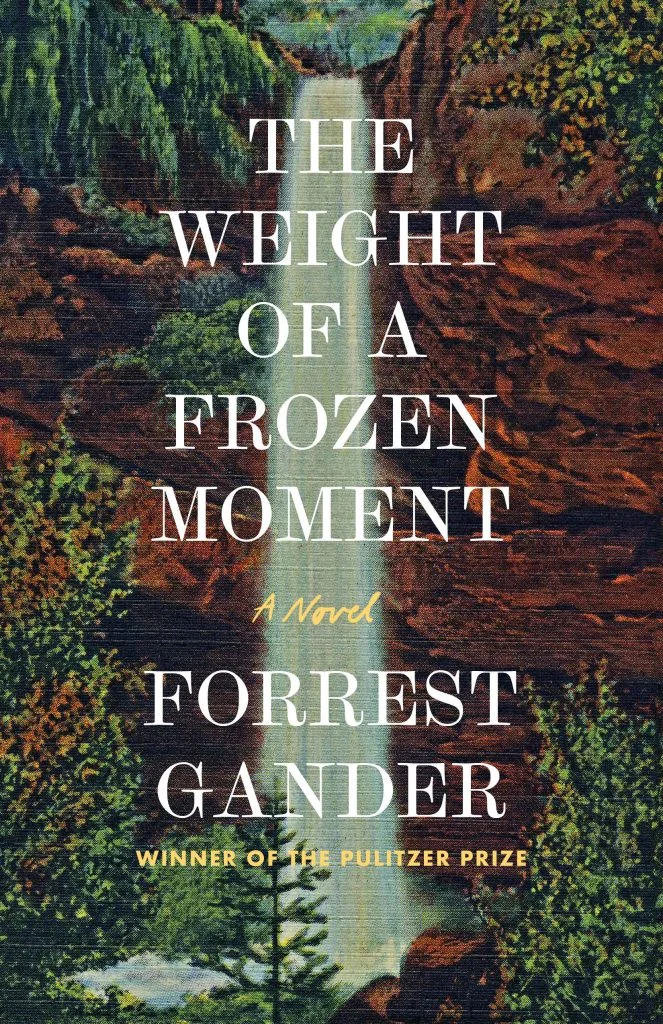
Speaker explained that she wanted to evoke the feeling of finding a private place in the woods, the kind the sisters discover. A waterfall suggested discovery, awe, and the mix of rushing and stillness that runs through the book. Waterfall photos tend toward cliché, though, so she looked for something more saturated and painterly. She has collected lithographic postcards for years because they sit between categories. Printed before color photography and then hand-colored, they blend the real and the imagined, and that blend gives them an eerie quality.
Gander's reading of the image is just as specific. He sees a photograph that might have started in black and white, and he's not sure whether he's looking at a painting, a drawing, or a print. The heavy, fissured rock holds back the sheer water. The forest's darkness looks more like preparation than threat. To him, that suggests memory and the moments that orient Maya, who has to face a self she can't fully enter as her sister grows up and her father gets sick. He also points out that the cover doesn't gesture toward the transnational side of the story, yet the landscape may be the real main character, and the image captures that anyway.
Dune Lines and forty years of poems
Pre-order details for the novel are available here, but the poetry collection is a different kind of book. Dune Lines gathers work from four decades of Gander's publishing life, and the selection is built to show how his interests have moved and held steady. The questions in these poems are direct: What makes a life ethical? What makes it erotic? What does it mean to be made up of other people, human and otherwise? The poems range from tenderness and tragedy to close phenomenological attention and the particular, almost sustaining details of love.
The scale is worldly, but the focus stays personal. Gander's poems fuse geological time with human time, so a single lyric can move from rock formations to a single breath. The collection pulls from many of his most-read poems, and as a result it makes his path through contemporary poetry easier to see. Readers who know him from one book will find the threads that connect the others.
A cover that works like a seismograph
The cover for Dune Lines comes from Rodrigo Corral and Giacomo Girardi, and it's Gander's third consecutive book with a Rodrigo Corral Studios design. The look is spare. A single vertical mark repeats, swelling and narrowing until the eye starts to hear a rhythm. Gander compared it to cymatics or oscilloscope traces, and he saw echoes of Bridget Riley's early black-and-white Op Art alongside the formal discipline of Ellsworth Kelly's drawings. The shapes could be reeds, ribs, or a seismograph reading. They could also be dune lines standing upright.
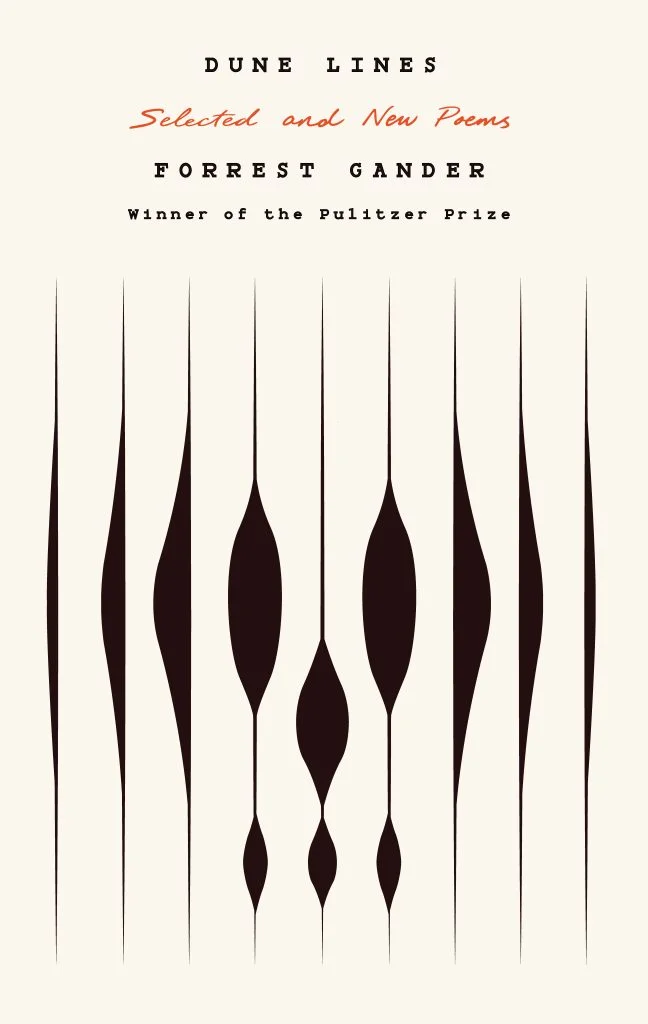
That ambiguity fits a selected-poems collection. Gander's sections from Mojave Ghost, the book that records a hike along the San Andreas fault into the Mojave Desert where he was born, are especially well matched to the dune imagery. The cover also suggests the rise and fall of the poetic sequences inside, where a theme or event gets approached from several angles. Gander even connects it to breathing, which he calls an integral part of his poetic process.
Corral reads the design differently. For him, the shifting line weights represent the dunes, and they converge in the middle to form a skull. That reading brings the collection's concerns into view: the cycle of life, grief, and memory, and what it means to be human when set against nature and a geological timeline. The two readings don't cancel out. A cover that can hold both a seismograph and a skull is doing its job.
What to watch in spring 2027
Here's the thing: a novel and a poetry retrospective from the same author, released weeks apart, can read as a publisher's coincidence. Here it looks more like a deliberate pairing. The novel gives a long, narrative account of how a person keeps a bond through separation and loss. The poems offer the compressed version of the same concerns across four decades. Readers who come to one will likely end up reading the other.
The covers also make the pairing easy to spot on a shelf. One is a hand-colored lithograph of a waterfall that carries the weight of memory. The other is a rhythmic mark that could be a dune, a sound wave, or a skull. Both suggest that Gander's work stays concrete and attentive to place even when it turns abstract. That's a useful signal for what comes next.