Robert Caro's Chauffeur and the Civic Work of Paying Attention
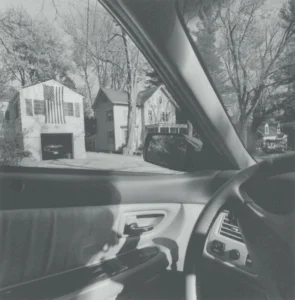
Photograph by Lee Friedlander. From a portfolio in issue no. 169.
Lyndon Johnson's chauffeur knew more about how Johnson thought than most of the people who covered him. That's the kind of detail Robert Caro built his reporting on, and it's why his view of democracy hits harder than a civics lesson.
A backseat full of political math
Caro's story about Carroll Keach is a small lesson in method. Keach drove Johnson around the Texas Hill Country, where, as Caro puts it, most of a campaign is spent in a car. Keach lived outside Corpus Christi, a trip Caro remembers as roughly 180 miles. He was laconic, not chatty, so Caro kept calling him back with the same questions. Eventually Keach said Johnson often talked to himself in the backseat, weighing whether the day had gone well and whether he'd made a good impression on voters.
The useful part is what Caro did next. He didn't take the remark at face value. He asked what Keach meant and how he knew. A vague comment only becomes evidence after someone pushes on it.
Democracy as a chain of informed votes
In his Art of Biography interview, published in issue no. 216, Caro makes a case that sounds modest and turns out to be demanding. "We live in a democracy, so ultimately, even despite a Robert Moses, a lot of political power comes from our votes," he says, referring to the New York planner at the center of The Power Broker.
The catch is in the next line. "The more we understand about the realities of the political process, the better informed our votes will be. And then, presumably, in some very diffuse, very inchoate way, the better our country will be." I like that he hedges. He doesn't promise a tidy result, only a direction. Votes count for something, but they count for more when the voter knows how the decisions actually get made.
A town that wanted out
Matthew Baker's story "Why Visit America" runs the opposite experiment. Residents of Plainsfield, Texas, a fictional town, vote unanimously to secede and call their new nation "America." What makes it bite is how ordinary the town is: porch swings, wading pools, pump jacks on the horizon, and a mix of views that won't sort onto a left-right axis. Pro-lifers who back gay marriage. Solar-panel owners who deny climate change. Creationists with degrees in biology and geology.
Baker's narrator explains the revolt in plain terms: "The executives were busy making donations that funded the campaigns of the politicians, the politicians were busy passing laws that protected the interests of the executives, and pretty much nothing else seemed to be getting done." Then comes the line that gives the story its edge: "...mostly we were normal people who couldn't afford to buy an election and had come to understand that our votes didn't mean shit."
Read alongside recent midterm results in Texas, where Democrats won the state's first Senate seat since 1988, its first governorship since 1995, and control of the state House for the first time in more than two decades, the story feels less like satire than like a snapshot of how fast a state's politics can shift.
Where the two meet
Caro's chauffeur and Baker's secessionists are the same problem from opposite ends. Johnson was a man obsessed with whether voters had heard him, and Baker's town had concluded that nobody was listening. Both sit in the gap between a vote and an understanding of what that vote can do.
My read is that closing that gap is less glamorous than it sounds. It means asking the chauffeur the second question, reading the bill instead of the headline, and treating the mechanics of power as part of civic life. Caro thought that work was worth doing for its own sake. Baker's town suggests what happens when people stop believing it's worth the effort.