What French Readers See in American Fiction: A Festival’s View
What French readers see in American fiction
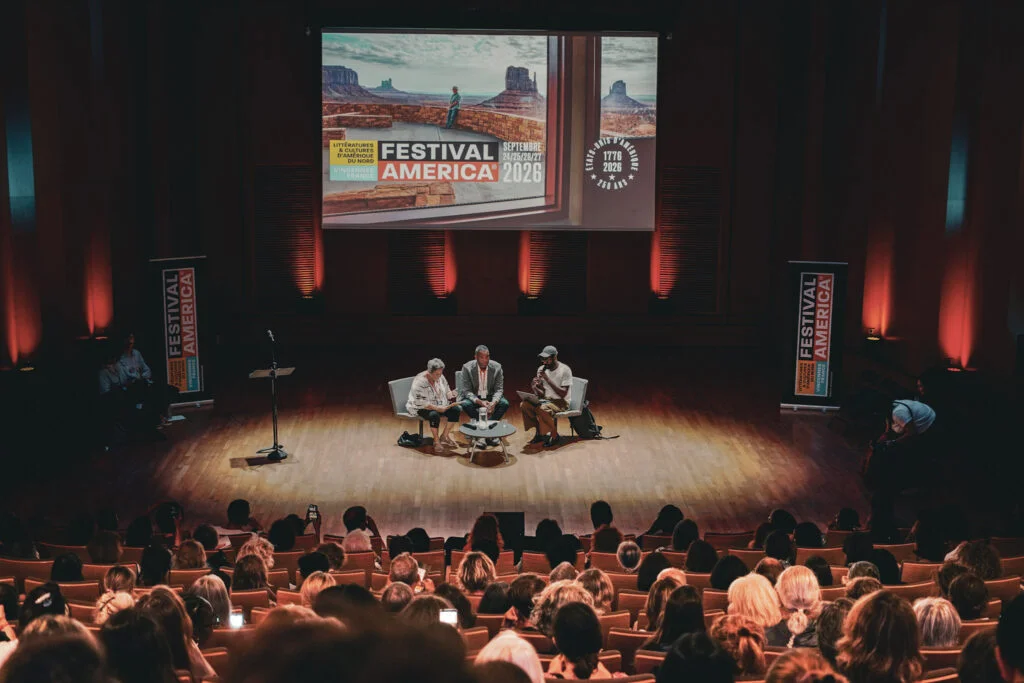
Ta-Nehisi Coates panel. © Siriot de la Petra.
Festival America’s 2026 trailer makes a striking argument before the festival’s first writer appears: American literature can’t be separated from the country’s history. Its images race from Native American men on horseback and George Washington to Wounded Knee, a mass grave, the suffrage movement, Normandy, a nuclear blast and a rocket launch. Then come three lines of French: Littérature. Expositions. 60 autrices et auteurs américains.
Littérature.
Expositions.
60 autrices et auteurs américains.
Headshots of John Grisham, Joyce Carol Oates, Laura Kasischke and Ta-Nehisi Coates appear over footage of the March on Washington. Sixty writers’ names scroll past scenes of men heading to war. The black-and-white footage gives way to color as Ronald Reagan signs a bill and a plane hits the Twin Towers. The sequence is meant to celebrate a nation, but it also leaves little room to mistake what that nation’s story contains.
Held every two years in Vincennes, just outside Paris, Festival America usually brings together writers from the United States, Canada, Mexico and the Caribbean whose work has recently appeared in French translation. The program includes panels and workshops. For 2026, the festival narrowed its focus to the United States, marking the country’s 250th anniversary. Alison Bechdel, Tommy Orange, Viet Thanh Nguyen, Karen Russell and Patrick Radden Keefe were among the invited writers, alongside many other well-known American authors. My husband, Jake, was on the list too—and found the company intimidating.
It’s easy to understand why. His debut, Slime Line, came out from a university press with so little fanfare that his next editor, at a larger New York imprint, still called him a “debut author.” A major French publisher had acquired the book under its French title, Alaska Parano. Two years after its U.S. publication, Jake and I traveled from Pennsylvania to Paris and found a readership waiting for him. His novel had a place on the “new and notable” table at a bookstore near our hotel, another copy appeared at a shop on the next block, and Shakespeare and Company had selected it as a staff pick.
Jake was delighted and baffled. French-language Instagram accounts had been praising his novel, which draws on his time in the commercial fishing industry, as a beautiful account of the “solidarity of magnificent losers.” Then his French publicist asked whether he’d speak with a journalist at a major French magazine for a profile as “the new voice of America.” The attention suggested that his book had found a particular French readership. I wanted to know what had clicked.
A taste for the margins
That sounds like a reporter’s neat mission statement. In reality, finding out about French literary taste ranked behind wine and cheese. On the festival’s first full day, writers and their guests were invited to a cocktail lunch at the Château de Vincennes, once a residence of French kings from the 14th through the 17th centuries. We ate radish slices on skewers, thin breads with charcuterie and small meringues beneath the castle’s towering donjon.
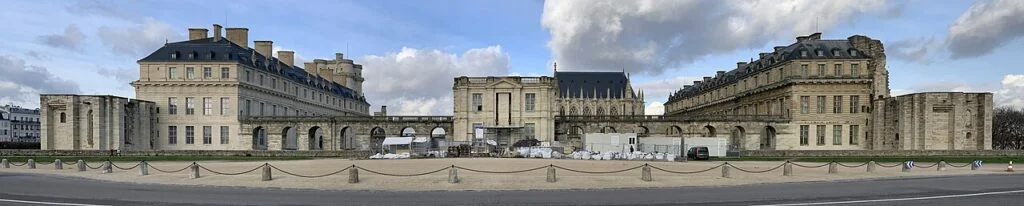
Château de Vincennes, CC BY-SA 4.0, via Wikimedia Commons.

I asked the festival’s chief interpreter whether the château had any torture devices. She said its most gruesome death was caused by illness. In 1422, during the Hundred Years’ War, Henry V of England came to the château after the Siege of Meaux. He had conquered Normandy and was close to becoming king of France, but dysentery killed him soon after he arrived.
The castle is a useful reminder of the historical scale mismatch behind this festival. The United States is young beside Europe, and its literature has to make something of that shorter past. “Compared to Europe, it’s very recent,” festival founder Francis Geffard said. Still, the 250th anniversary offered a tidy reason to gather American writers across generations, regions and identities. Geffard hoped that group might help answer a larger question: what does American fiction mean to readers outside the country?
There’s an obvious practical answer to why so many writers accepted: Paris is a hard invitation to refuse. Geffard said it’s “very unusual for a writer to turn down the invitation.”
After lunch, Geffard moderated a discussion called “The French Taste for American Literature” at Vincennes’s 19th-century town hall. To get inside, I crossed a red carpet bordered by a photography exhibit that included migrants paddling across the Rio Grande. More than 200 people climbed the grand staircase to the marriage hall, where painted aristocrats watched from the walls. The previous festival had attracted 60,000 people; the press team expected this edition to match or exceed that turnout.
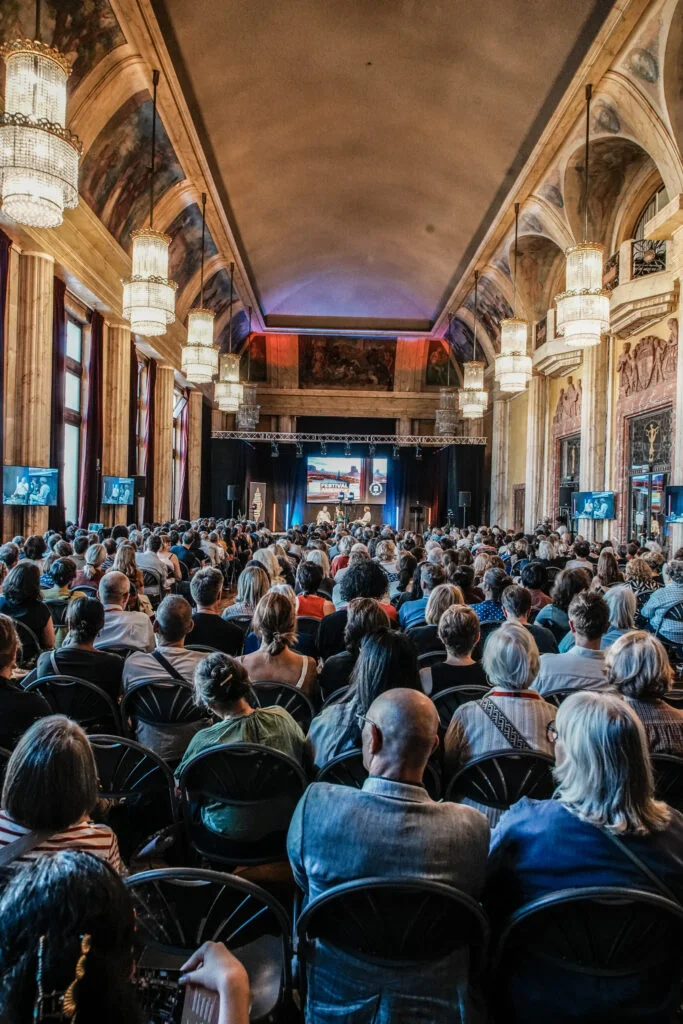
The panel was in French, but its opening questions made the assumptions plain. One speaker began by saying American writers weren’t quite like French writers. Another observed that people in France often imagine the United States as a country without culture.
One panelist, Sébastien Bonifay, is a Corsican writer and bookseller who has made more than 20 trips to the United States to visit authors he admires. He has sometimes stayed with them for days. His recent book, (Not) Born in the USA, recounts meetings with James Ellroy, Chris Offutt, Donald Ray Pollock, Stuart Dybek and James McBride, among others. These aren’t necessarily the names an American reader would choose first. “The literature that nourishes me is an American literature that Americans don’t like,” he said.
Bonifay described it as “a literature of the margins.” The panelists linked that writing to countercultures that push back against l’establishment—the French use of the English word, with a pejorative edge—and to traditions such as rock and roll, psychedelia and punk. Another speaker drew a line between “the coasts” and “the other”: a body of writing that is less often published but can be excellent. University presses, the panelist said, were especially good at bringing this work out. Mainstream recognition seemed beside the point; the panelists trusted their own judgment.
Their description began to sound like Jake. They spoke of an “American-style résumé,” the kind that might belong to someone who fits writing around blue-collar work. They called that writer “artisanal,” someone whose lived experience shows up on the page. And they imagined that experience taking place somewhere a French reader might struggle to picture, such as Ohio.
Bonifay’s book begins in exactly the sort of place that can feel foreign even to a curious reader: a Wendy’s parking lot, where he waits nervously before visiting Donald Ray Pollock. I found him later at the signing tent, seated behind a stack of books. He said he fell for American fiction at 14, reading Stephen King. The horror wasn’t what drew him in. It was the small-town setting: Derry, King’s fictional Maine community, had him hooked before the plot took its first turn. As someone from an American town, I understood the appeal.
“The writers who have a lot of success in France” are often less successful at home, Bonifay said; some “are not even published in America.” Asked why French readers gravitate toward American books that get little notice in the United States, he offered a theory: “French people, they’ve got a problem with America. We are fascinated by America. But we truly, deeply think we should be, as France, as a country, where America is.”
France, he said, has far more history. American books that find a French audience often expose the country’s darker, rougher side. He pointed to crime novelist Benjamin Whitmer, whose books have a much larger following in France than in the United States. Bonifay had visited him in Colorado as part of his travels to meet American writers.
Whitmer owns 13 guns, Bonifay said. In France, he explained, gun ownership can read as a marker of a redneck. But when Bonifay visited, Whitmer asked him about the French literary theorist Maurice Blanchot. The combination delighted him: “Benjamin Whitmer knows Maurice Blanchot. He reads Maurice Blanchot, and he’s got thirteen guns.” One gun, he added, was for grizzlies; another was for coyotes.
Bonifay had little patience for the other side of his imagined divide. “It’s just my opinion, but these writers are a lot better than the other ones,” he said. “Really, I don’t care about Jeffrey Eugenides! Really, I don’t care.”
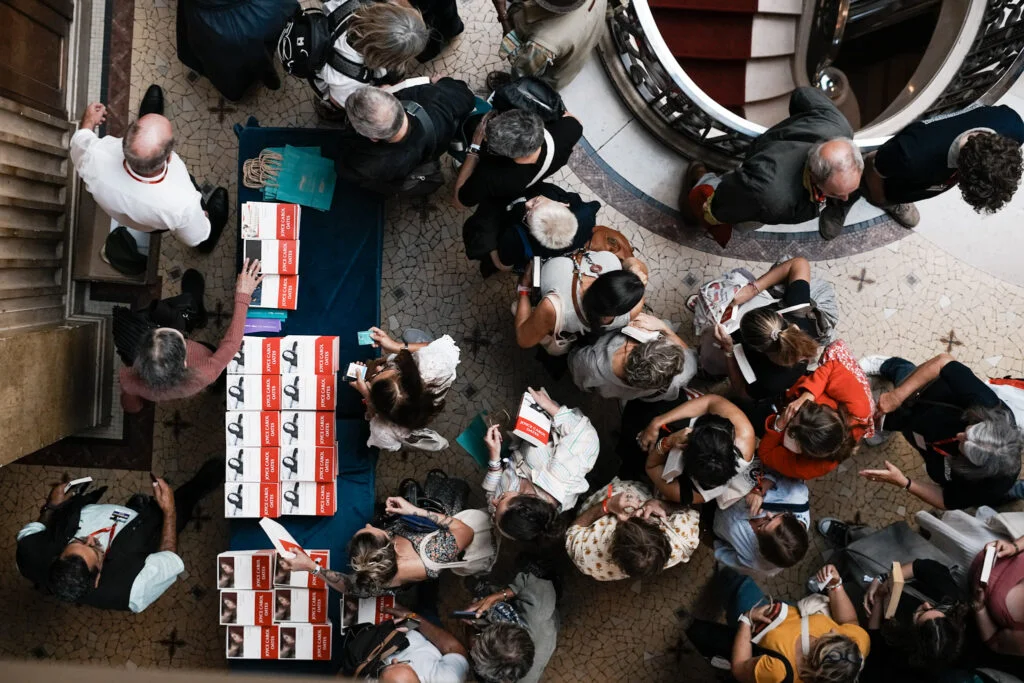
© Siriot de la Petra.
Jake, whose book came from West Virginia University Press, was already selling copies quickly in the bookselling tent. A group of teenagers had just mobbed him after he spoke to their class. When I told him about Bonifay, he said, “That guy rules. I think he wants us to come to Corsica.”
A queue for Joyce Maynard wound through the booths. I asked two women browsing nearby what they liked about American writing. The younger one answered: “The stories, the journey, the wide-open spaces, and all that.” Then she began asking me about the United States. They’d come to learn about America, and I was standing there as an available specimen. I told them about Jake’s work.
“Ah, that wouldn’t exist here, someone who writes about being a fisherman,” the younger woman said. “In France, it’s more l’establishment.” Her companion translated that as “professionals”: she’d expected a writer discussing capitalism to be “more like a banker.”
They also told me I should know the woman with the black hat and red lipstick if I wanted to understand French literature. “She has her own myth,” the older woman said. I couldn’t follow her remarks about le wokisme, and didn’t ask her to explain. Later, I worked out that they meant Amélie Nothomb, the Belgian Francophone novelist known for large hats and television appearances. King Philippe named her a baroness.
The festival had its share of striking literary characters. Novelist Rob Franklin told me that at the opening ceremony, an older woman named Sophie introduced herself. She was around 90, with a pixie cut and an eccentric style. Franklin had been told his French editor was called Sophie. When this woman asked to photograph him, he assumed she worked for his publisher. She checked her schedule through a monocle, then began the portrait session.
The next day, Franklin went to his publisher’s tent to meet Sophie and discovered a different woman. He spent the rest of the festival wondering who had taken his picture. On the final day, the first Sophie found him again and handed over her card. She was France’s most famous photographer of writers, and had been doing the work for 60 years. “I found out she’s like … quite famous,” Franklin said. Her business card featured a black-and-white portrait she had taken of Michel Foucault.
What “the establishment” means
I wanted to test the panel’s talk of l’establishment with Fabienne Gondrand, a literary translator who interpreted for Jake throughout the festival. She had sat beside him on panels, translating his comments into French. I asked whether American writers were more opposed to the establishment than French writers.
“That’s a little reductive,” she said, sounding surprised. She suggested that the people I’d spoken with might have been responding to the festival’s range of voices, including nonwhite and Indigenous writers whose work directly challenges American cultural norms. I’d been too quick to turn l’establishment into a simple split between coastal literary elites and scrappy Rust Belt writers with day jobs—and to imagine French readers automatically preferred the latter. That theory served my own story more than it explained theirs. The American establishment, in a more literal sense, had been invited and declined. I mean Charles Kushner.
Since Festival America began in 2002, Geffard told me, the U.S. ambassador to France has spoken at every opening night. The current ambassador is Kushner, a real-estate developer and pardoned felon. The U.S. Embassy normally contributes some cultural funding to the festival—less than Canada’s embassy, but still a meaningful amount. This year, it cut its contribution by 80 percent. Geffard interpreted the cut as a sign of distrust and rejected the remaining money.
Geffard said French people were “feeling a little estranged” from the United States. A festival press release issued shortly afterward put the point more sharply: the cut had come, it said, “ironically,” in the year of the Declaration of Independence’s 250th anniversary, when the festival was hosting the largest delegation of American writers ever assembled in France, and likely in Europe or anywhere else.
That delegation matters because American writers are rarely grouped together at home. They’re more likely to be gathered around genre, identity or subject. “American” is too broad a category when you’re standing inside the country. In Vincennes, distance made it easier to see the writers as part of a shared picture. What struck me was the confidence French readers brought to their own taste—and their willingness to let it outrank the preferences of many American readers. They’ve spent their lives looking toward America. After the festival, I found myself looking back at it.
Kushner’s embassy had advised Americans to “exercise caution.” Since the festival, student protests there have escalated into widespread riots. Those, at least, were aimed at l’establishment.