Barbara Trapido’s ‘Brother of the More Famous Jack’ Finds Its Shape in Dialogue
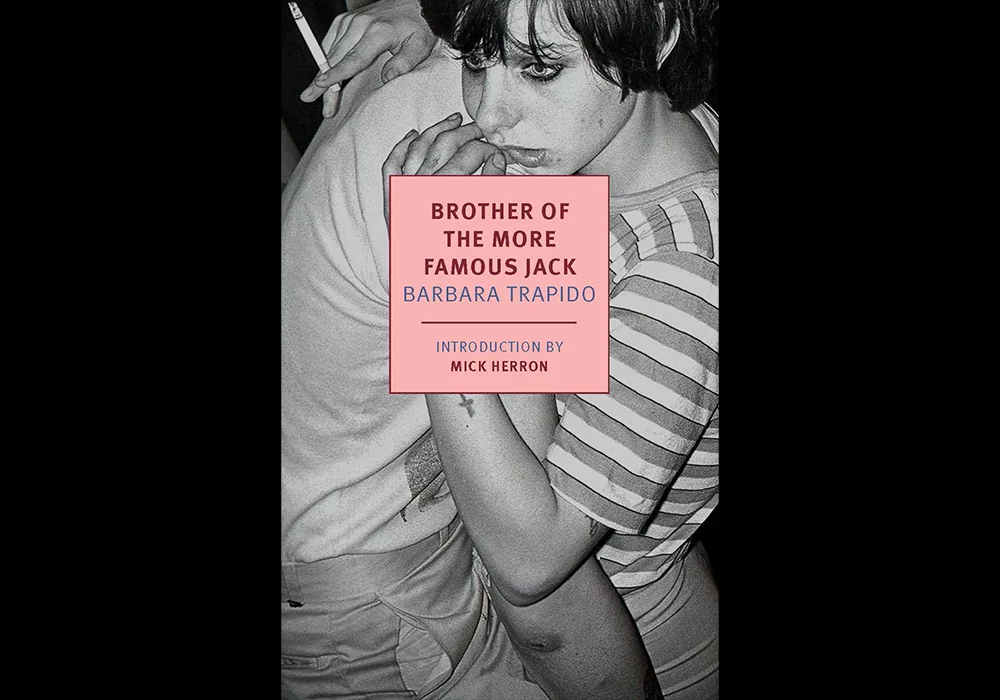
Barbara Trapido’s Brother of the More Famous Jack makes its case through company. Its young narrator, Katherine, is drawn into the crowded, argumentative household of Jacob and Jane Goldman, and the novel’s lasting pleasure comes from spending time among people who talk, tease, clash and care at full volume. First published in 1982, the book has been reissued by New York Review Books this year. Its return puts a particular kind of literary pleasure back in view: the momentum of vivid conversation, and the way a new social world can change how a young person imagines adulthood.
Katherine arrives from a conventional middle-class upbringing and encounters a family whose habits unsettle her expectations. Jacob, a Marxist professor, and Jane, his elegant wife, have six children. The eldest boys, Roger and Jonathan, become especially important to Katherine’s emotional education. Around the dinner table, books, music, politics, sex and money are discussed without much regard for quiet or decorum. The Goldmans’ sophistication is part of their appeal, but they don’t behave as if it makes them superior. Katherine is captivated by the scale and energy of their life.
The novel treats that encounter as a practical education in living. Katherine absorbs ideas about love and family, but also about clothes, cooking and social manners. She sews and thinks carefully about what to wear; the story gives those details the same lived-in attention it gives arguments about politics or the pain of a failed romance. Even a birthday present for an appealing, overconfident sixteen-year-old—a bicycle bell—belongs to the book’s close interest in the small choices through which people express affection and taste.
A novel discovered through conversation
Trapido didn’t begin with a plan for a novel. A friend, irritated that she kept telling stories aloud, urged her to submit one to a Guardian short-story competition. Trapido began inventing the Goldman family and found she wanted to return to them. She wrote in secret, sometimes late at night, while her husband, Stanley, assumed she was finishing a thesis on the Pre-Raphaelite poets. The story soon outgrew its intended form.
Her account of the book’s development helps explain its loose, episodic feel. Trapido says she initially had “no shape” in mind. One event led to another: the characters could go to the beach, then to the cinema. She later recognized that recurring images helped bind the episodes together, including Monteverdi, a “Hamlet hat,” initials printed in capitals, an embroidered butterfly and falsetto singing. These motifs provide quiet connections. The stronger engine, though, is the dialogue and the desire to remain in the characters’ company.
That approach gives the novel a dramatic quality. Trapido describes writing as choreography: she imagines the positions of people around a dining table, moves between chairs and speaks each character’s lines. She reads drafts aloud, revises them by hand, records them and listens back. The process is less a matter of plotting in advance than of staging encounters until the voices and movements feel right. The method also brings practical headaches. She has to track chronology, seasons, meals, train journeys and whether a character can reach a destination before closing time.
Imagined people, observed class
Trapido says the characters are inventions rather than portraits of people she knew. Katherine draws on her memory of the transition from school to university: the anticipation of freedom and adult life. Katherine’s interest in sewing and clothes also reflects Trapido’s own youth, when she used Vogue “Paris Original” patterns and slept in rollers to shape her straight hair.
Her parents offered a different kind of material. Trapido describes them as displaced foreigners in Cape Town and says their cross-cultural marriage gave her a framework for imagining Jacob and Jane, though the fictional couple are unlike her parents. Her father grew up poor and won a scholarship to Leiden University in the Netherlands. Her mother came from a sheltered, bourgeois Berlin household, with holiday homes, mountain skiing and a boat on the Wannsee. Her family watched the rise of Germany’s fascist dictator with unease and lost everything as a result of the Second World War.
That background sits alongside Trapido’s interest in social class. She describes herself as an outsider, which makes her attentive to the different pockets of middle-class life. In the novel, Katherine’s exposure to the Goldmans changes how she understands family and respectability. Jacob’s appetite for newsprint also draws her toward political awareness. Trapido sees socioeconomic context as part of how people think and write, including writers such as Wordsworth: the conditions in which people grow up and survive help illuminate the force of their work.
What the voices reveal
The preface to Jacob’s book establishes one of the novel’s questions about marriage and domestic roles. He refuses the customary thanks to a wife for editing and proofreading, because Jane has done none of that work. Instead, he thanks her for her continuing presence, which he says he has never presumed to expect. Trapido enjoyed inventing the passage in part because she had been one of the wives doing editorial work for academic writers herself.
Katherine says the preface influenced the paths she chose. For Trapido, its effect is tied to the alternative family life the Goldmans model: people are less inhibited about being respectable and tidy, and domestic roles don’t follow the expected script. The family’s noisy freedom makes a different way of negotiating family life imaginable.
That freedom also complicates the novel’s distribution of wit. Trapido recalls a reviewer’s complaint that the women “smile and knit” while the men get the best lines. She concedes there’s something to the observation: the women are more confident and don’t need to shout or show off. Katherine, as narrator, has her own sharpness, while the men’s conspicuous talk helps create the household’s rowdy atmosphere.
Trapido’s influences are similarly less direct than a list of literary models might suggest. She says she wasn’t consciously following another writer, though she recognizes a possible debt to Jane Austen in the quick, sparkling movement of dialogue. She remembers skipping descriptive passages as a child and says she largely dispensed with scenery in Jack. Iris Murdoch’s theatrical Under the Net and Elaine Dundy’s The Dud Avocado also stayed with her as books whose characters she wanted to join.
A long first novel
Brother of the More Famous Jack took shape over years. Trapido began it around 1970, then put the manuscript in a box after moving from Durham to Oxford. Childcare and part-time teaching occupied much of the following decade. Around 1980, a conversation with the mother of one of her son’s playgroup friends prompted her to retrieve the pages and finish the work as a kind of serial. She was about forty when she rewrote and edited it extensively.
When a friend who worked as a typesetter for Gollancz suggested submitting the novel, the publisher responded within a week. Trapido says the editor changed little beyond correcting her spelling of “righteous” and adding three commas. The manuscript’s years of revision had given it polish, even though its initial impulse was play. That combination still defines the book’s appeal: an intuitive, talk-driven story held together by careful craft, where a young woman’s education unfolds through the people she learns to listen to.