Book Reviews: Annie Proulx, Louise Kennedy, William Gass and More
This week’s reviews make a case for fiction that refuses to behave politely. Dwight Garner considers Annie Proulx’s unruly collected stories; Clare Clark follows Louise Kennedy’s Irish émigrés across decades in Stations; John Semly revisits William Gass’s forbidding The Tunnel. Daniel Mason finds a gentler civic vision in Tom Drury’s West of Loveland, while Nick Holdstock takes on William T. Vollmann’s enormous account of American history and the CIA, A Table for Fortune.
Annie Proulx’s stories thrive on excess
Garner’s central point is that Proulx’s crowded style is the source of its force. Her new career-spanning collection piles detail upon detail, with the effect of opening a packed closet and getting hit by everything inside. The image is grotesque, and deliberately so: the stories’ world is full of chain-saw injuries, emu attacks, fatal fires, wrecks, amputations, murders and other calamities. Garner compares their accumulated misery to Michael Lesy’s Wisconsin Death Trip.
That grimness doesn’t make the work careless. Proulx turns disorder into a rough, windblown kind of poetry, and the overfull prose carries a critique of modern life’s appetite for convenience and polish. New wealth arrives in the form of doctors buying old ranches for weekend homes; even the door knockers seem to advertise a cleaned-up version of the world. Proulx won’t clean it up.
Garner places her among artists who build through accumulation, invoking James Joyce’s associative writing, Gustav Klimt’s layers of paint and Charles Ives’s clashing musical textures. Stephen King once likened his own work to a Big Mac and fries; Garner’s comparison for Proulx is a plate of offal. It’s a funny distinction, but it also gets at the challenge: this is writing that asks readers to sit with what’s strange and unpleasant.

–Dwight Garner on Annie Proulx’s Stories: New & Selected (The New York Times)
In Stations, the past travels with its characters
Louise Kennedy structures Stations as a relationship story told in dated fragments, with long stretches of time missing between entries. Clare Clark sees a distant echo of David Nicholls’s One Day, though Kennedy’s London is far harsher: a city of squats, gas heaters and payphones, inhabited by Irish migrants marked by poverty, violence, addiction, shame and loss. They leave home and make new lives, but displacement doesn’t free them from what they carry.
Kennedy’s own move to London as a young woman informs her vivid account of the 1980s city. Clark argues that the book’s deeper strength is its compassion for people who can be funny, generous and painfully vulnerable even as they hurt themselves and others. Róisín, especially, grows older without becoming a different person. Clark’s glad of that: the character’s messy persistence feels true.
The book’s title points both to the trains, boats and coaches of migration and to the Catholic Stations of the Cross. That double meaning fits a novel that is at once a love story about loyalty and generosity and an elegy for lost Irish men, tracing violence and fear passed from fathers to sons. Kennedy leaves the central questions unresolved: whether people can break cycles of neglect and anguish, and whether love, with all its limits, can save them.
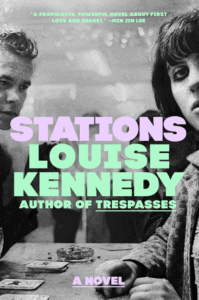
–Clare Clark on Louise Kennedy’s Stations (The Guardian)
Gass makes the reader live inside a troubled mind
William Gass’s The Tunnel is a difficult book in every sense: long, violent, ostentatiously written and full of doodles, diagrams, bawdy verse and wordplay. It was also hard to get hold of after going out of print, with secondhand copies sometimes selling for hundreds of dollars. Dalkey Archive has brought it back in full color, as Gass intended, alongside a companion volume, The Tunnel Reader.
For John Semly, that republication matters because the novel’s portrait of American authoritarianism still bites. Gass traces exclusion and resentment to what he calls “the fascism of the heart.” Its narrator, Kohler, digs a tunnel beneath his basement office and hides the soil in his wife’s antique wardrobes. The novel never settles what the excavation means: escape from a loveless home, an effort to escape himself, a kind of grave, or simply a symbol of desperation. The uncertainty suits a story that burrows into its protagonist’s mind.
Kohler isn’t just an unreliable storyteller whose account can be checked against some stable outside truth. His consciousness is the book’s world. Semly links that ambition to Gass’s admiration for Proust’s ability to make a reader inhabit a fully realized life, then offers a deliberately jarring comparison: imagine Proust writing The Turner Diaries. Gass’s formal experiments—crude cartoons, dirty jokes and dark fantasies—make the novel’s treatment of fascism psychological and often metaphorical, with a consciously anti-Enlightenment edge.
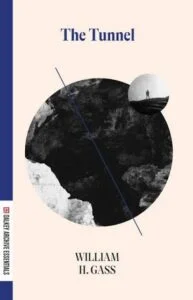
–John Semly on William Gass’s The Tunnel (The Nation)
Drury’s map leads to a quieter kind of novel
Tom Drury begins West of Loveland with a map of Grouse County, the fictional territory that links his novels. It recalls William Faulkner’s Yoknapatawpha County, born from Faulkner’s conviction—expressed in a 1956 The Paris Review interview—that his own small patch of native soil could contain a whole cosmos. Drury’s map charts roads and odd landmarks, including the Swedish House, the Earring, the Gates of Hell and the Gun. It also hints at the book’s interlaced lives.
Daniel Mason finds that the wide cast never overwhelms the novel. Readers of the earlier Grouse County books will recognize old acquaintances, but newcomers can start here. Drury gives weight to ordinary scenes: conversations, meals, care work, a thrift shop shift, the demolition of a silo. His prose has plenty of clever turns, though they often arrive quietly enough that their effect becomes clear only afterward.
There’s a gentle idealism here, and Mason doesn’t take it at face value. The decency of Grouse County may describe what people could be more than what they are. Still, the map can be read as a guide toward tolerance and civic involvement at a time when both seem vulnerable. Mason connects Drury to Irving Howe’s 1953 defense of “writers of sweetness”—authors who leave room for kindness and don’t grant evil the final word.
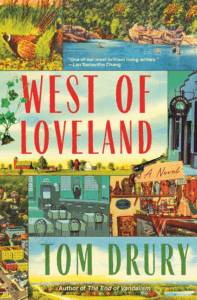
–Daniel Mason on Tom Drury’s West of Loveland (The New York Times)
Vollmann turns the CIA into a dark office comedy
William T. Vollmann’s four-volume, 3,000-page A Table for Fortune took 15 years to write. Its scale reflects its ambition: a family narrative and an insider’s account of the CIA, examining American history, the pursuit of liberty and the idea of national exceptionalism as the United States reaches its 250th year. The book tries to hold personal lives and state power in the same frame.
Nick Holdstock’s sharpest observation is that Vollmann presents the agency through the texture of work: office jokes, sexual tension, small grudges and a steady stream of acronyms and codenames. The CIA itself narrates these passages in a dry, sardonic voice that treats suffering and death as “fun.” That humor draws readers into subjects from the Angolan civil war to Stasi interrogation methods, while exposing the agency’s hypocrisies and double standards.
The length is part of the argument. A CIA superior tells DAVE that truth can only be delivered detail by detail, and Vollmann follows the United States’ gradual entanglement in unwinnable conflicts with near day-to-day attention. Holdstock compares the accumulating effect to Uwe Johnson’s epic Anniversaries, which ends with the Soviet occupation of Prague: watching disaster unfold in painfully slow motion.
By the final volume, the comedy has curdled. An aging DAVE keeps white towels nearby in case someone wants to bleed to death. The image captures the novel’s bleak diagnosis of a country still unable to resolve the tension between individual freedom and the state’s power. Vollmann supplies many perspectives and no final verdict. That open question is part of the design.
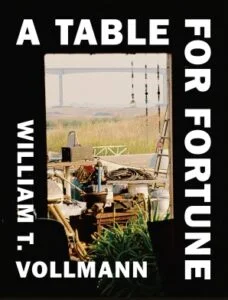
–Nick Holdstock on William T. Vollmann’s A Table for Fortune (The Guardian)