MJ Lenderman on Harry Crews: How a Georgia Novelist Shaped His Songwriting
Harry Crews gave MJ Lenderman a way to think about artistic failure—and a model for writing about people whose lives can look absurd from the outside. The novelist’s mix of grotesque humor, precise language and unexpected tenderness helped shape Lenderman’s songwriting, including the work that brought him an audience beyond Asheville.

MJ Lenderman. Photograph by Sol Procter-Tarabanov. CC BY-SA 4.0, via Wikimedia Commons.

A writer found by word of mouth
Lenderman first heard about Crews as a teenager, from a friend during late nights on a porch near downtown Asheville. They were supposed to be working on songs. Instead, they drank and talked about writing and the people who had managed to make a life of it. His friend described Crews as “this fucked-up guy” and pointed him toward A Feast of Snakes, the 1970s novel set in Mystic, Georgia.
What pulled Lenderman in was The Knockout Artist. Its central character, Eugene Talmadge Biggs, makes money by knocking himself unconscious for spectators. Lenderman ordered that book, A Feast of Snakes, and a collection containing Crews’s memoir A Childhood and the novels The Gypsy’s Curse and Car. The books’ dialogue felt true to life, and their Southern settings were vivid without resembling anything he’d personally witnessed. They suggested a distorted version of home: scenes he could imagine unfolding among people he knew, including his landlord.
That landlord, Gary King, owned the Haw Creek property where Lenderman lived with friends and bandmates. The cluster of houses felt more like a band compound than a shared rental. King told dirty limericks in his kitchen, smoked Pall Mall Blues while connected to oxygen and sometimes leaned on his car horn until the musicians came outside to talk with him. He treated them like grandchildren and kept the rent steady.
Advice for writing through failure
The pandemic kept Lenderman at home with music, books and writing. He describes that stretch as the most focused and formative songwriting period of his life to that point. Crews was part of it. Karly Hartzman, his girlfriend then and bandmate in Wednesday, gave him several Crews books he hadn’t read, including some signed copies. Lenderman also found an index of Crews interviews and began using it as a kind of guide to songwriting.
Crews had grown up in a family of tenant farmers in Bacon County, Georgia. He taught himself to write and had little encouragement as a young artist. In interviews, Lenderman found advice he kept returning to: creative work demands the ability to withstand failure. Crews could project a hard edge, but this idea struck Lenderman as candid and humane. You have to put an idea on the page before you can judge whether it works.
That lesson mattered while Lenderman was writing the songs that became Boat Songs, the 2022 album that drew attention from beyond Asheville. He knew the songs might look foolish in print, but they felt right when he played them. Crews had also described writing as an act of courage. Lenderman saw something similar in the decision to sing those songs. The counsel helped him then, and he still draws on it.
Crews’s language offered another kind of instruction. His writing could be serious and silly at once, built around specific, startling phrases. Lenderman remembers a recurring expression, “hustling his balls,” and says those three words could sustain an essay of their own. He began looking for turns of phrase with that same charged precision—and sometimes took them directly from Crews.
A borrowed line, and the work behind it
One line listeners often quote from “Joker Lips,” a song on Manning Fireworks, is “Every Catholic knows he could have been Pope.” Lenderman points out that Crews wrote it first. It appears on page 209 of the 1968 first edition of Gospel Singer, published by William Morrow & Company. The passage continues with a thought Lenderman particularly likes: “Every man knows that his gift will set him free if he is just lucky enough. Or unlucky enough, depending upon your point of view.”
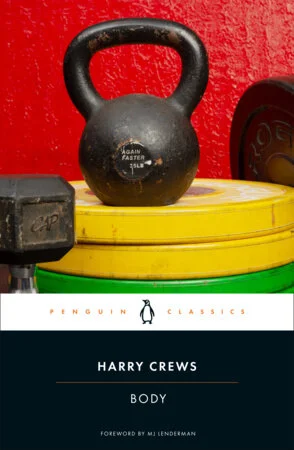 That line’s mix of possibility and risk suits Body, the novel Lenderman discusses in the foreword. Its apparent contest is between two women bodybuilders: Shereel Dupont, a compact white woman from Waycross, Georgia, once named Dorothy Turnipseed, and Marvella Washington, a formidable Black woman from Detroit. But the rivalry that drives the story belongs to their coaches, Russell “Muscle” Morgan and Wallace “The Wall” Wilson. Both are aging, still physically imposing, and looking to win through the women they control.
Muscle’s grip on Shereel extends well beyond training. He changes her name, dictates how much water she drinks, keeps her away from her family and decides when she must have sex with him. She had wanted to work as his secretary; he has other plans for her, including a run at the Ms. Cosmos title. Crews makes the power imbalance difficult to miss, while letting the plot’s absurd scale push the characters into view.
Absurdity with human warmth
Body piles on extravagant names, bodies and actions until it can read like caricature. Lenderman sees that excess as part of Crews’s method: even in a world this outsized, the people aren’t just jokes. Beneath the hard surfaces, Crews finds room for attachment and vulnerability.
Take Nail Head, whose capacity for love complicates his name, or Billy Bat, a bodybuilder whose relationship with Shereel’s sister, Earline, gives him a family and romance he hadn’t expected. Earline’s appetite is so consuming that she carries spare fried chicken. The bodybuilding contest at the Blue Flamingo turns into a comic mess, but it has real feeling as well. Crews lets ridiculous circumstances reveal recognizable wants.
The book’s ugliness is part of that picture, and Lenderman doesn’t gloss over it. Body contains racist insults exchanged between Muscle and the Wall, as well as sexual scenes in which women have little say. It opens with a violent encounter that wrecks hotel furniture. The hotel manager, ashamed of his appearance and his toupee, repeatedly hires secretaries he calls “Miss Beverly”; he demands oral sex from them beneath his desk.
Lenderman describes Crews as a writer who sometimes turns the colors up so high that the reader can’t ignore what people are capable of. That approach can be abrasive. It also gives the book’s moments of tenderness their force: warmth emerges among characters and circumstances that offer little reason to expect it.
Reading the clues in the ending
Lenderman avoids giving away Body’s ending, but singles out its final three pages. Crews is known for exaggeration, yet the closing reveal works through careful detail and restraint. Lenderman had to reread it before he understood what had happened. On later visits, he noticed the clues Crews had planted earlier, each one making the ending feel less like a surprise than an approaching certainty.
That discovery changed more than how Lenderman read the novel. It sharpened his attention as a writer and helped him look with more patience at people whose choices seem strange. Crews’s characters may behave in outrageous ways, but the book leaves Lenderman with a modest, durable thought: most people are trying to do their best, however hard their actions are to understand.
MJ Lenderman was born and raised in Asheville, North Carolina. He is a singer-songwriter and multi-instrumentalist whose albums include Boat Songs (2022) and Manning Fireworks (2024), named among the year’s best by Rolling Stone, Pitchfork, Paste and The New Yorker.
Adapted from MJ Lenderman’s foreword to Harry Crews’s Body, to be published by Penguin Classics on November 10.