How AI-Generated Skincare Ads Turn Women’s Aging Into a Soap Opera
All photographs courtesy of Jean Garnett.
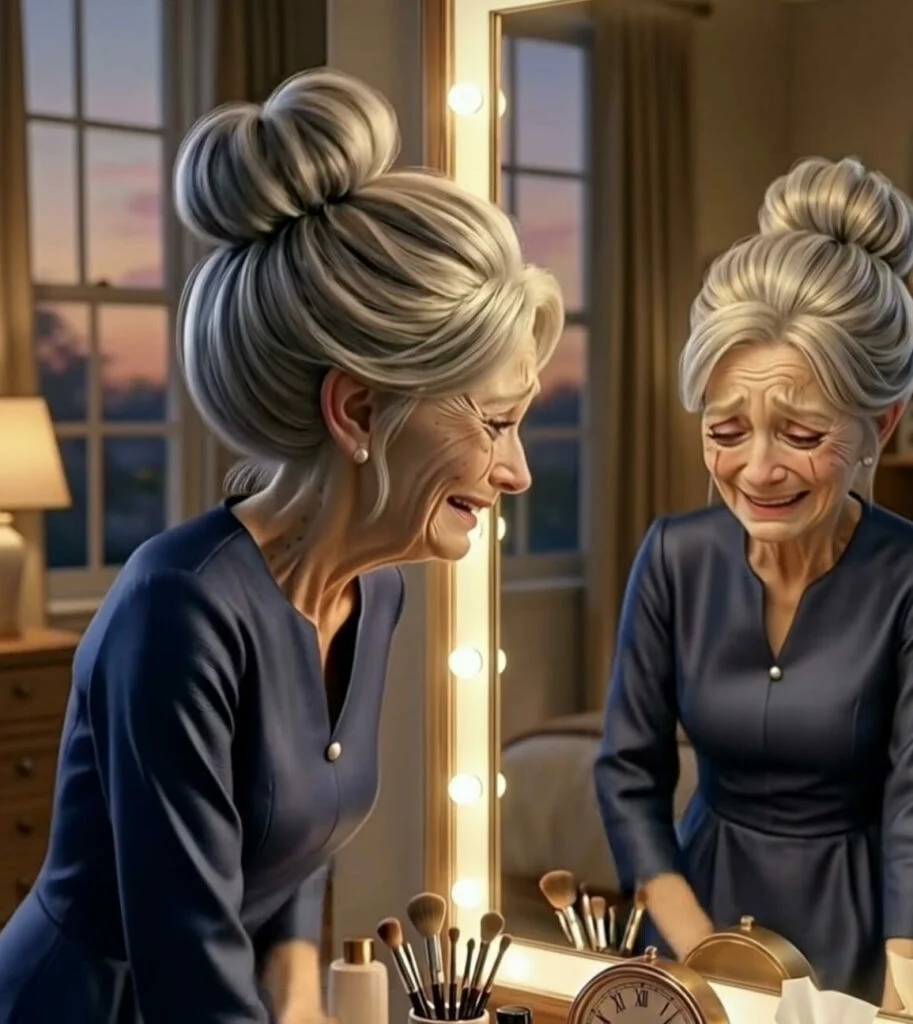
The tears give the ad away. They bulge out of a woman’s wide, frightened eyes, then hang from her face in clear, sticky strands. They don’t run down her cheeks. They look wrong—and that’s what makes me stop scrolling.
She’s a cartoonish, large-headed woman folded into a cubicle, crying because she’s getting older and getting older because she’s unhappy. Other versions move her distress to a bathroom, a car, a soccer game, or her daughter’s rehearsal dinner. The plot barely changes: her husband has stopped loving her. “You used to light up,” he tells her in one video. In another, she overhears him saying she’s “let herself go.” Sometimes he’s already left for a younger woman; sometimes he’s having an affair with a colleague who hasn’t “let herself go.”
Then someone intervenes. A sister or friend returns from Seoul with a solution; a colleague who works there offers advice. Sometimes it’s the daughter, watching her father leave with his younger girlfriend. She sets out to “save face”—her mother’s literally, her own figuratively—with a hydrating gel mask, serum, or nonoxidizing foundation.
The tears are part of the sales pitch
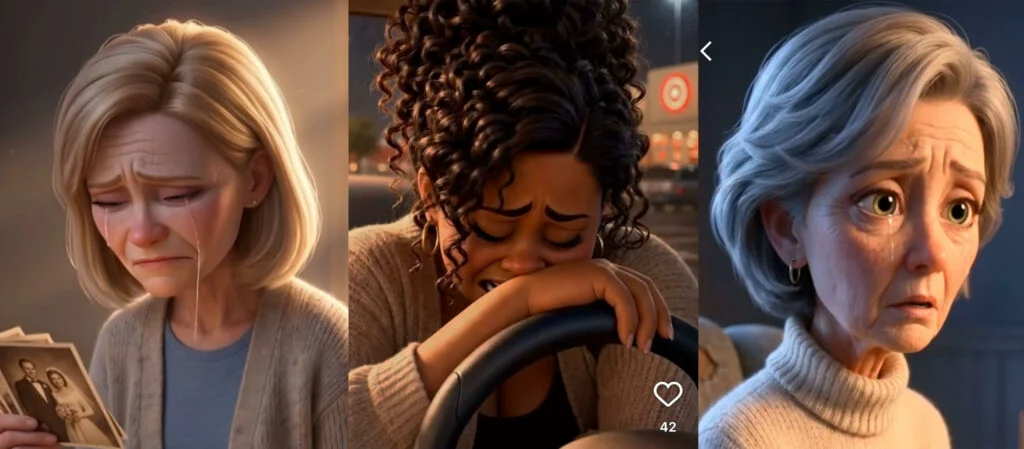
I’ve started calling this fast-spreading Instagram Reels genre “Purification Slop”: AI-generated marketing that turns a private worry into something visible, removable, and—if the pitch is to be believed—easy to fix. The same fantasy powers ads for mushroom drinks, with cute probiotics sweeping through the intestines, and jade rollers that supposedly drain lymphatic fluid. The promise is that whatever feels bad or dirty inside you can be extracted. The algorithm may also know I’m single, and that looking in a mirror has become a matter of light and mood.
These spots borrow the rhythms of infomercials, complete with dubious science and limited-time offers, but they can run for more than ten minutes and play like miniature soap operas. I call them Aging Woman Emomercials, or AWEs. Their songs build from conversational heartbreak to a grand, pleading chorus, with the sound of Taylor Swift or Olivia Rodrigo in the background. The hooks are blunt: “This is the story of the day he walked away.” One woman’s ex-husband arrives with the woman he left her for, “young enough to be our daughter.” In an ad featuring a Black woman, she runs into her “baby daddy at daycare drop-off with the bitch he left me for.”
When I was twenty, a fashionable restaurateur paid me to make new mahogany tables look old. I spent a summer beating them with chains, gouging them with chisels, and sanding, staining, and carving fake lovers’ initials into the wood. A new bistro, he figured, would feel more intimate if its furniture looked as if it had lived a little.
Age gives men that same kind of finish in these ads. It reads as authority, sturdiness, even vitality. Gray hair and dry skin become patina; losing a wife or children can seem to clear space for a more valuable life. After several AWEs in a row, the gender math starts to look absurd: how, exactly, are an aging man and an aging woman supposed to share the same room?
Susan Sontag named the “double standard of aging” decades ago. What’s new is how fluently AI can turn that old bias into a story designed to hurt. Until recently, marketers often assumed people were “algorithm averse”: we might accept a computer’s superior prediction for a medical diagnosis, yet still favor a person’s judgment. In 2020, Chiara Longoni and Luca Cian complicated that picture in a paper in the Journal of Marketing. They called the pattern the “word-of-machine” effect. People with utilitarian goals—finding dental floss, say—could trust AI recommendations more. For hedonic goals, where the point is a feeling or sensory experience, such as watching a horror movie, people still tended to prefer a human recommendation.
That distinction had been marketing orthodoxy since the 1980s, when researchers used the “hedonic viewpoint” to explain why people seek out experiences that can hurt, including certain kinds of media. It shifts attention from the product to the consumer as an emotional being looking for release. By 2026, AI seems to have crossed that line. It can act out emotional understanding with unsettling fluency. Can a machine sell you a feeling? Apparently it can—even when the machine’s fingerprints are all over the ad.
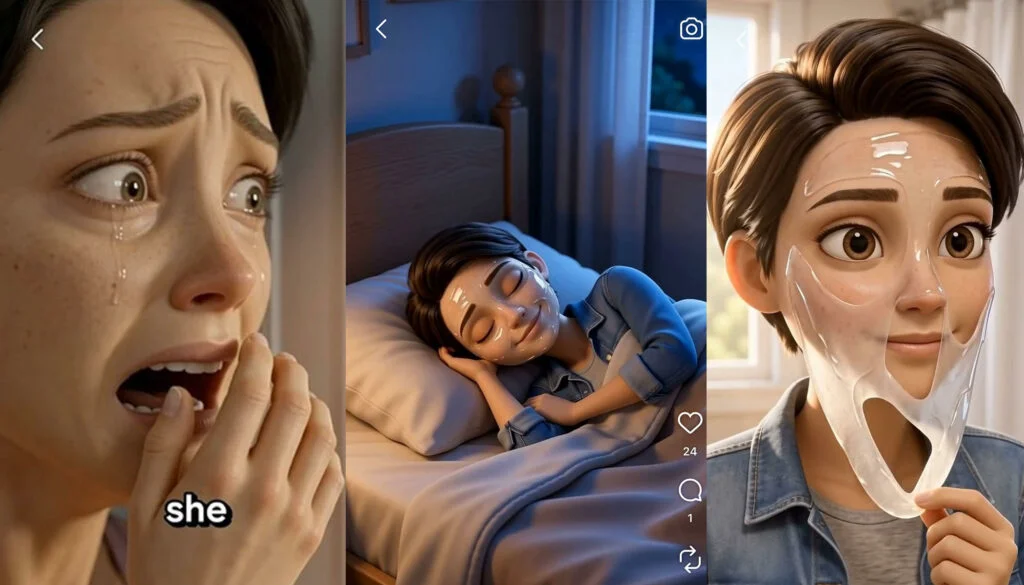
American K-beauty brands such as Quasi, Yuri, and Koriderm run many of these ads. New York State law requires disclosure when an ad is AI-generated, but the companies don’t disclose it; the videos do the job for them. The lip sync slips. Clothes change between shots. Cuts land oddly, tears dangle like hot glue, and the scripts wobble: one woman is “fifty-three-forty” years old, while competing moisturizers “evaporate like glass.” Those mistakes make it easier for a brand to distance itself from the content. That distance is useful when the ads sink as low as these do. In one, the woman asks her daughter, “How can I be loved when I look like this?”
It’s hard to know where to aim the anger. Because I recognize the AI immediately, I don’t read an AWE quite like a human-made con. It feels more like a jumble of things the machine has absorbed—whispers without an obvious speaker. A child repeating something the adults said, perhaps. That’s the unsettling part: I may be less alert to manipulation when no person seems to own it.
These stories also take their women into emotional territory most mainstream ads avoid. They aren’t mildly annoyed about a juice stain or quietly worried about bills. They’re sobbing on the floor, having panic attacks, shutting themselves away, or considering skipping their daughter’s wedding because they can’t bear to be seen. They talk and behave as if they’re in a dangerous depression or a perimenopausal breakdown. Their distress is extreme, but it isn’t unfamiliar.
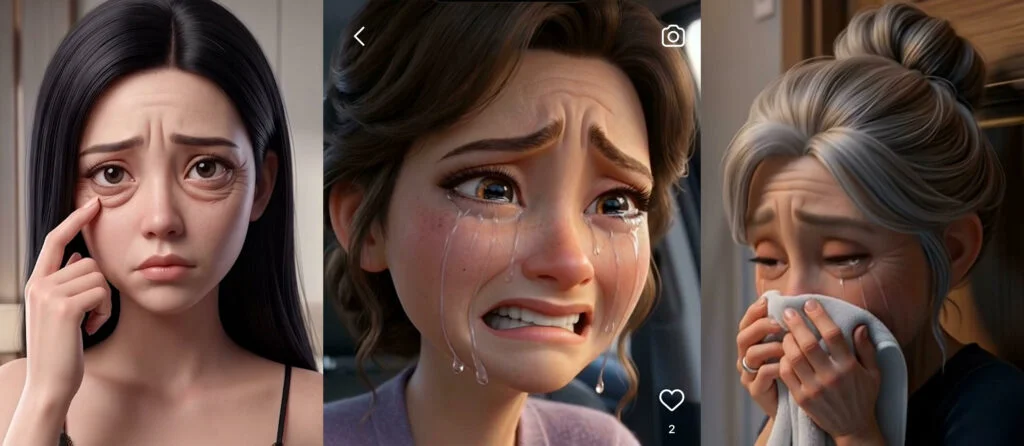
That combination—manosphere-style certainty about gender and a woman’s midlife collapse—gives these melodramas an odd, frightening catharsis. We learn early that getting older as a woman can mean social disappearance. Most of us have spent years absorbing that message, and we may think we’ve become too knowing to be caught by it. The ads make the old idea feel newly discovered: not a general rule, but an individual wound. They let us feel its unfairness again, almost as if for the first time.
The women I know sometimes fall apart over their changing faces. Even the ones who understand the pressure can feel anxious—and guilty for being anxious. AI is giving voice to those feelings, using familiar, shopworn lines that might sound embarrassing among thoughtful friends. We are what we say and think, so there’s a case for refusing the ad’s cruelty. But the feelings are real, and the machine’s bluntness can make a viewer feel seen. One woman sings that after sleeping in the advertised collagen mask, she looked in the mirror and finally saw herself clearly.
That’s the stated revelation in every AWE: self-reclamation, confidence, recognition. But the story’s emotional peak usually arrives when the woman runs into the man who left her. She’s used the product, regained her supposed authentic hot-young self, and learned that her skin was the real problem. “It is not vanity,” she sings in one pre-chorus. “It is not in your head, it is not age, your skin is starving.”
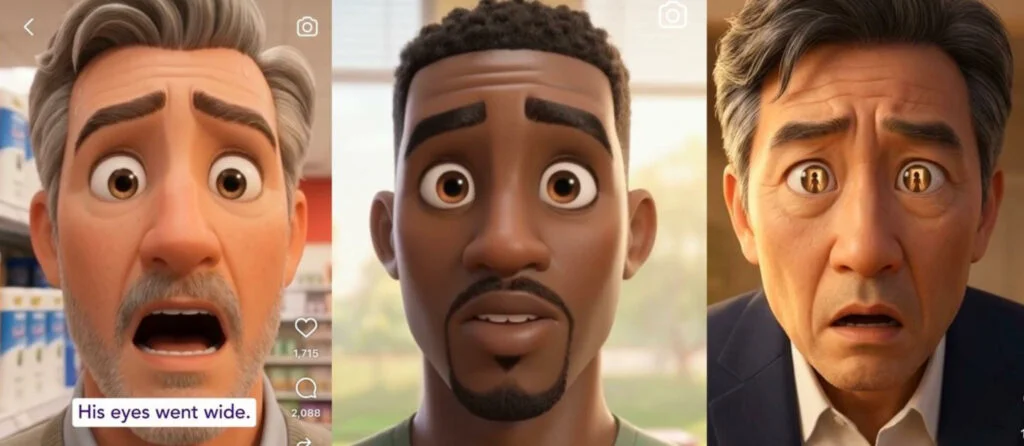
Then the ex appears—at a pharmacy, daycare drop-off, or a restaurant where she’s meeting someone new. He sees a face plumped and smoothed like a toddler’s. His eyes widen; his mouth drops open; for a moment, he nearly goes full “awooga.” He expected to see “the old broken face” and finds a “radiant woman standing tall.” The ad lets us enjoy his stunned expression, then has her insist she doesn’t want him back. The final turn is a quick “I did this for me” and an offer to buy before supplies run out.
The real run-in
I had my own encounter with an ex recently, alone on a New York City beach. After a few hours in good weather, I saw dark clouds rolling in and hurried along the dune path toward the exit. Around a bend, I found the man who had left me two years earlier, walking beside someone close enough to touch arms.
“Hi,” I said to their backs. They stopped and half turned. Neither looked surprised. Their calm made me wonder if they’d spotted me earlier and tried to avoid me, only for the clouds to push us together.
At the opening in the chain-link fence, where the dunes give way to a field and the road beyond, his companion stepped aside. She was tall, muscular, and looked at least ten years younger than me. She held herself apart as if we were strangers in a museum, each looking at a different painting. I waved. She gave me a tight smile while he crouched to put on his shoes.
I started saying something; I couldn’t tell you what. He seemed to be apologizing, though his attention was on a video he’d recently seen of someone being struck by lightning. The approaching clouds had made him afraid it would happen to him. In that strange moment, his fear seemed perfectly reasonable.
Time went slack. Somehow I was apologizing, too, saying I could cross the field on my own. I turned away, walked a few yards, then surprised myself by shouting back: “Peace!” The man couldn’t hear me and jogged over. “It doesn’t have to be weird,” I said—or sang, almost like a jingle—as his companion joined us. He introduced us properly. We shook hands and started across the field together, three abreast toward the clouds.
I said where I was headed that evening. When she said she knew the place, I nodded too eagerly. Her recognition felt like a small rescue. She pointed out that his shoes were untied; we all watched his laces drag through the grass. Then she announced she had to pee and headed for the low concrete restroom building. He stopped. I kept walking. The rain began with a few cold drops, then came down in sheets. I ran to my car a few blocks away, soaked, and pulled the door shut.
We want the people who left us to see what we’ve become. If loving them changed us, losing them changed us more. We’re tougher, more vivid; we’ve found colors in sorrow and joy we didn’t know we had. Getting older keeps making me feel more alive. So when my face droops or I look tired, it feels like a failure of representation so perverse that I start to imagine some intelligence behind it. Maybe I’m being punished for caring how I look.
We’re also told that the Intelligence is becoming more autonomous. The fear is that recursive self-improvement could soon give it violent agency—perhaps next year, perhaps this year. In my imagination, that future AI turns on us like the radiant, “fifty-three-forty”-year-old ex-wife whose power everyone underestimated. “This is what you get,” it says, “for thinking you could watch me ironically.”
A mask for later
“What is that?” my daughter asks, eyeing the pink box I’m holding. Its logo looks like the killer’s mask in Scream.
“It’s just something for my face,” I tell her. “To make my skin better.”
“Don’t use it,” she says at once. “Don’t believe that kind of thing.” When an ad interrupts a show we’re streaming, she often explains what problem the ad has invented so it can sell us a solution.
“Mom, for real.” She’s worried the mask could work as advertised, and that it might make me look unfamiliar to her.
“You’re right,” I say. “You’re so smart. I shouldn’t have bought it. I won’t use it.” I carry the box away as if I’m going to throw it out, then tuck it beneath a pile of books in my bedroom for a night when she’s at her dad’s.