Turner Brooks’s Architecture of Memory, Movement and Hidden Space
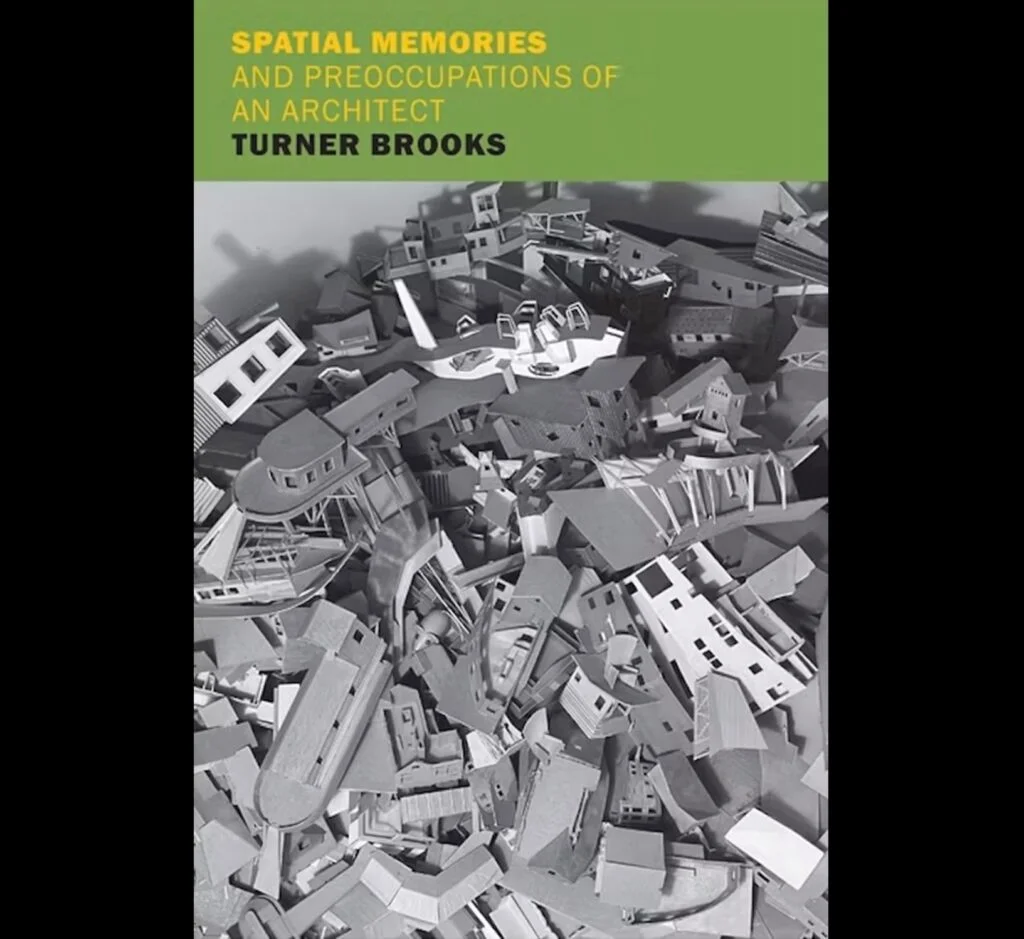
Turner Brooks’s architecture begins with a question that his new essay collection keeps returning to: when does a place become more than its walls, floor and ceiling? For Brooks, space also holds sound, memory and expectation. A room can persist in the mind through the ocean beyond its window or voices heard from another floor, even when its physical boundaries fade from view.
That idea gives Spatial Memories and Preoccupations of an Architect its organizing principle. Across twenty short pieces, Brooks treats buildings as settings for human experience rather than objects to be considered on their own. The writing moves between architecture, art, childhood recollections and cultural references, following the connections that shape how a place feels. His interest is less in defining a single architectural style than in showing how spaces become entangled with the people and worlds around them.
A room that travels with you
Brooks traces his sense of spatial memory to childhood nights in a small bedroom in his grandparents’ creaky seaside house in Maine. He could hear his grandparents talking below and the Atlantic breaking outside. The wallpaper, the voices and the waves formed one experience of the room. Years later, a fellow student at Yale School of Architecture put the idea this way: “if you removed the floor, walls, and ceiling, the space would still be there.”
The collection tests that proposition through images that shift architecture into something bodily and imaginative. Brooks describes Grand Central Terminal as a womb giving rise to other destinations. The columns of the Bibliothèque nationale de France become anchors holding its ceiling down against the buoyancy of the thoughts inside. These aren’t conventional building descriptions; they’re attempts to capture what a space seems to do to its occupants and what they, in turn, bring to it.
Brooks’s own memories make that exchange particularly clear. As a boy, he buried himself in his father’s oversized furry coat and looked down the sleeve’s long interior. With that extra layer between him and the outside, the world seemed more inviting. His tree house offered a related kind of shelter: from its dark perch, watching the surroundings changed a bleak landscape into a place that felt companionable. In both cases, enclosure altered the meaning of what lay beyond it.
That same attraction to hidden passages can arise in an ordinary house. A laundry chute, for instance, might matter less as a device for moving clothes than as a secret route through the building. For a child small enough to crawl inside, its narrow, concealed passage could suggest the possibility of emerging somewhere unexpected. Utility gives way to adventure; a feature designed for a household task becomes a private world.
Buildings with routes of their own
Brooks’s professional work has often given physical form to that appetite for movement and surprise. In the fifty years since he graduated from Yale and briefly worked for the Modernist architect Philip Johnson, he has designed buildings around New England that resist a settled reading. His projects include rural polygonal houses, a residential campus for people with autism, a subterranean museum for preserved brains and a theater shaped like a steamboat.
Some of his buildings suggest vessels, and some can actually move. Yale’s Gilder Boathouse, in Brooks’s description, looks as if it “beached itself on the riverbank” of the Housatonic. The Peek House in Vermont seems to be “resting on mudflats waiting to float off with the rising tide.” The Laffin House was built on an eight-foot-wide steel frame with wheels; the last Brooks heard, it was heading across the Canadian border. Here, a building’s relationship with its site carries a sense of possible departure.
Inside, Brooks favors mazes, alternate routes and rooms nested within rooms. He celebrates the secret garden and the disorienting plan because they make visitors reconsider their position: where they are, where they came from and what route might come next. A building, in this view, unfolds over time. Finding one’s way through it becomes part of what the architecture means.
Two touchstones help explain this interest. In Kafka’s short story “The Burrow,” an unnamed animal gets lost in the intricate tunnels of its own dwelling while trying to keep intruders away. Brooks relishes the animal’s involvement in its own maze. Sir John Soane’s Museum in London offers a built counterpart: a group of Georgian townhouses whose rooms feel intimate even as the connections among them seem to stretch without end. Brooks describes wandering through the museum as being “among trees in a forest.”
These examples point to his broader claim that experience is built into a structure’s plan. The turns, thresholds and interruptions matter because they guide attention and shape movement. A visitor doesn’t simply look at a building; the visitor makes a sequence of choices inside it. Architecture’s emotional effects can emerge from that sequence as much as from its surfaces or silhouette.
Pictures that make interiors porous
Brooks extends the argument beyond architecture in a chapter on painting. Fra Angelico’s Annunciation draws his attention to the tips of the angel Gabriel’s wings, which appear to extend into or out of two pillars in the surrounding colonnade. The image makes the figure and the architectural setting seem continuous. A boundary that should separate them instead becomes a point of connection.
Edward Hopper’s Rooms by the Sea offers another kind of disturbance. Brooks focuses on the central blank wall and the diagonal stroke of sunlight across it. The wall becomes a threshold between the ocean’s vastness and the small domestic interior. The painting calls up the Maine bedroom of his childhood, where the sea outside and the contained room inside belonged to a single remembered place.
For Brooks, the best architecture works through a similar tension between what is close and what is distant, what can be touched and what can only be felt. “Often it is the pulsation between two deliberately ambiguously different volumetric readings of the space that brings the work to life,” he writes. His buildings’ resemblance to multiple things at once—an animal, a vehicle, a machine and a person—was also noted by Jonathan Schell in the 1995 monograph Turner Brooks: Work. That ambiguity leaves room for visitors to participate in making sense of what they see.
A museum for the mind
The Cushing Center at Yale School of Medicine brings Brooks’s interests into unusually direct contact with the mind itself. Tucked into a corner of the medical library, the small museum houses hundreds of brain and tumor specimens, along with thousands of photographs and microscope slides collected by neurosurgery pioneer Harvey Cushing.
The room turns inward like a maze. Polished wood and curved glass cabinets frame the specimens, their forms suggesting the folds and grooves of the organs on display. The architecture echoes the collection without reducing it to decoration. Inside, visitors encounter the physical remains of hundreds of human minds, each brain marked by its own shape and irregularities.
Those differences prompt a question the room can’t settle: how much of a mind’s form comes from inherited code, and how much from a lifetime of experience? Brooks might ask whether the distinction can be made at all. The museum’s architecture and its contents meet on that uncertainty. Its cabinets give the specimens a place, while their singular forms make the room feel like more than a container.
That is the collection’s lasting insight: a building doesn’t stop at the edge of its materials. Its routes, sounds, views and enclosures can turn a physical setting into a storehouse of memory, or make an unfamiliar place feel newly legible. Brooks’s work suggests that architecture’s most resonant qualities may be the ones that leave space for occupants to complete it.