How Derek Walcott’s Omeros Made Homer Speak to Caribbean and Haitian Experience
Derek Walcott’s Omeros changed what the classical epic could mean to me. Homer’s poems had once felt like distant coursework: works I could analyze for meter and imagery, then set aside. Walcott made them feel like tools for telling a story grounded in Caribbean life. That shift became a starting point for my novel, Beyond the Baths of Stars.
In Walcott’s hands, the Iliad becomes a way to examine vanity and the damage it can cause.
That reading took time. At college, I sat through discussions of Homeric epithets, family lineage and dactylic hexameter in rooms whose architecture seemed more vivid to me than the ancient wars on the syllabus. Homer’s Iliad and Odyssey, Virgil’s Aeneid, Dante’s Inferno and Milton’s Paradise Lost struck me as worthy of study, but remote from the life I expected to lead.
I had grown up in a Haitian immigrant family in South Florida, among communities shaped by migration from across Latin America and the Caribbean. My sister, cousins and I spent much of our childhood together. We rode our bikes around the neighborhood, gathered at the local park and sometimes went into Miami for a celebration. My father, who had taught physics in Haiti, worked in construction and plumbing; my mother studied her way into a nursing career before illness forced her to stop. Our life was stable, though not wealthy. The neighborhood also carried a harsher reality: Black boys, including those around us, sometimes faced aggressive policing.
At university, I liked the poetry workshops and the campus’s Beaux-Arts and Neoclassical buildings. I also believed a prestigious education could help me find secure work. But I couldn’t see how stories of warriors killing one another in faraway conflicts would speak to the place I came from. The canonical texts were assignments to complete, not living frameworks.
Walcott places Homer in Saint Lucia
Omeros broke that distance by recasting the epic’s figures as people navigating the present-day realities of Saint Lucia. Walcott’s Achilles is a fisherman whose livelihood is threatened by an economy oriented toward tourism. His life leads him toward an encounter with ancestry and spirit that recalls Odysseus’s journey among the dead and his meeting with Tiresias.
Hector, too, belongs to the island’s economic present. Once a fisherman, he gives up his canoe for a brightly painted van, seeking a more dependable income. His choice carries an echo of the tragic fate awaiting Hector in Homer. Helen, meanwhile, is neither a distant prize nor a symbol in a war between empires: she is a local woman whose relationships with the two men help drive the story.
Walcott reshapes other epic details with the same care. Philoctetes becomes a tour guide with a persistent wound, a fondness for rum and a belief that a photograph can take something of the subject’s soul. The characters’ conflicts are intimate—love, rivalry, work, belonging—but the epic’s scale gives those struggles room to resonate beyond individual lives.
That scale comes through in the language. Oars can suggest spears; rain over ferns brings the violence of arrows to mind. Vehicles become chariots, while the felling of trees carries the force of battle. West African deities live alongside Greek gods in the poem’s imaginative world, and Shango’s thunderbolt can answer Zeus’s. The Caribbean Sea holds these references together, carrying history between the Atlantic and the Aegean.
A Caribbean inheritance in an epic form
Walcott doesn’t treat the classics as a template that Caribbean writers must imitate. He takes their form and fills it with local histories, beliefs and landscapes. The result makes the Caribbean feel as ancient and mythic as the worlds of Greek poetry, while showing how its people’s lives connect to stories told across centuries.
In one passage, Walcott describes the sea’s elemental sound as a shared inheritance, whether it rises from the Windward Islands, Ithaca or Africa. In another, he asks readers to see Helen in the brightness of her own island life, without the shadow Homer casts over her. The poems shift the focus: the Caribbean isn’t a backdrop to someone else’s mythology. It generates its own meanings.
Walcott described Caribbean literature and culture in his 1992 Nobel Prize acceptance speech as “not timid, not derivative,” comparing them to the distinctive petals of the frangipani. The point, as I read it, is not that writers should reject the European literary tradition. The point is that a tradition inherited through colonial history can be transformed, joined to other histories and made to speak in a voice specific to the Antilles.
This kind of exchange has a long history. Luis Rafael Sánchez reworked Sophocles’ Antigone in La pasión según Antígona Pérez, using a fictional Caribbean republic to examine the suppression of Puerto Rican nationalist movements in the 1960s. Jean Rhys’s Wide Sargasso Sea gives a history and voice to the woman Charlotte Brontë’s Jane Eyre confines to the attic. Aimé Césaire’s Une Tempête recasts Shakespeare’s The Tempest through Caliban’s experience of dispossession. Jamaican poet Safiya Sinclair, in Cannibal, writes through Césaire’s work to consider identity and migration to the United States.
What an old story can hold
The Odyssey has prompted adaptations and arguments across literary history. Dante sends Ulysses to the flames in the Inferno, where his desire to travel becomes part of his damnation. Tennyson’s poem “Ulysses” turns that yearning into a Romantic call to adventure. James Joyce uses the ancient journey as a frame for a novel set in modern Dublin. Ezra Pound’s The Cantos draws on an Odyssean figure moving through history and politics, while William Faulkner takes the phrase “As I Lay Dying” from the speech of Agamemnon’s ghost in the underworld for the title of his novel, As I Lay Dying.
Margaret Atwood’s The Penelopiad gives Penelope a pointed perspective on the male-centered epic. Roberto Bolaño’s The Savage Detectives can be read as a fractured journey through countries and years. These works demonstrate how a familiar narrative shape can hold radically different concerns, from gender and ambition to history and exile.
Walcott’s achievement landed differently for me because his characters and setting made the form feel close to home. His poem showed that an epic could be both deeply particular and expansive: a story about people caught in specific social and economic pressures, linked to the wider currents of history. The Iliad could offer a way to think about pride and its consequences. The Odyssey could become a story of losing one’s way and trying to return.
I wanted to tell a story about a man in a place.
That meant writing about the South Florida I knew: a place shaped by race, migration and social difference, far from the insulated world of my university campus. I wanted to write about a place I had left and hoped to see again, and about what home means to someone who has crossed between worlds. Those aims shaped Beyond the Baths of Stars, which draws on classical poetry, Caribbean imagination and my experience in a Haitian immigrant family.
Walcott gave me a way to approach that work. He showed that inherited forms can carry local voices without diminishing them, and that a writer can make a distant epic answer to the life directly at hand. The lasting lesson of Omeros is that a story’s scale needn’t come from its distance or grandeur; it can grow from the precision with which a writer sees home.
__________________________________
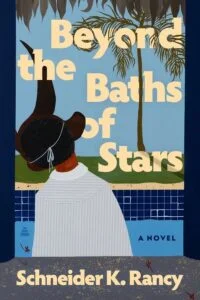
Beyond the Baths of Stars by Schneider K. Rancy is available from Amistad.