Fly Fishing and Fiction: What Casting, Patience and Revision Have in Common
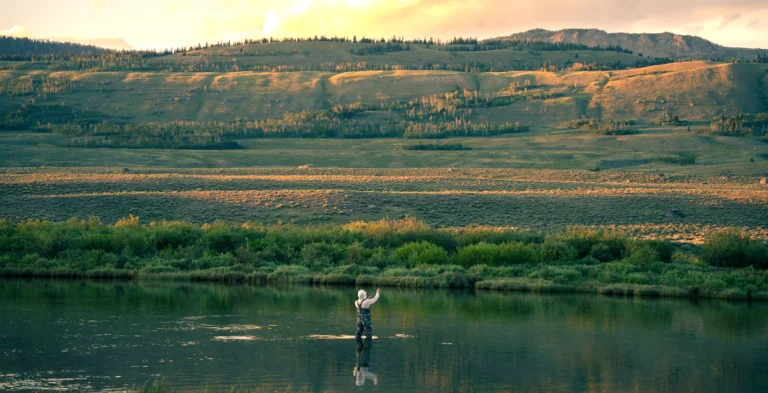
Fly fishing has a useful lesson for novelists: a convincing result depends on details the audience may never consciously notice. The fly has to look right, the line has to move with the current, and the cast has to land with the right timing. Fiction asks for the same kind of attention. A character’s voice, a scene’s setting and the shape of a sentence all have to feel true together.
That connection is easier to see from the water than from Hollywood. Screen versions tend to show effortless casts, handsome anglers and spectacular rivers. My own experience is less graceful. I’ve fished with expert guides and married someone who knows the sport, yet I’m still an amateur. On my last outing, a wasp stung me in the eye before we even reached the water. I went anyway, swollen face and all, and caught nothing.
Writing a novel can have that same stubborn, sometimes painful quality. You work through awkward attempts, misjudgments and stretches where nothing seems to land. The work changes when the pieces finally come together: the difficulty doesn’t disappear, but it starts to feel purposeful. For me, fly fishing makes that process tangible.
Technique gives style somewhere to go
A fly rod cast is a physical action, but it’s also a sequence that depends on timing. The line needs to travel behind the angler and straighten before the forward motion can carry it. With practice, the pauses and follow-through become a personal rhythm. A good cast can feel almost effortless; mine is more likely to resemble a paper airplane that has lost its way.
Writing has its own mechanics and habits. Some novelists favor spare sentences; others build long, layered passages. Writers develop preferred rhythms, punctuation and points of view. Those choices can become a recognizable style, but they work best when they serve the book in progress. The water determines what kind of cast makes sense. A novel’s characters and subject matter should shape its language and form.
In my debut novel, Madeline McKnight’s voice arrived before the structure did. She has spent her career in workplaces hostile to women, and her language reflects that history: she’s blunt, often vulgar and suspicious of sentimentality. After several drafts and sustained work on the character, I found a form that fit her. Madeline records her life in journal entries arranged like annual reports, complete with measures of her enemies, personal brand, relationships and chances of survival. The structure makes sense because her life has often felt transactional.
That was a craft decision, not decoration. A form that might feel clever in another novel became a way to show how Madeline understands the world. The writer’s equivalent of casting practice is learning which techniques help a particular story travel.
Believability lives in the particulars
Fly fishers use the phrase “match the hatch” for choosing an artificial fly that resembles the insect fish are feeding on. Anglers pay attention to its size, color, behavior and stage of life. A fly that imitates a small fish won’t make sense when mayflies are emerging on the surface. The point is to observe what’s actually happening, then respond with precision.
Fiction also asks a writer to know what the reader will accept. While drafting, I wasn’t focused on chasing an audience. I was focused on the possibility that someone would stop and think, “That doesn’t ring true.” I used to teach English, and the financial world at the center of the book was unfamiliar territory. I read, spoke with people who understood those systems firsthand and tried to build a believable account from what I learned.
That effort matters even when readers don’t see the research behind a scene. Specific details can make a fictional world feel inhabited; errors can expose the machinery. Like a fly on the water, a scene has to behave in a way that fits its surroundings. And once a manuscript leaves the writer’s desk, readers bring their own knowledge to it. Feedback can reveal where the imitation doesn’t hold.
When the current pulls, revise
A dead drift is the effort to let a fly travel at the same pace as the current. If the line pulls against the water, the fly drags and looks unnatural. Anglers mend the line by flicking it upstream, correcting its path. The adjustment has to be subtle enough to preserve the drift.
Revision often begins with recognizing that kind of drag. My novel originally moved between Madeline and Hetty Green, the real-life financier known as the Witch of Wall Street. I couldn’t find Hetty’s voice. Worse, the version I had written reinforced the caricature I wanted to question: a mean, miserable woman speaking in folksy aphorisms.
More effort wasn’t going to solve the problem. I cut Hetty’s point of view and removed roughly 100 pages. Madeline now introduces her to the reader, which gave me room to present a more nuanced figure. That change was substantial, but it followed a basic observation: the story was moving against its own current.
Revision also means knowing where a novel should begin. In an early draft, my story opened about a month later than it does now. A workshop teacher I trusted encouraged me to show what Charles Baxter calls the “request moment”: the point at which the characters enter the predicament. The book now starts with Madeline scrutinizing an email she sent to her estranged goddaughter, then waiting anxiously for a reply to her unusual request. The opening gives the reader a clearer view of what’s at stake.
Patience is part of the equipment
Fly fishers collect gear: waders, boots, vests, fly boxes and clippers. Writers have their own preferred tools, from notebooks and pens to playlists, corkboards and familiar places to work. But equipment doesn’t do the difficult part. Both crafts require stamina, attention and patience, along with the judgment to keep adjusting when conditions change.
I’ll keep fishing because I love being outside with my family, and wading in a river has a spiritual quality I don’t want to lose. I’ve also found a more reliable way to bring the sport into my work: I gave Madeline a rod. She wouldn’t let a wasp sting her in the eye without responding. She’d admire its predatory skill, catch it, pull off its wings and save them for her next fly.
That image captures what fiction can do with lived experience. The writer doesn’t need to master every craft in the story; close observation and a well-chosen detail can carry the knowledge. The next draft, like the next cast, begins with paying attention to what the conditions are telling you.
_______________________________
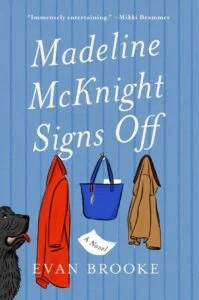
Madeline McKnight Signs Off by Evan Brooke is available from Atria Books, an imprint of Simon & Schuster.