Natasha Trethewey on John Edgar Wideman’s Lessons in Writing and Justice
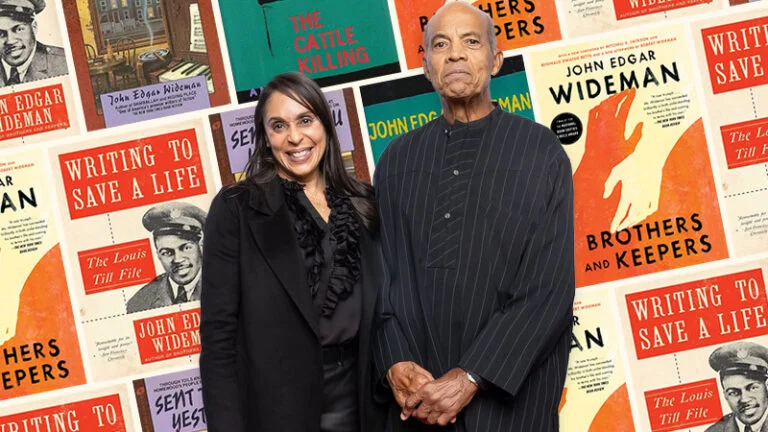
Natasha Trethewey delivered these remarks at the second annual Harper’s Magazine Awards Ceremony, where John Edgar Wideman received the Lewis H. Lapham Award for Literary Excellence. The event took place October 26, 2026, at the Morgan Library & Museum.
A teacher’s permission
John Edgar Wideman’s work has spent nearly six decades confronting the burdens of American history: racial injustice, political conflict, family hardship and the search for justice. For Natasha Trethewey, his influence reaches beyond the page. He showed her how a writer can face painful truths with moral clarity, and how that work can preserve stories that might otherwise be pushed aside. That example matters because the subjects a writer is encouraged to address can shape what a literary community recognizes as worthy of attention.
Trethewey first read Wideman’s Sent for You Yesterday, the third book in his Homewood Trilogy, in 1992. The novel had earned him the first of his two PEN/Faulkner Awards. On her way to an MFA program at the University of Massachusetts, she’d already chosen poetry, but hoped to study with Wideman. Her account begins with the recognition of a writer’s work, then turns to what it meant to encounter the person behind that work as a teacher.
That choice proved formative, both for his writing and for his example as a teacher. Trethewey recalls his grace, wit and intellectual force, qualities she saw him maintain through personal hardship. Early in her graduate studies, she sought him out after a prominent poetry professor told her to set aside being Black and the death of her mother, and simply “pour your heart out in the poems.” The advice treated identity and grief as distractions from the work, rather than as experiences a writer might investigate with craft and care. Wideman’s response offered a different account of what literary discipline could mean.
He listened, then offered a brief answer: “You have to write what you have to write.” Trethewey remembers the words as permission from a writer she admired, and as a turning point in her own development. They affirmed that her experience and subjects belonged in her work. There’s no elaborate method in the sentence, but its simplicity carries weight: it makes the writer responsible for finding the form and language her material requires.
His memoir Brothers and Keepers had already shown her how personal experience could become an act of witness. The book brings Wideman’s voice into close relation with that of his brother Robby, whose incarceration shaped their divergent lives. Trethewey saw in that formal choice a model of empathy and an ethical responsibility: when writing about people who have little power to tell their own stories publicly, a writer must make room for their voices. The challenge isn’t solved by speaking on someone else’s behalf; it begins with attention to how a story is told, whose perspective it allows readers to hear, and what the writer’s own position leaves out.
Personal history meets public memory
Wideman’s encouragement mattered to Trethewey as a young Black writer navigating a graduate program. She connects it to the purpose behind Writing To Save a Life, his researched and imaginative account of the intertwined histories of Emmett Till and his father, Lewis Till. For her, writing could help keep alive not only the writer’s own experience, but also the lives of loved ones and communities at risk of being erased, diminished or relegated to the margins. That work asks a writer to attend to what public memory preserves and what it leaves in shadow.
“Save” is a demanding word for a book to claim, and Trethewey’s account gives it a specific meaning: writing can preserve testimony and make neglected lives harder to dismiss. It can’t undo the harms a story describes. But it can change what readers are asked to remember, and how they understand the relationship between a family’s private grief and a nation’s public history.
Another lasting lesson came from hearing Wideman read The Cattle Killing at the University of Massachusetts. Trethewey sat on the floor of a crowded Memorial Hall, absorbed by the novel’s intense, almost hypnotic language. Her recollection points to a feature of literary influence that can be difficult to capture in a summary of themes: a work’s sound and movement can affect a reader before its ideas can be neatly explained. The experience sharpened her sense that personal history gains meaning through engagement with public history.
She came to see a writer’s work as a search for truth: confronting difficult knowledge to expand understanding and offer a form of redress. That approach runs through Wideman’s career, which spans more than twenty books of fiction, memoir and nonfiction. Trethewey’s tribute frames his achievement in those terms: his writing has helped shape American literature by insisting that the stories at its margins belong at its center. This is more significant than it looks: moving a story toward the center changes which lives readers are asked to treat as part of the shared record.
What a literary inheritance asks of readers
Trethewey’s tribute also describes a form of inheritance. A teacher passes on more than technique; the teacher can offer a writer a way to approach difficult material, and a sense of what the work owes to its subjects. Wideman’s advice gave Trethewey room to write from her own experience, while his books showed her how individual lives might open onto questions of family, race, history and justice. The connection between those lessons is the insistence that personal experience needn’t be cordoned off from the public world.
Here’s the thing: the subjects Trethewey names aren’t made easier by turning them into literature. The writer still has to contend with grief, power and the limits of what can be known. Wideman’s example, as she presents it, offers no shortcut around that difficulty. It offers a reason to keep working through it, with attention to language and to the people whose lives give the work its stakes.
For readers, that approach offers a way to consider what a book does beyond recounting events. It can preserve a voice, bring different histories into contact and ask who gets recognized as part of the national story. And yet. The work of remembrance remains unfinished.
If you’re working in this space as a writer, teacher or reader, Trethewey’s account leaves a practical question: whose experiences are being treated as material for serious attention, and whose are being set aside? Her tribute presents Wideman’s career as an answer built book by book, through forms that make room for difficult histories and voices. The example doesn’t dictate what another writer must say. It affirms that the choice of what to write, and the care brought to telling it, carries consequences.
And that’s the lasting force of the lesson she recalls: a permission that becomes a responsibility.