Dodie Kazanjian’s Case for Wearing Pajamas After Loss
|5 min read
A wardrobe after loss
The decision to wear pajamas everywhere began with a death. On March 20, Tad—Dodie Kazanjian’s husband—died. She writes that she would never again wear anything else, day or night. The declaration sounds like a fashion provocation; its roots are in grief.
Tad was the person Kazanjian never doubted. They met when she interviewed him on January 27, 1987, at three in the afternoon, in his New York writing studio. About 18 months later, she was living in that same room with him. They married and built a life around working, playing, and traveling together. Then, as she puts it, that life stopped.
Their family grew too. Kazanjian, then in her mid-30s, became a stepmother to four children, the youngest four years old, and a grandmother to four more. Tad called her “belle-mère” and “GrandDodie,” partly to keep the word “stepmother” at bay. The joke didn’t always hold: one hot Friday, heading to Quogue in a tiny Fiat convertible, Kazanjian tied her long dark hair on top of her head. Tad’s five-year-old daughter Sarah spotted the look from the back seat, where she was perched on a rocking horse, and cried, “The wicked stepmother!”
The case for pajamas
Kazanjian pauses over the word itself: she prefers the British “pyjamas,” though she thinks both spellings deserve a place, like “doughnut” and “donut.” The diminutives—“pj’s,” “jammies,” “jam-jams”—are another matter.
Her plan is simple: wear pajamas out of the house as well as in it. Julian Schnabel has done it, she reasons, so why shouldn’t she? She had already noticed her eldest stepdaughter, Trippy, in navy pajamas with white piping. A week after Tad’s death, a visit to their Newport home made the idea stick. Tad’s niece Torrie changed into crisp white poplin pajamas with navy trim, and Kazanjian was sold. They were from Matouk.
A few days later, Kazanjian’s Vogue editor sent her a box from Petite Plume: tailored blue-and-white striped pajamas in cotton, with a long-sleeved top and full-length pants. Her editor, Chloe, is six feet tall and favors nightgowns; she says pajama pants often hit at an awkward length on taller people. Kazanjian, who stands five-foot-two when she can straighten up, envies Chloe’s height—and her Salter House nightgowns, made from what Kazanjian calls the finest cotton in Western Christendom.
The fit she likes is loose, with a baggy ankle-length leg. Webster’s defines pajamas as clothes for sleeping or lounging, usually a top and matching trousers. The word entered English in the 19th century from Hindi *pājāma*, itself derived from Persian *pā* (“leg”) and *jāma* (“garment”). Pajama pants had long been everyday clothing across Asia before becoming sleepwear and loungewear in the West. That history makes the modern dress code look less fixed than it might seem.
Kazanjian draws a firm line, though: she has no interest in lounging, and she won’t wear pajamas to bed. The top is out, too. She compares pajama shirts to anchovies pushed aside on a plate. Ryan Gosling may be an exception; he wore a white-piped pajama shirt with crisp white pants at Cannes in 2011.
The bottoms are the point. Kazanjian has worn her Petite Plume pants almost daily since they arrived last April. Watching Doris Day in the 1957 film *The Pajama Game*, she heard factory workers sing that their “Sleeptite” pajamas belonged at every social function: “Dresses are fine but Sleeptite’s divine.” Kazanjian agrees.
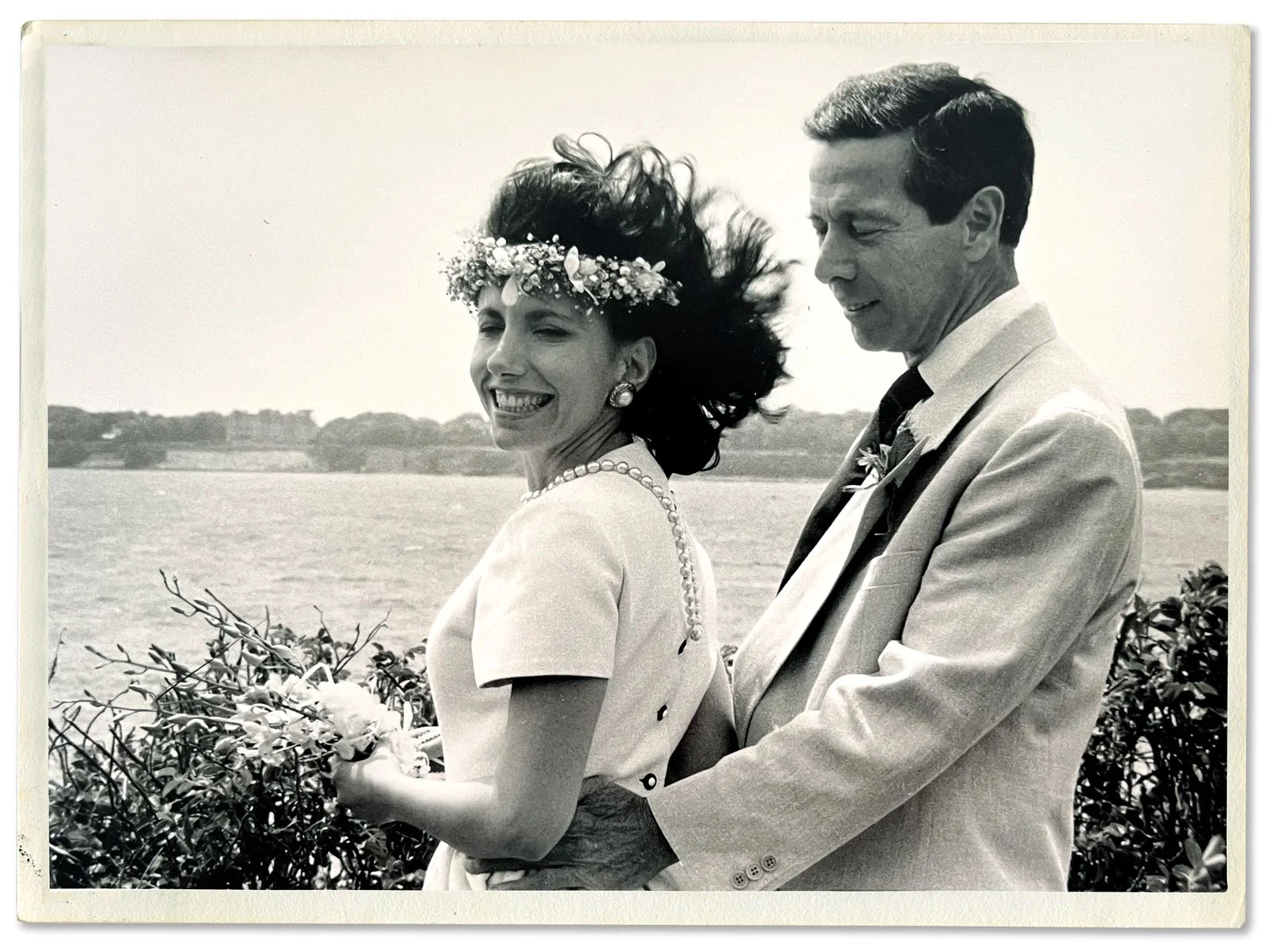
WEDDING BELLE Dodie and Tad on their wedding day. Courtesy of Dodie Kazanjian. Polaroid frame: Getty Images.
For now, Kazanjian is mourning at home, with close friends visiting for meals. The artist Jamian Juliano-Villani recently stopped by with Kat Herriman, a young writer friend. Juliano-Villani likes pajamas that can pass outdoors without making her look “like a crazy person.” Her rotation is a Matouk robe and pajamas from Copenhagen label Tekla, a gift from an art dealer. Sunglasses, she says, complete the look. The sets are expensive, but she thinks they’re worth it; matching pieces make her feel more put together.
Juliano-Villani sleeps in hers. Kazanjian says that’s unusual among the pajama wearers she knows: they take them off before bed and sleep naked. She doesn’t.
A uniform for getting through the day
Pajamas can be a kind of armor. My friend Ruth Ganesh, who brought 100 life-size elephant sculptures made from the weed Lantana camara from southern India to America to raise awareness of wildlife conservation, favors Indian cotton pajamas made with block printing in Jaipur. “They make the most beautiful multicolored ones, with flowers and patterns all over them, that give me the happiest dreams,” she says. English visitors to India, she adds, treat shopping for pajamas at Anokhi as a rite of passage and pack their suitcases with them.
The habit has its own art-world network. Cecily Brown says her dealer and friend Stefania Bortolami gives artist friends pajamas from Rome for Christmas. John Currin gets pairs from his London dealer, Sadie Coles, who sends him [Turnbull & Asser](https://turnbullandasser.com/?utm_source=google&utm_medium=cpc&utm_campaign=00_us_brand&utm_content=adgroup%3A+t&a%2Busa%2B%26%2Badid%3A%2B604155689953&gad_source=1&gad_campaignid=235745685&gbraid=0AAAAAD9I5W9VjQcZZ5aI9Pnf9HfFO1Kej&gclid=CjwKCAiAhqHXBhAXEiwATbksUwpBTKYUyid61Zo1HXwfK_IcueFYE79FKAUr6KX9Y_0BYzWRhXwuNRoCZ1EQAvD_BwE) for Christmas. Diamond Stingily arrives with Pucci, her friend Martine Syms’s Pomeranian, and points me toward Schostal in Rome. “All the artists go there,” she says.
Gavin Brown helped make that so. His Roman gallery occupies Sant’Andrea de Scaphis, a ninth-century church that’s been deconsecrated, and he and his wife, artist Hope Atherton, have introduced countless people to Schostal. The pajamas are made from fine, high-thread-count fabric: soft, slightly sheer, and available in solids and stripes in vivid colors. I wanted a pair, but ordering online defeats me—even FreshDirect is a challenge. Then Hope visits for tea one Monday in June, and a lemon pair with red-and-white pinstripes is soon on its way from [Schostal](https://schostaloriginals.com/collections/women-pajamas?srsltid=AYCX9vJPUeOb1y2Wc0qQS_tSbisnVM2znidwCvg1pEkR4ohaTJZiyLa_). The price is nearly $300, thanks to Trump’s tariffs.
Comfort has its own dress code
I told my friend, dermatologist Joel Kassimir, that I planned to live in pajamas. He called it a uniform, comparing them with Peter Marino’s leather clothes, Julian Schnabel’s pajamas, and Vinny “Chin” Gigante’s bathrobe. “It is a uniform, and it works.”
Rachel Feinstein agrees about the comfort, though her taste runs elsewhere. She wears [Dôen](https://www.vogue.com/vogue-world-los-angeles-doen), a brand her daughter Flora, 17, introduced her to. Feinstein describes the look as “new Gen Z Laura Ashley”: very fine, thin cotton in a blue Delft-like pattern. She changes into them as soon as she gets home. Silk feels too hot and cloying, she says. I’m with her. Satin suggests a 1930s starlet’s boudoir—Carole Lombard, Claudette Colbert, Lauren Bacall, or Katharine Hepburn in Bringing Up Baby.
Even Vogue’s head of fashion, Virginia Smith, has a roster: For Restless Sleepers, Olivia von Halle, and the classics—Charvet, Brooks Brothers, and Ralph Lauren. She recalls Grace Coddington wearing Michael Kors blue pajamas to the 2015 Met Gala. Smith wore mint Erdem pajamas to the 2024 Met Gala, “[Sleeping Beauties](https://www.metmuseum.org/exhibitions/sleeping-beauties-reawakening-fashion).” The idea has clearly escaped the bedroom. Last night, I saw a woman on Park Avenue walking her dog in matching pajamas.
Still vertical
A few close artist friends have helped keep me afloat through the difficult days, weeks, and months since Tad died. He had a phrase for how he was doing: “I’m still vertical.” Pajamas make me feel safe and, in their way, vertical—even when they’re meant for lying down. They’re my safety net.
One sunny evening in mid-June, Maurizio Cattelan and Anna Weyant came to dinner. Over the 30 years Tad and I knew Maurizio, he had a habit of bringing increasingly outrageous gifts: a blowfish ceiling lamp, a human-size package of Oscar Mayer wieners, and a Gucci box that opened to reveal a two-dimensional cutout of Tad and me. This time he brought a tennis ball signed by Billie Jean King the day before, after a photo shoot for his magazine, Toiletpaper. He tried to explain the signature. I didn’t quite follow.
Anna brought a birthday present a day early: a white box tied with an oversized vanilla grosgrain ribbon, like one of her hyperrealist paintings. Inside were the navy Eberjeys with white trim I’d been dreaming about. “You can return them if you don’t like them,” she said. I knew I wouldn’t.
When Maurizio asked if I’d wear “sleepers,” I didn’t understand. He had to repeat the word three times before I caught on: slippers, to go with my new pajamas.
On June 17, my birthday, I wore the Eberjeys and felt at once comfortable, safe, and dressed to go out. They’re 95 percent Tencel Modal, from the rayon family and derived from beech trees; the fabric promises cotton-like softness and durability, along with environmental benefits. That afternoon, Cecily Brown, Rachel Feinstein, Anna Weyant, and Kat Herriman surprised me with a pajama party. They changed into their own pairs as they arrived. Rachel hadn’t had time to go home, but Cecily had spare peach pajamas with navy trim in her bag. Rachel wore both pieces. No one else dared.
We talked about everything from Cecily’s 30th birthday to a book on witchcraft, [Abject Eroticism in Northern Renaissance Art](https://www.bloomsbury.com/us/abject-eroticism-in-northern-renaissance-art-9781350283503/). That evening, I went to dinner at the Mark Hotel with Peter Gelb, general manager of the Metropolitan Opera, wearing my navy pajamas with pearls. I could have added open-toe satin bedroom slippers. Nobody noticed the pajamas. I did. I know how much I need them—for as long as I need them.