What a Fact Checker Does at Bon Appétit: Ryan Harrington’s Role
What My Job Is Like as a Fact Checker at Bon Appétit
Ryan Harrington’s route to fact-checking ran through chemistry, lung cancer research, and food studies. Now, as Bon Appétit’s research director, he helps make sure the magazine’s stories and recipes are accurate, thoughtful, and legally sound. The job’s reach is broader than its title suggests: sometimes the answer to a reporting question comes from a local business owner who remembers a bar that disappeared decades ago.
Publishing a magazine, website, app, YouTube channel, and everything else takes a team. Bon Appétit’s research director Ryan Harrington explains what his work involves.
What fact-checking covers
For readers outside journalism, what does research and fact-checking involve?
At Bon Appétit, stories and recipes pass through several rounds of editing before they reach the research team. The review checks whether the details hold up: names and brands are spelled correctly, restaurant menus and dishes are described accurately, sources are credible, and quoted people are represented fairly. The aim is simple: readers should be able to trust what they’re reading.
There’s also a cultural responsibility. Food media has often treated unfamiliar cuisines as discoveries and reduced whole cultures to curiosities. Research can help catch that framing and make room for people’s experiences without turning them into a spectacle.
The team also connects editors with the legal department. That can mean flagging possible libel, copyright questions, food safety issues, or concerns about protecting sources. Fact-checking is part verification, part editorial judgment, and part knowing when a question needs a lawyer.
A route from science to food media
How did you become a fact checker, and what were you doing before Bon Appétit?
Harrington earned a bachelor’s degree in chemistry and spent six years managing operations at a thoracic surgery laboratory studying forms of lung cancer. When the next step seemed to require a master’s degree or PhD, he reconsidered where he wanted to invest years of further study. Food media was the subject that held his attention.
He enrolled in NYU’s Food Studies master’s program to examine food media’s cultural effects. An internship at Food & Wine opened the door to projects beyond the internship itself, and helped him see the field as a career as well as an academic interest. He later worked at Travel + Leisure and Lucky Peach.
Harrington also tried working at a brewery, starting in February 2020. The timing meant he saw the pandemic’s effect on the industry firsthand. When Bon Appétit advertised a research director role, he felt his education and past jobs had prepared him to lead the work. He says he’s been at the magazine for five years.
You teach food studies at NYU, too. How does that shape your work at Bon Appétit?
Whether he’s preparing a class or reviewing a story, Harrington thinks about the person receiving the information: What will students or readers understand? What will they take away? Helping someone reach a moment of clarity is what connects his teaching and newsroom work.
Opening doors for new researchers
You started a research fellowship so students can gain experience in media. What do fellows get to do?
Harrington began his own media career with an internship, despite having no formal journalism or media training. That experience helped him gain skills and make connections, so creating a path for other aspiring food journalists became a priority at Bon Appétit.
Fellows learn research editing, but they can also follow their own interests. Some spend time in the Test Kitchen learning how recipes are developed and edited; others pitch and publish stories or work with the photo team on recipe shoots. Harrington wants each fellow to leave with useful experience and a clearer path toward their goals.
The satisfying searches—and the difficult ones
Which stories are your favorites to work on, and which ones are hardest?
Harrington grew up watching Alton Brown’s Good Eats, and its mix of science and cooking shaped his interest in why food works, not only how to prepare it. He especially enjoys explanatory stories that unpack a process, such as Dr. Arielle Johnson making a chocolate bar. Johnson and Harrington were chemistry lab partners during their first year at NYU.
Wine is tougher. The work involves specialized vocabulary, rules that vary across countries, and spellings with diacritics. Harrington relies on a network of knowledgeable wine contacts when the details get difficult.
What’s the funniest research rabbit hole you’ve followed?
A 2021 story about Moe Girton and her bar Gossip Grill sent Harrington looking into San Diego’s lesbian bar scene in the late 1990s. Girton had mentioned three bars, and the writer asked the fact-checkers to verify their names. Two were easy to confirm. The third barely appeared online.
Harrington searched newspaper archives and old community forums, but the scraps he found didn’t always agree. Girton couldn’t recall many details, though she gave him the cross streets where she thought the bar had been. He began calling nearby businesses to ask whether they’d been there in the late ’90s and remembered a neighborhood lesbian bar.
One call reached the owner of George’s Camera, a photography shop operating since 1965. The owner recalled that Patti’s Bar had been next door, describing it as a “lesbian and biker friendly bar.” He even had a photograph of the storefront from that period, signs included. That’s the work in miniature: a thin lead, a lot of patient calls, and a source with exactly the memory the story needed.
Recipes, sandwiches, and useful uncertainty
Which Bon Appétit recipe do you make most often?
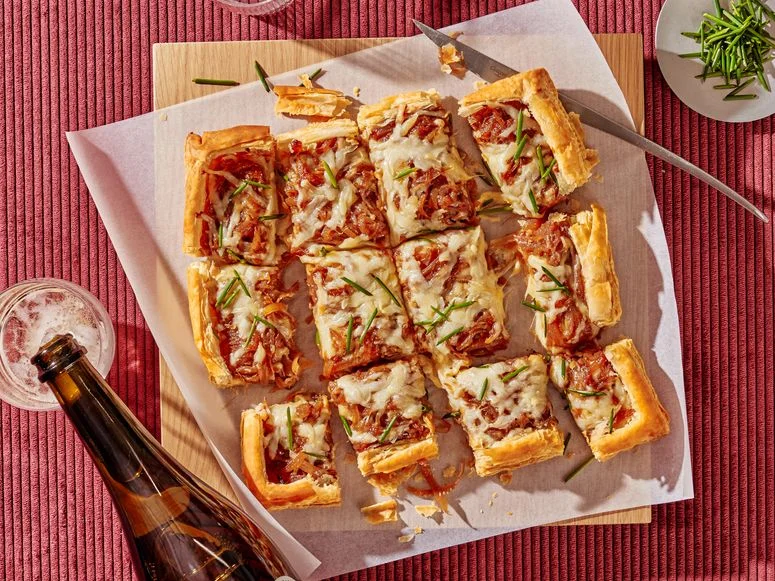
Harrington’s go-to is Shilpa Uskokovic’s French Onion Tart. It looks like a project, but most of the work happens without much attention, leaving time for other things. The box has two sheets of puff pastry, too: one for guests and one for breakfast the next morning.
What’s your favorite piece of obscure food trivia?
Harrington has spent plenty of time arguing about what counts as a sandwich. New York generally taxes sandwiches, and the New York Department of Taxation and Finance takes a broad view: its examples include a hot dog, a burrito, and even a buttered bagel.
Massachusetts drew a narrower line in 2006. When Qdoba planned to open at White City Shopping Center, Panera Bread argued that a lease clause barred competing sandwich shops. After hearing expert testimony, Judge Jeffrey Locke ruled that a burrito wasn’t a sandwich, clearing the way for Qdoba to operate near Panera. The legal answer depends on the question being asked—and, apparently, where you ask it.
Maybe there’s no final answer to the sandwich debate. Maybe the sandwich was the friends we made along the way.
Could we convince you to try out for Jeopardy?
Harrington says his job doesn’t require knowing everything. It requires knowing how to find someone who does. He doubts Ken Jennings would let him use Google on the show.
How does AI intersect with or influence your current work?
AI earns its place in editorial work through narrow, practical jobs—not blanket trust. Transcription is a good example. Early in my career, I was the junior editor assigned to turn reporters’ interview recordings into text. With my limited experience, an hour of audio could take two or three hours to transcribe by hand. AI tools still make mistakes, so I listen along and correct the transcript. Even with that extra check, they save a lot of time.
A tool that fits a small kitchen
What kitchen tool am I obsessed with right now? My immersion blender. In a small New York kitchen, freeing up counter space matters. This one handles pasta sauce, soup, salsa, and smoothies, and I can blend right in the pot instead of risking a spill while transferring everything to a pitcher and back.
I also recently tried chef Frank Proto’s trick of using tongs to squeeze citrus. It came in handy in a vacation rental with a bare-bones kitchen: we needed plenty of fresh juice for marinades and margaritas, and the tongs made the job easier.
Why I keep coming back to Happy Endings
The show I could rewatch indefinitely is Happy Endings, the ABC sitcom that ran from 2011 to 2013. It borrows Seinfeld’s group-of-friends setup, following young adults through city life and the social rules they have to navigate to fit in. The characters know those rules are often arbitrary. That self-awareness is part of the joke.
I once wrote an academic paper about how the series uses—and sometimes overturns—the big eater trope to explore food and gender. The trope plays out through characters of different genders and sexualities, making appetite a kind of performance. The series suggests that social expectations can be restrictive or simply made up—and that breaking them can make room for other people to do the same.
Also, it’s really fricking funny.
Make Ryan’s favorite recipe
Support our journalism and get access to thousands of Test Kitchen–vetted recipes by subscribing.