Generative AI and the Horror of Trading Human Creativity for Convenience
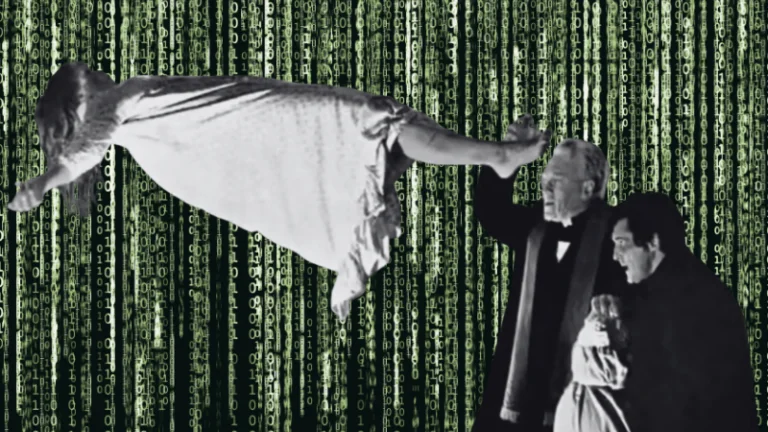
Generative AI’s most unsettling promise may be the oldest one in technology: that people can be improved by leaving their physical limits behind. The idea sounds abstract until it reaches daily life, where automated summaries, search results and customer service bots increasingly stand between people and the information or help they wanted. The unease isn’t only about what these systems can do. It’s also about the human judgment they invite us to surrender in exchange for convenience.
That tension has a precursor in the work of Irish physicist John Desmond Bernal. Nearly a century ago, he imagined human brains separated from their bodies and kept in cylinders, “immersed in a liquid of the nature of cerebro-spinal fluid.” In his vision, the body was an inadequate shell, destined to give way to a form of existence he described as “more plastic, more directly controllable and at the same time more variable and more permanent than that produced by the triumphant opportunism of nature.”
Bernal was a significant scientist whose work in x-ray crystallography helped advance the field. His speculation about life beyond the body was another matter: a stark vision of progress in which biological existence could be discarded. For many readers, that vision lands less as an optimistic forecast than as horror. It treats the body’s frailty and limits as defects to overcome, rather than as part of what makes a human life human.
The horror inside ordinary life
Horror often works best when it enters a familiar place. In The Exorcist, the demonic force surrounding the MacNeil family makes itself known through extraordinary scenes, but also through a brief, ugly confrontation in the kitchen. During a party, the drunken film director Burke Dennings taunts Karl, the family caretaker, with a remark about the Gestapo. Karl corrects him: he is Swiss, not German. After Karl leaves, Burke mutters, “Nazi bastard.” Moments later, Karl has his hands around Burke’s throat.
The episode could be read as a burst of drunken aggression. In the film’s context, though, it suggests that evil has spread into ordinary interactions: an insult, a flash of violence, laughter as the party resumes. The scene doesn’t need supernatural spectacle to feel disturbing. Its horror lies in the way a hostile force appears to travel through people and their everyday conduct.
That kind of domestic unease helps explain why AI can feel frightening even when nothing dramatic happens. A search engine inserts an AI-generated overview before the links a user was looking for. A company’s bot promises assistance, then frustrates someone trying to resolve a problem. These interactions are small, repetitive and increasingly routine. Their effects accumulate in the habits people form around finding information, expressing themselves and asking for help.
I’ve come to believe that AI is a form of horror, and its most pernicious element is that it tricks us into believing that it helps us when it actually hurts us.
Convenience and the value of human limits
In The Exorcist, Father Merrin offers a bleak account of the demon’s purpose: “I think the point is to make us despair. To see ourselves as animal and ugly. To make us reject the possibility that God could love us.” The line connects bodily vulnerability with a deeper fear: that people may be made to feel unworthy of existence as they are.
The comparison with AI isn’t a claim that software is supernatural. It’s a way to describe the cultural unease around tools that encourage people to treat human effort as a problem waiting to be removed. Writing, drawing, thinking through a difficult question—these activities can be slow and imperfect. Their value doesn’t depend on producing the quickest possible result. They matter in part because a person chose to make something, worked through uncertainty and put a piece of themselves into it.
Bernal’s imagined future and today’s AI systems are very different things. But both can prompt the same question: what gets lost when human limitations are treated as obstacles to eliminate? People tire, change their minds, tell stories and care for one another. They also die. The brevity and vulnerability of life can make it difficult, but they shape the way people experience and create meaning.
AI was made and adopted by people, and its presence in daily life reflects decisions by companies, public institutions and users. Criticism of the powerful organizations and political figures that have encouraged its spread matters. So does recognizing the ordinary participation that makes these systems feel inevitable: accepting automated answers by default, bringing them into schools and workplaces, or describing their use only in the language of convenience.
Making room for human creation
There are ways to resist the assumption that every act of thought or creation should be automated. People can keep writing poems, sketching, and filling notebooks or napkins with their own words. Such work may not be fast or polished. That’s part of its significance: it records a human being choosing to pay attention and make something by hand.
Language matters, too. Calling an AI system a helper doesn’t guarantee that it will help. Describing a tool honestly means paying attention to what it does in practice, including the friction it adds and the human work it displaces or diminishes. When ease becomes the only measure of value, it gets harder to notice what people have given up.
The future of AI will be shaped not only by the people building these systems but by the daily choices that make them normal. That doesn’t mean every person can opt out of every tool, or that hand-made work resolves every concern. It does mean that human creativity and embodied life remain worth defending as practices, not just as ideas.
Halloween offers a fitting image for that argument: people stepping into the night in masks and borrowed forms. The costumes are temporary; the bodies beneath them are not abstractions. The more AI becomes part of ordinary routines, the more useful it may be to ask whether a promised shortcut supports human life—or quietly teaches us to regard it as expendable.