How Psycho Turns the Open Road’s Promise of Freedom Into a Trap
The open road’s broken promise
Walt Whitman imagined the road as an invitation: step out light-hearted, follow the path, choose your destination. He published “Song of the Open Road” in the second edition of Leaves of Grass in 1856, thirty years before Karl Benz built the first modern gasoline-powered automobile. Whitman couldn’t have known the car, but his poem already held the images and promises that car culture would later make its own.
Cars and cinema grew up alongside each other, and the open road became one of film’s defining images. Picture the view through a windshield: highway running toward a point on the horizon, mountains seeming fixed in the distance while roadside diners, gas stations, billboards, trees, overpasses, tourist traps, telephone poles, rock formations, roadkill, and the occasional muffler man streak past. The rearview mirror gathers what’s behind; the road ahead offers possibility. It’s a potent picture of escape, adventure, self-discovery, individualism—and freedom.
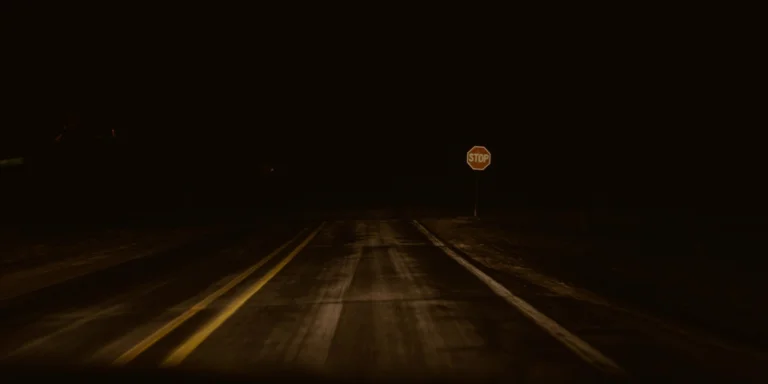
Horror turns that image inside out. If a house in a horror film makes its promise of safety look like a façade, as I’ve argued before, then a road in horror exposes freedom as another illusion. The highway’s darkness doesn’t wait at the end of the journey. It’s there all along, just beyond the headlights’ narrow reach—the always-already-terror of a world we can glimpse in fragments but never fully make sense of. David Lynch’s Lost Highway makes that darkness part of its title sequence.
No matter how far you drive you can never escape yourself.
Psycho turns the road into a trap
Alfred Hitchcock’s Psycho begins with Marion Crane and Sam Loomis in a hotel room, at the end of a lunchtime affair. The camera first draws attention to Marion’s breasts beneath a white bra, a visual echo of snow-capped peaks on a distant horizon. Marion says she’s tired of meeting Sam “in a place like this.” He jokes that married couples sometimes choose cheap hotels too. “When you’re married you can do a lot of things deliberately,” she replies.
That exchange carries the weight of their unequal choices. In 1959, an unmarried woman like Marion had to guard the “respectability” that limited what she could do; marriage could grant her freedoms she didn’t have on her own. Sam, who has already been married, is burdened by his father’s debts and his former wife’s alimony. He wants Marion, but sees another marriage as a financial trap until he’s more secure. The same patriarchal order constrains them both, though in different ways.
Then Marion gets the chance to steal $40,000. She doesn’t spell out what the money means, but the connection is plain: it could help her marry Sam and claim the liberties she associates with marriage. She leaves town with the cash, and the road initially looks like a route to that future. It becomes the route to her undoing.
As Marion drives, Hitchcock cuts between close views of her face and her perspective through the windshield and rearview mirror. Her imagined conversations about the theft play in voiceover. She is watching the road and rehearsing its consequences at once: physically moving forward, mentally pulled back to the crime and her guilt. The highway doesn’t clear her mind. It gives her room to circle what she’s done.
Marion isn’t in immediate danger, but the tight framing and mounting paranoia make the drive feel ominous before anything happens. She’s already caught in what Norman Bates will later call a “private trap.” By the end of her second day, rain and darkness blur the road. She unknowingly leaves the modern highway for an older route it has bypassed, spots a neon sign, and pulls into the Bates Motel. It reads “BATES MOTEL,” with “VACANCY” below. The motel is only fifteen miles from her destination. Her road trip ends in its shower.
Before that, Norman talks with Marion about “private traps” and “private islands.” “No one really runs away from anything,” he tells her. He believes people are clamped into their traps, scratching at the air and at one another without ever getting free. The line could serve as the film’s thesis. Marion doesn’t escape with the man she hopes to marry; she drives into danger. Norman has no interest in her stolen money, and the danger isn’t a punishment for the theft. It comes from a gap in understanding that the psychiatrist’s explanation at the film’s end can’t fully close.
Psycho spends less than a sixth of its runtime on driving, all of it in the first third. Still, it marks a turning point: the road stops reading as a Whitman-like promise and starts revealing the terror that was waiting beneath that promise all along. The car looks like a private island, but it can be another private trap. No one drives far enough to leave themselves behind.
The car is, first and foremost, a sex object.
Driving splits attention—and the self
Lynch called Lost Highway a “psychogenic fugue,” a state of dissociative amnesia in which someone loses their identity, wanders in confusion, and may take on another persona. Jean Baudrillard offers a related image in America: “Driving is a spectacular form of amnesia. Everything is to be discovered, everything to be obliterated.”
That account catches something about the road, but Psycho shows what it misses. The landscape can feel unreal at speed; the driver’s mind doesn’t simply empty out. Driving may be a spectacular form of schizophrenia: one self handles the lane, the speed limit, other drivers, and the next exit, while another roams through memories, fears, plans, songs, arguments, and imagined futures. Baudrillard is half right. The road creates a kind of mental vacancy, and the mind fills it with its own traffic.
The repetitive mechanics of driving help produce that second stream of thought. Your attention has a job, but the body’s steady work leaves the mind under-stimulated enough to wander. That wandering isn’t freedom from the present so much as a second track running beside it.
Where the road goes in a dream
This divided attention helps explain why road horror so often bends into dream logic. In Lost Highway, Lynch begins and ends with the same image: darkness rushing past, the lane markers briefly lit by the headlights. The road appears to promise a straight line from here to somewhere else. The film questions whether either the journey or the self is as linear as it looks.
A road can curve and still carry you away from where you started. In Lynch’s film, that basic promise collapses into a loop, a surface that folds back on itself. Motion doesn’t guarantee progress; the driver can spiral inward even while the car keeps moving.
Horror has long played tricks with distance. Michael Myers may walk slowly, yet still catch the people fleeing from him. Cars make that distortion even stranger, since they can cover so much more ground than a person on foot. In Robert Harmon’s The Hitcher, John Ryder appears and vanishes without settling into a stable place in the landscape. He may be a projection of Jim Halsey’s mind, or he may not; the film doesn’t resolve the question. Similar hitchhiking presences haunt Dust Devil and Passenger, while the faceless driver and tanker in Steven Spielberg’s Duel seem able to emerge around any bend.
These films make the road feel like a dream, but that doesn’t mean it erases the self. Freud called dream interpretation the royal road to the unconscious because dreams, in his view, disguise repressed desires and conflicts rather than appearing at random. That road doesn’t lead to a place we can map and reach. In Lost Highway, and in the purgatorial loop of Dead End, the journey points toward the impossibility of arrival: a royal road to what we can’t fully understand.
The car as lover, extension, and threat
Sex and death travel together in road horror. The car has long embodied both of Freud’s competing drives, Eros and Thanatos. It is, first, a sex object: a symbol of masculine power, an engine of speed whose vibration carries an unmistakably bodily charge.
That association predates mass car ownership. Freud wrote in “Infantile Sexuality” that the link between railway travel and sexuality came from “the pleasurable character of the sensations of movement.” The automobile later made that pleasure private and accessible. As Henry Ford’s Model T entered mass production in the early twentieth century, cars gave young people—especially teenagers—a place to meet beyond parental supervision. The car helped widen opportunities for sexual experimentation and played a part in changing sexual norms and the sexual revolution.
The car also completes a familiar fantasy: the human joined to an animal’s strength. We still measure engines in “horse power,” even though cars freed us from relying on horses for speed and distance. Riding a horse involves another creature with its own consciousness and desires. A machine is easier to fold into the self.
Jean Baudrillard makes that distinction in The System of Objects. In a relationship with another person, he argues, the impulse to break the other into parts is checked by their living unity. A manufactured object invites that kind of disassembly. We speak of “my brakes,” “my tail fins,” and “my steering wheel”; we even say “I am braking,” “I am turning,” or “I am starting.” We wouldn’t claim a horse’s hooves the way we claim a car’s tires. The car is something we don’t merely have, but imagine ourselves being—a modern centaur, or a person extended by a machine.
John Carpenter’s Christine pushes that fantasy into horror. The possessed car becomes an object of desire and obsession, even staging a “show me” seduction and striptease through its own bodywork. But Christine also externalizes Arnie Cunningham’s repressed desire. Even if we accept that the car is literally possessed, his fixation remains narcissistic: in Christine, he desires an idealized version of himself.
That’s why auto-erotic desire remains self-directed even when it seems to promise an encounter with something else. The car extends the driver; the desires attached to it circle back toward the self. And its other promise is violence. Christine makes the killer car literal, but every car carries the possibility of collision. We call crashes accidents, though the risk is built into driving and increases with every mile.
So why keep getting behind the wheel? Because the car offers pleasure and power alongside danger and destruction. We want both. In horror, the machine’s hidden force and our own buried drives turn out to be hard to separate.
In David Cronenberg’s Crash, desire and death meet in the recreation of car wrecks. Robert Vaughan, who leads a group of survivors drawn to staging collisions made famous by celebrities, calls a crash “a fertilizing rather than a destructive event.” The film takes him at his word without letting destruction off the hook: impact tears apart the body’s familiar relation to pleasure and makes room for desires that weren’t there before.
That’s what makes the film’s eroticism more than a response to danger. Its characters are driven to repeat the crash that first awakened them, then push closer to death to intensify the pleasure. The event begins as an accident; repetition turns it into a pursuit. Eros and Thanatos blur until the desire to live seems to depend on revisiting violence.
Julia Ducournau’s Titane takes this entanglement further. Like Crash, it links sexuality and bodily change to trauma, but it extends Vaughan’s aim of “the reshaping of the human body by modern technology” into a new kind of reproduction: desire becomes “auto-erotic trans-mission-fluid,” and the machine re-engenders man.
That vision complicates car culture’s promise of human control over technology. We already have limited command over our own bodies; our desires can steer us toward actions we don’t fully understand. As the boundary between person and machine thins, bodily autonomy may narrow further. Whatever governs the human body may govern the machines we build, too.
VI. Rearview Mirror and Windshield Diplomacy
The open road rarely delivers the solitude it promises. Every drive brings contact with other people: passengers beside us, drivers in neighboring cars, pedestrians, hitchhikers, and strangers at each stop. The road may offer space to be alone with yourself, but it keeps putting others in the frame.
Diplomacy is always a two-way street. It is built on reciprocity. We must make concessions and compromises.
A car’s windows and mirrors turn that contact into a peculiar form of looking. The windshield, side windows, and rearview mirror frame the world outside, while the restless, dreamlike tedium of driving can make watching feel both intimate and unsettling. We look out; others can look back.
Alfred Hitchcock’s Rear Window gives this problem a name: “rear window ethics.” Confined to his apartment after an accident, L. B. Jeffries watches his neighbors through binoculars and a long-focus lens, then wonders whether doing so is ethical. His girlfriend, Lisa Fremont, is part of the argument; his nurse, Stella, cuts to the unease behind it: “we’ve become a race of Peeping Toms.” Jeff’s immobility enables his voyeurism. Richard Franklin’s Road Games, a loose remake set on Australia’s Nullarbor Plain Highway, carries that ethical question onto the road.
Patrick Quid, a truck driver hauling meat across the country, can move where Jeff cannot. But movement has its own confinement: Quid spends the drive inside his truck cab, a private room traveling through public space. Jean Baudrillard captures the contradiction: “The car achieves an extraordinary compromise, for it makes it possible to be simultaneously at home and further and further away from home.” The glass works both ways. Travelers watch the road, and the road watches them.
Quid’s passing neighbors are defined by motion. Unlike the fixed residents outside Jeff’s window, they overtake him, fall behind, and vanish. Their closeness is temporary. And because Quid is driving, he can’t simply observe: he acts, pursues, gets pursued, and causes collisions. One hitchhiker is the runaway daughter of a diplomatic advisor. She jokes that “Life was incredibly diplomatic in Canberra.” The highway offers her excitement, but it also demands negotiation among people sharing a dangerous stretch of road.
That’s the point of the “diplomacy” in the section’s title. Drivers have to make room for one another; without reciprocity, a hazardous road becomes a threat to everyone on it. Steven Spielberg’s Duel strips that bargain away. The tanker truck terrorizing David Mann offers no explanation and no compromise. Its unseen driver becomes almost indistinguishable from a machine, much like the driverless car in The Car. In both films, the machine’s menace is sharpened by what we cannot understand about it.
VII. Here Is a Man Tallied
The road may loop back on itself like a Möbius strip, but it still confronts travelers with the self and the other, the body and the machine, sex and death, dreams and desire. Horror complicates Walt Whitman’s romantic vision of the highway, yet it doesn’t erase his belief that the road can reveal what a person carries within.
Here is realization,
Here is a man tallied—he realizes here what he has in him,
The past, the future, majesty, love—if they are vacant of you, you are vacant of them.
The revelation horror offers is harsher: terror was already there, waiting beneath the surface. The attempt to escape it leads into the vacancy within us, and we become part of the vacancy outside. Ahead, the long black highway keeps returning us to the same collision. Accidental recreation.