Roni Madhvani’s Rare Cartier Watches Head to Auction
Roni Madhvani’s Cartier Collection Is Headed to Auction—and That’s a Bigger Deal Than It Sounds
For Roni Madhvani, Instagram has been a collecting tool as much as a place to show off watches. Now the Uganda-based collector is putting some of his rarest Cartiers up for auction, giving buyers a chance to see what usually changes hands through private messages and dealer networks.
Watches · By Cam Wolf · October 28, 2026

This is an edition of the newsletter Box + Papers, Cam Wolf’s weekly deep dive into watches. Sign up here.
A collector who knows exactly what he likes
Roni Madhvani’s Instagram feed has a recognizable point of view. Even without the account name attached, I’m confident I could pick out his wrist shots: the same taste runs through his choices, from Patek Philippe’s most adventurous designs—many conceived by Gilbert Albert in the 1950s and ’60s—to enamel-dial watches from Omega, Universal Genève, and Eska. His collection also includes some of the rarest and strangest Cartiers around. If I had his budget, I’d be looking in much the same places.
That’s why his decision to sell several prized pieces in an upcoming Monaco Legend Group auction caught me off guard. Madhvani describes the sale as “me testing the water for the first time and getting rid of some things.” His relationship with representatives at modern-day Cartier soured, prompting him to offer nearly all of the brand’s watches in his collection. A few, he says, may stay with him “until the grave” for sentimental reasons. With the others, he says, “I’ve lost that emotional connection.”
The sale matters because Madhvani’s watches rarely come from ordinary shopping. Dealers who know his precise tastes often contact him with pieces before they reach the market. He estimates that Instagram has brought him 40 percent of his collection. At least five or six times a week, he says, a message arrives about an interesting watch. “That’s the biggest thrill to me every morning: to wake up and see on Instagram what direct message someone sent offering something,” he says. “It’s really like a child waiting for something.” His verdict on the platform’s effect on collecting is blunt: “Instagram’s changed the dynamics of collecting watches totally.”
Two of the watches discussed here came through a dealer Madhvani met on Instagram, and each has an auction estimate above six figures. I spoke with him about four watches from the sale. The first shows why Cartier’s less documented vintage pieces still command such attention.
Cartier “Cornice”
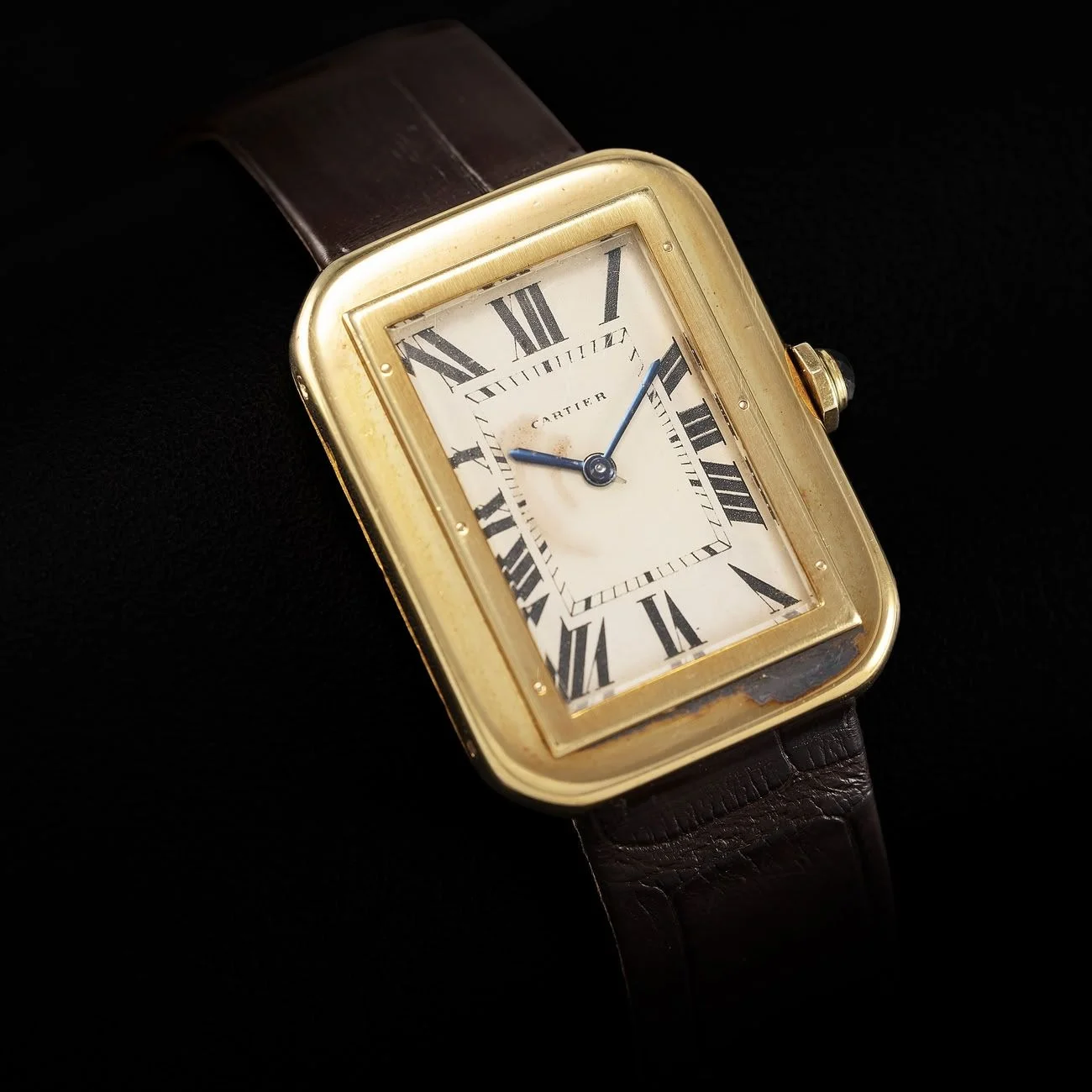
High estimate: €120,000 (about $134,000)
Cartier’s watchmaking history has a clear dividing line: before and after 1972. Before then, the company’s London, Paris, and New York branches had room to pursue their own designs. The period produced famous models such as the Crash, associated with Swinging ’60s London, as well as eccentric watches that never became catalogue regulars. After 1972, Cartier consolidated watch production in Switzerland and moved toward a more standardized approach.
That earlier freedom makes the record keeping difficult. Individual branches could create bespoke watches for a single client or a small group, and surviving documentation can be scarce. “Without [Cartier] willing to give an archive or confirm anything, it’s really a poke in the dark for anyone,” Madhvani says. Paperwork is unusual enough that Mike Nouveau, TikTok’s favorite watch dealer and a Cartier expert, recently posted a video to show an invoice from Cartier’s London branch.
The Cornice belongs to that loose, experimental chapter. Its outline suggests a Tank that has been inflated, with a bulge that seems to push out from the side. Madhvani has collected rare vintage Cartier for decades and says he has never encountered another one. “For me, it epitomizes what the maison is about in terms of design,” he says. “It’s from the days when creativity was not stifled and was able to be expressed by the individual casemaker—I think [the Cornice] is a culmination of that.”
Its condition tells part of the story, too. The dial has discolored, and the sword-shaped hour hand looks battered. Madhvani sees age as evidence of a watch’s life, not a defect to erase. “I think that’s what makes a piece attractive,” he says. “It communicates the history of where it’s been. It’s obviously aged over time rather than rough use or anything, and that’s the beauty of it.”
Cartier “Deck Chair”
High estimate: €120,000 (about $134,000)

Most watches go on the wrist by opening a clasp or unfastening a strap. This one takes a more theatrical route: its case separates and folds open while the strap stays closed. Putting it on is, in Madhvani’s description of the mechanism, like opening a deck chair.
There are precedents for watches with moving cases—the Jaeger-LeCoultre Reverso flips to protect its dial, while the Cartier Tank Basculante pivots on a hinge at 12 o’clock—but Madhvani says he has never seen another Deck Chair in four decades of collecting. It is a one-of-one design, and another product of Cartier’s decentralized production era.
The gold case carries an eagle-head hallmark on its back, identifying it as French-made. France uses the eagle as its official mark for gold; 18-karat gold must carry the stamp to verify its purity, while other regions use different symbols. Despite being made in the 1960s, the watch and its hallmark remain in nearly pristine condition. Madhvani suspects its original owner rarely wore it: “I think it’s such a sort of dandy piece that probably the original owner never wore it.”
Instagram’s value to Madhvani goes beyond finding watches for sale: it can reconnect a watch with the people who know its history. After he posts an acquisition, someone may message him with details about its former owner or an engraving. “There’s always a story which makes the watch more fascinating,” he says. A dealer even got in touch after Madhvani shared the “Deck Chair,” claiming he had bought it from its original owners in Canada. That kind of provenance is hard to plan for, and it’s a reminder that a watch can carry a social history alongside its mechanical one.
Cartier Tank
High estimate of €120,000 (about $134,000)
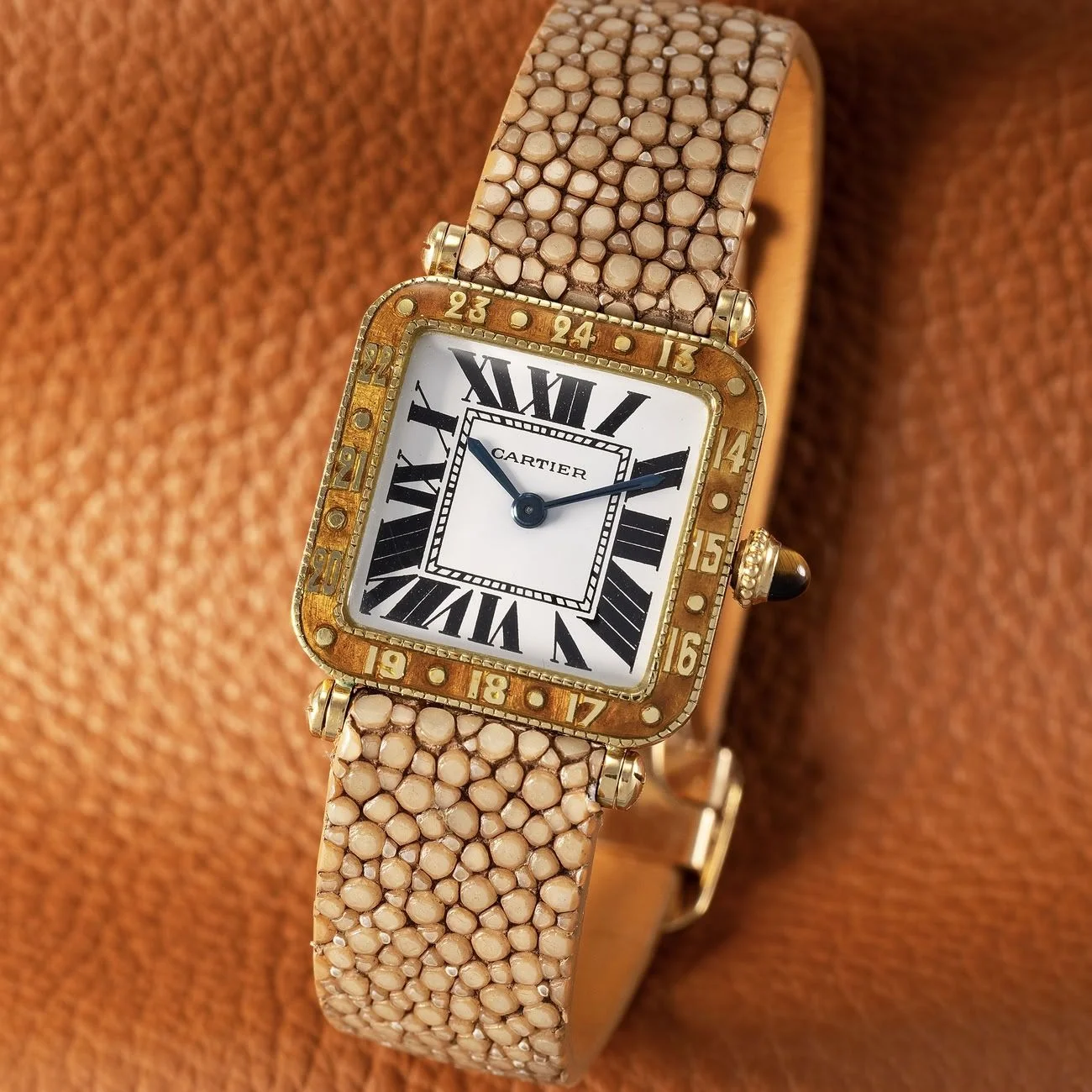
Of the watches headed to auction, this Tank was the hardest for Madhvani to part with. He says selling any watch hurts, but this one stands apart: it’s a Cartier Tank with an enamel bezel, a combination he says he has never seen before. Like the “Deck Chair,” it bears the engraving “N° UN,” marking it as unique.
The appeal is in the balance. The enamel bezel gives the familiar Tank silhouette an unusual flourish, while the 24-hour numerals seem almost carved into the surface. Against them, the dial’s crisp Roman numerals keep the design unmistakably Cartier. The watch changes the details without losing the shape that makes a Tank a Tank.
Cartier Pasha “Arab Watch Club”
High estimate of €20,000 (about $22,300)
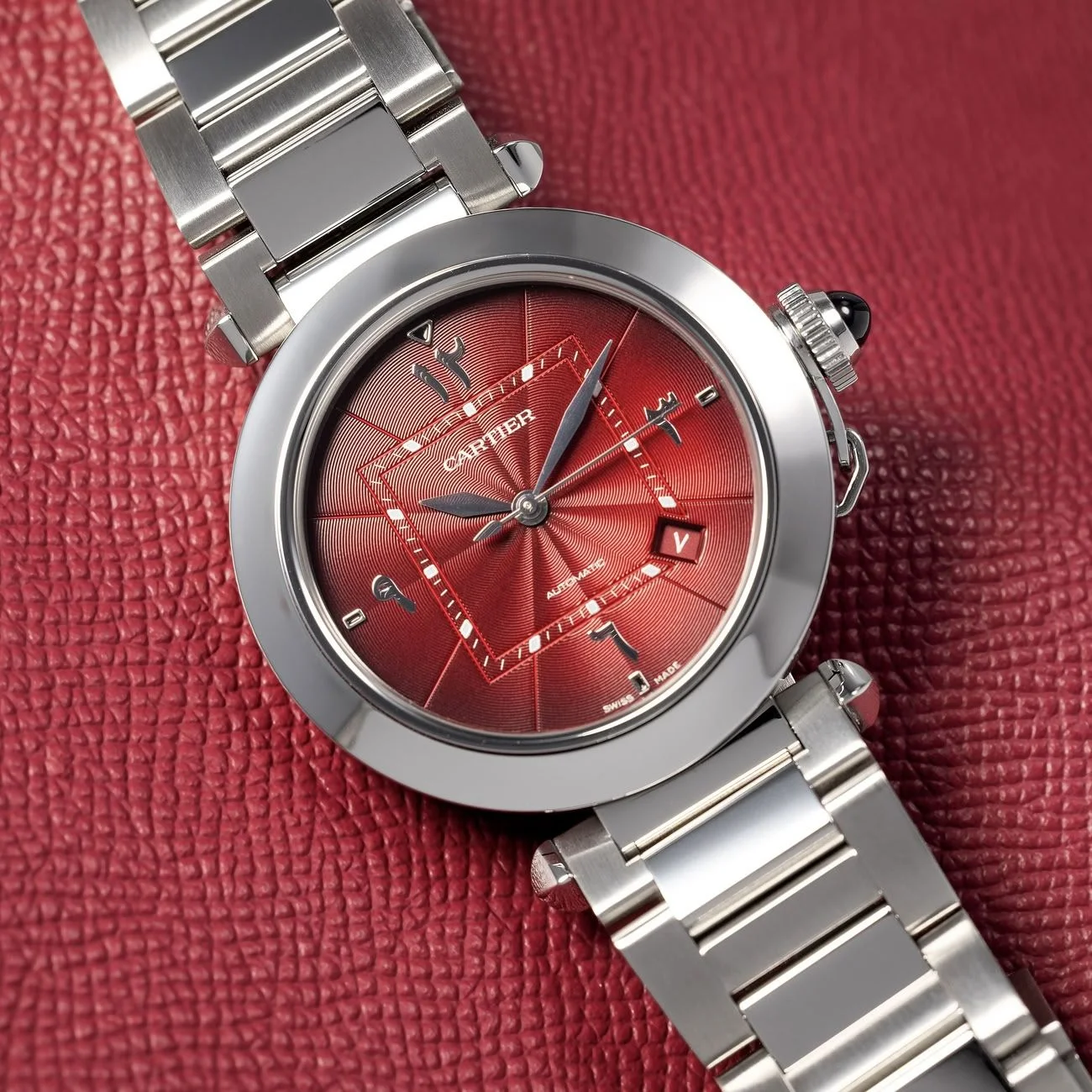
The Pasha made for Arab Watch Club members is a livelier, less personal piece for Madhvani. Its ruby-red dial calls to mind a cherry’s dark center, and the case carries the inscription “Time is master of all.” He bought it on a whim after friends in the club coaxed him into it, but says he never wore it and has no personal connection to the Middle East. This one, he says, was always likely to be sold.
That contrast says something about collecting: rarity and beauty can make a watch remarkable, but attachment often comes from the stories and connections gathered around it. For Madhvani, the Tank is difficult to release; the Pasha is an appealing object he never made his own.
See all of our newsletters, including Box + Papers, here.