Fraternity Culture, Hazing, and the Question of Gang-Like Behavior
Are Frats Just Gangs by Another Name?
Fraternities can control access to prized social resources while using humiliation and hazing to enforce rank and bind members together. That combination deserves more scrutiny than it gets. The resemblance to gangs isn’t just a provocative headline; it’s the question at the center of a lawsuit over alleged sexual violence at Cornell.
This article describes allegations of sexual assault. Read the rest of GQ’s special report on Cornell here and here.
Benjamin Nugent’s view of fraternities began close to home. Growing up in Amherst, Massachusetts, about ten minutes from UMass’s frat row, he knew a strip of shabby mansions that has since been demolished and bought by the university. As a child, he went trick-or-treating there and came away with rolls of toilet paper. As a teenager, he went for the drinking and the sense that no one would step in to keep him safe. The parties offered a kind of outlaw theater: drinking until people were sick, rock shows, mosh pits, and rides for hitchhiking frat boys moving between houses.
His town was quick to mock the rich, Nugent recalls, yet students from UMass sometimes took that hostility to Amherst College, pelting students with snowballs—and, reportedly, rocks one year. The college president later threatened to call in state police. Nugent found the disorder thrilling. He thought of the students as local Vikings.
That early fascination eventually became research: Nugent wrote a book of short stories about fraternity men and interviewed many of them. So when a woman filed a civil lawsuit alleging that she was gang-raped at Cornell’s Chi Phi house in 2024, people asked him how such an incident could happen. The men named in the case deny wrongdoing. The allegations remain allegations, but their details are disturbing.
According to the plaintiff’s account, she was so heavily intoxicated by alcohol and ketamine that she could barely be considered conscious. “I was a sex doll for all intents and purposes,” Jane Doe told a police interviewer, according to The New York Times. She reportedly told officials she wondered whether taking ketamine again might make her pass out. The lawsuit also includes a photograph of a Snapchat group, where a fraternity member allegedly urged others to “pu” (“pull up”) for “free pussy.” What kind of group turns an incapacitated woman into an invitation?
Hazing, masculinity, and the audience
Public discussion has focused on whether hazing trains fraternity members to be violent toward pledges and women. That may be part of the picture, but it doesn’t explain everything. American fraternities also have a long record of mixing homophobic policing with homoerotic rituals.
In her 1990 book Fraternity Gang Rape, anthropologist Peggy Reeves Sanday recounts a woman’s description of a ritual she saw while living in a fraternity house for a summer. When the Doors’ “L.A. Woman” played, she said, the brothers formed a fast-moving circle, shouting “Ho! Ho! Ho!” Shorter members were lifted off the floor; eventually the group lost control and piled on top of one another. She observed that men who made “nasty, ugly, homophobic remarks” seemed to enjoy the physical closeness.
The song comes on and the brothers start yelling “Ho! Ho! Ho!” All the brothers link arms and join in a circle. Then the whole circle moves around so fast that the shortest members are lifted off the ground. The “Ho!”s continue until the circle loses control and the entire group piles on top of each other, squashing the smallest members […] For a bunch of guys who were always so full of nasty, ugly, homophobic remarks, they seemed to enjoy jumping around on top of each other very much.
Sanday also records rituals that cast pledges’ bodies as objects of inspection or ridicule. In one account, pledges were ordered to expose their genitals; those who refused were punished with push-ups. Other reported exercises involved simulating sex in front of the group, showering together, or consuming liquor through the anus. The rituals could be anti-gay in their stated logic and homoerotic in their physical demands at the same time.
Women, too, have sometimes been placed inside fraternity performances aimed partly at the men watching. In 2015, Indiana University revoked the Alpha Tau Omega chapter’s charter after a video emerged showing members gathered around a brother lying on a mattress in boxers and socks, apparently performing oral sex on a woman. The chapter’s chief executive said she was a hired exotic dancer. Some men watched nearly naked from the floor; others stood fully dressed, spanking the brother or patting his back. It’s unclear whether he was coerced. The scene, however, presents him as an object of attention, while the woman appears to hold him in a headlock and push his face toward her. Her role seems to be performing dominance for the group’s amusement and arousal.
The alleged events at Cornell may have occupied a similar space between spectacle and sexual titillation. In the Snapchat messages included in the lawsuit, one Chi Phi member reportedly noted that a brother had gone into a room seven minutes earlier and was “not afk”—not “away from keyboard.” Another message, attributed to one of the men allegedly involved in an initial threesome with Jane Doe, said: “Like you can walk in and whip it out.” If that encounter happened as the lawsuit describes, the men may have faced ridicule or suspicion from their fraternity brothers. The underlying question—who did what with whom, and did they enjoy it?—could turn the woman into a prop in a performance of heterosexuality.
The lawsuit alleges that one man forced oral sex on Jane Doe while another slapped her buttocks repeatedly, leaving bruises. It describes this as the start of an alleged escalation involving drugs and violence, with Jane Doe treated as a shared resource, like a keg or a pizza. The account is deeply disturbing. The messages may help explain the group dynamics, but they don’t tell us everything about what the men thought or why they acted as they allegedly did.

Jane Doe’s lawyer, Thomas Giuffra, said she learned about the Snapchat exchange from a photograph taken by a fraternity member who wasn’t present. A few days after the alleged assault, she also saw online posts condemning Chi Phi, according to text messages reviewed by The New York Times.
“Are Chi Phi brothers Crips or Bloods because I hear they have been doing hell Gang Banging?” one post reportedly asked.
“They do drugs and gang r*ped a sophomore. Report them,” read another.
Jane Doe later told investigators that the posts changed how she understood what had happened: “That’s the first time I had ever heard the narrative change that I wasn’t a whore and that I was assaulted,” she reportedly said. The posts also exposed the gap between fraternity ideals and alleged conduct. Chi Phi’s creed promises, “Chivalrous behavior crosses the ages to touch the heart of Chi Phi.” When an organization’s members are accused of acting in direct opposition to its stated values, the comparison to a gang can feel less like a taunt than a question about power and belonging.
In the foreword to Fraternity Gang Rape, Philadelphia trial judge Lois G. Forer drew a parallel from her experience trying both fraternity members and street gang members. Both groups, she wrote, “engage in sexual behavior that others call gang rape,” treating it as “a form of male bonding for which the female is merely an available instrument.”

The power of a fraternity can come from controlling access to something hard to find elsewhere. A gang might control drugs in a neighborhood; in a small college town such as Ithaca or Amherst, a fraternity may control access to a large house where drinking and drug use can go largely unchecked. That gatekeeping helps explain why, as a curious teenager, I found myself on frat row, where underage drinking and other mischief seemed routine.
Text messages published by CBS suggest that Jane Doe was still considering going to Chi Phi’s Halloween party about a week after she was allegedly raped at the house, and days after seeing online comments comparing the fraternity to the “Crips or Bloods.” One brother told her, “Chi phi is your house and you are welcome here.” She answered, “Thank u i really appreciate that,” adding, “<3 i’ll bring my cigs tomorrow.”
Then, she reportedly said, the chapter president called to uninvite her. Her response—“yall aren’t my friends” and “the woman will always get the short end of the stick”—shows how much belonging to that party scene mattered, and how much power the fraternity held to withdraw it. On a campus where social life can feel tightly enclosed, exclusion carries its own force.
Belonging, masculinity, and the cost of admission
Fraternity brothers can fear that same rejection. In her book, Sanday describes one man who set quotas for sexual encounters because he worried about his attractiveness and masculinity. Sex, in that account, was less about pleasure than “the feeling of acceptance and approval.” The alleged violence at Cornell echoes that pressure to turn sex into proof of manhood. A fraternity committed to helping young men grow could challenge those expectations. But could it do so while keeping the culture that draws people to its parties? That’s the uncomfortable question.
I wanted that approval when I was in high school. I lived with my mother most of the time, and she taught me to shave. I wasn’t on a sports team or in a club. Fraternities appealed to me for reasons that can also draw boys in poor neighborhoods toward gangs: loneliness, boredom, and a search for male role models.
One autumn night, shortly after rush week, I watched pledges lined up on a lawn outside a fraternity house. They wore office clothes—sweater vests, ties, Oxford shirts, khakis, and brogues—while an active paced before them like a drill sergeant. He lectured them on tie knots, aftershave, pressed trousers, and polished shoes. The pledges stood quietly, some fidgeting, their clothes ill-fitting and their ties askew. They seemed ready to do anything he asked. I would have been, too. I thought he might teach me how to be a man.
What fraternities ask a university to accept
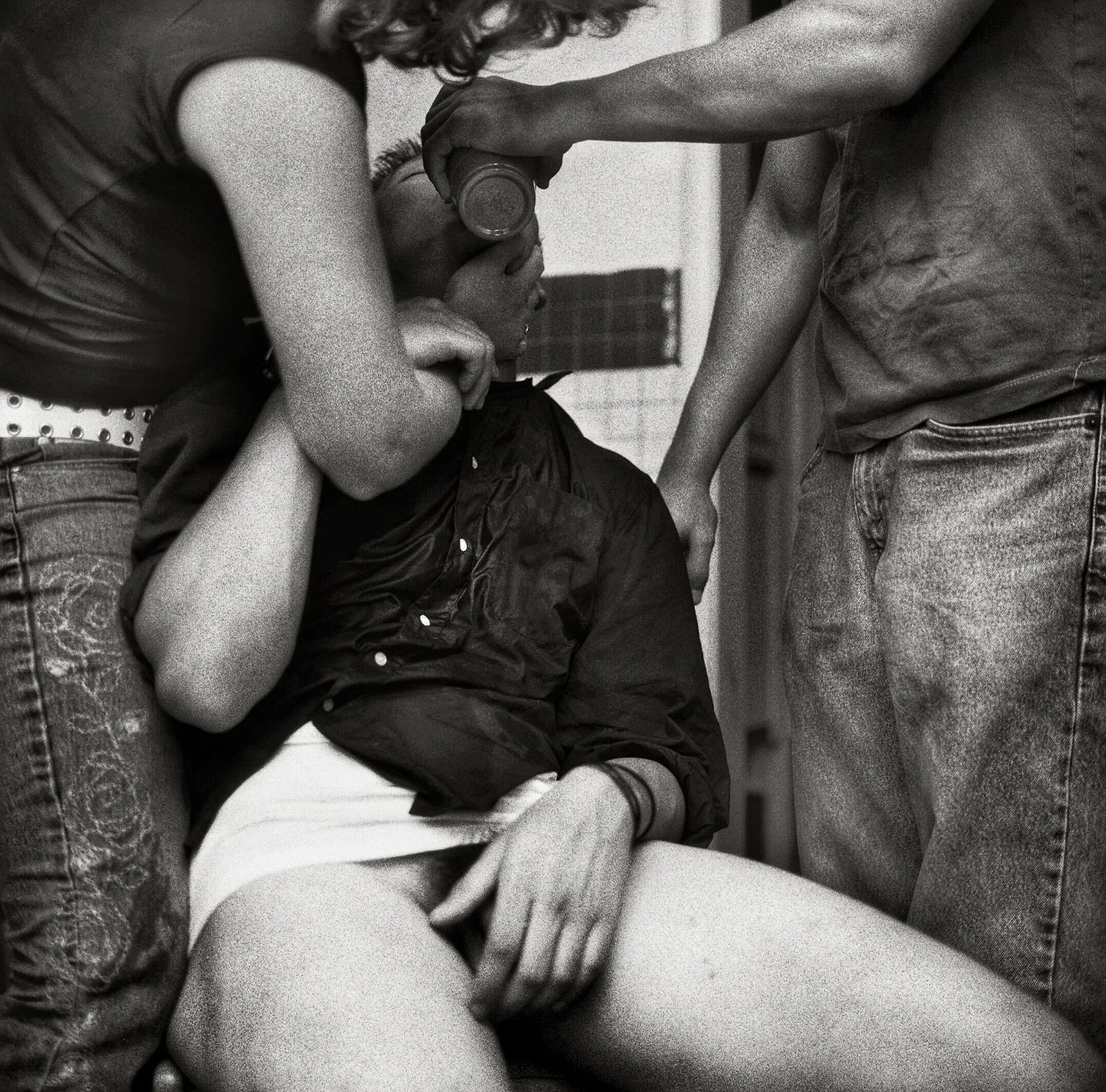
Andrew Moisey’s 2018 book The American Fraternity uses intimate photographs of Greek life at his alma mater to expose its central contradiction: pledges promise to help one another become ideal men, then celebrate conduct that undercuts that promise. Now a professor of art history and visual studies at Cornell, Moisey told GQ that fraternities resemble an abusive relationship: they assure task forces they’ll change, while their culture is built around breaking those assurances.
He also points to the university’s incentives. If fraternity members go on to prominent careers, Cornell may see a benefit. But when there’s a death, an alleged rape, or another tragedy, the institution’s association with fraternities brings dishonor too. Antonio Tsialas’s body was found at the bottom of a gorge two days after an unauthorized Cornell fraternity party in 2019. Moisey says the debate among faculty, administrators, trustees, and donors comes down to an old question: “What’s more important, honor or money? Cornell is supposed to represent enlightenment. Does this look like enlightenment to you?”
That question reaches beyond one chapter. A fraternity can offer young men friendship and a model of belonging; it can also make access to that belonging conditional on accepting its rules. Whether Cornell can preserve the former while confronting the latter is still unresolved.
Young Men of Cornell Want to Talk. Why Are Older Men So Quiet? — What people in Ithaca are saying—and not saying—about the sexual assault allegations brought against members of the Chi Phi fraternity. By Savannah Sobrevilla.
Why Is It So Hard to Call Someone Out on the Group Chat? — A sociologist who studies online groups explains how social dynamics play out on our screens. By The Editors of GQ.