Food Fashion’s Viral Moment Is Giving Way to Questions of Quality and Meaning
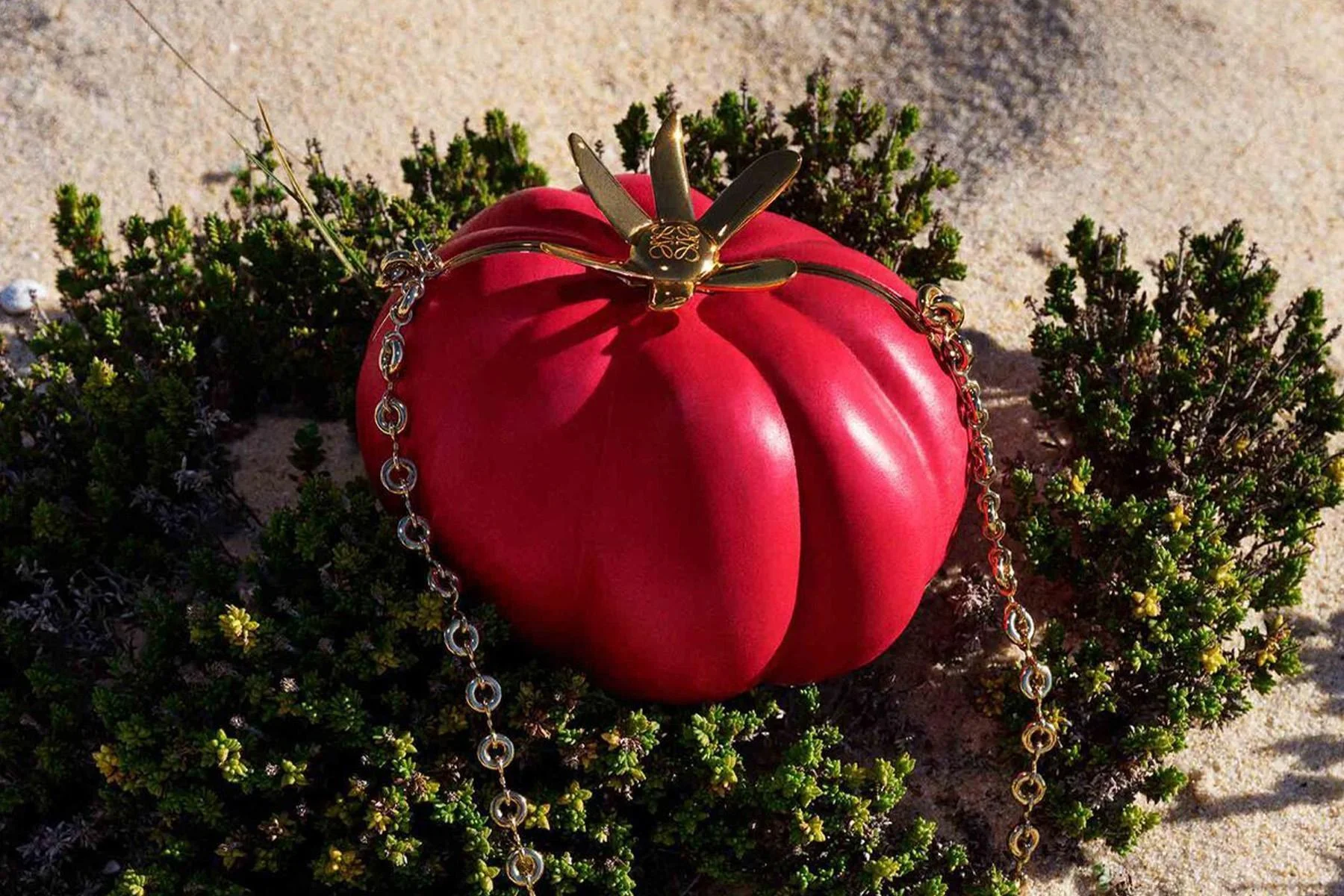
Food has become an easy shorthand for personality in fashion. A tomato clutch or seafood print can signal humor, taste, nostalgia, even affluence. But as edible motifs turn up across luxury labels and mass-market stores, the format is losing the surprise that once made it travel. The question now is whether designers can give food-inspired clothes a life beyond the next social-media cycle.
From runway novelty to mass-market staple
The shift is visible in the price tags. Loewe’s summer collection included a lambskin tomato clutch priced at $4,150; Walmart offered rotisserie-chicken-shaped purses and charms starting at $5.97. That range captures the path many trends take: a high-fashion idea spreads through online attention, then reappears in products made for a much wider audience.
The current wave gained momentum around the pandemic, though fashion has borrowed from food for much longer. One early signal arrived at New York Fashion Week in 2020, when Puppets and Puppets sent a black handbag with a chocolate-chip cookie protruding from it down the runway. The design became a viral calling card for a young brand that built food into its visual language.
Designer Carly Mark had worked as an artist focused on candy and snacks before entering fashion. In a 2023 interview with Business of Fashion, she described food and fashion as sharing two powerful drivers: pleasure and money. That pairing informed the label’s other surreal pieces, including cake-topped aviator caps, Ferrero Rocher heels and hats sculpted from beeswax to resemble cheese. They were odd enough to draw attention, and clear enough to circulate quickly online.
The pandemic era supplied more examples. The much-copied strawberry dress became a TikTok fixation, while Tombolo Company’s vongole shirt, first released in 2019, reached its peak popularity in 2021. Katie Kimmel’s chicken-parm T-shirts treated food fandom with the fervor of sports allegiance. By 2022, seafood motifs had become a seasonal fashion story, with Rachel Antonoff’s seafood-tower dress among the pieces that sold quickly.
Food works because it carries identity
Food prints aren’t just playful decoration. They tap into a culture where what someone eats, where they eat and which brands they love can all function as personal signals. The earlier rise of “foodie” culture in the 2000s and 2010s helped prepare the ground: apparel brands put coffee, avocados and other familiar favorites on shirts, making consumption part of an outward-facing identity.
Cole Poska, a content creator and partner and creative director at Beyond Studios, sees food brands as unusually rich source material. “Food brands have something most brands would kill for: decades of nostalgia, iconic identities, and consumers who are borderline obsessed with them,” he tells Eater.
Poska has made that point through playful designs for restaurant merchandise, including apparel inspired by Cheesecake Factory and a hat modeled on the chain’s brown bread. The appeal rests on recognition and attachment: People can be fiercely loyal to a fast-food order, a taco shop or a martini recipe. Wearing those preferences makes an outfit feel personal, even when the design is built around a widely known product.
That’s also why the category traveled so well across price points. Food references are immediately legible. A recognizable dish or package can communicate a whole set of associations without requiring much explanation. For brands trying to earn attention in crowded feeds, that quick read has obvious value.
Abundance has dulled the joke
The same recognizability that powers the trend can also flatten it. By 2024, Bon Appétit was asking why so many dresses featured pasta and cocktail shrimp. A few years earlier, a shrimp-print dress could feel delightfully strange; now, the image risks reading as one more iteration of a well-worn joke.
There’s a practical concern, too. Products designed primarily to provoke a reaction can be short-lived, especially when brands rush to meet fast-moving online demand. A gimmick may generate attention for a moment, but that doesn’t guarantee the item will remain useful or meaningful once the feed moves on. When novelty drives the design, the result can feel disposable.
Food motifs also carry a sharper social meaning as food prices rise. A $425 cardigan decorated with oysters can suggest more than a taste for kitsch: It may imply that the wearer has the means to enjoy expensive food. A caviar sweater can turn culinary preference into a marker of access and status. The symbolism changes at the budget end, too. A mass-market tomato purse may not carry the same associations as a luxury label’s version, even if both use the same basic image.
That tension makes food fashion more complicated than a simple joke about novelty. A motif can express affection for a dish, a place or a brand, while also revealing who can afford the lifestyle the item evokes. And when the same visual idea appears everywhere, the distinction between a knowing reference and a generic product gets harder to maintain.
Utility and storytelling offer a longer shelf life
Sam Salad, co-founder of Los Angeles apparel company Meals, argues that food references can work when the clothes have a purpose beyond the image. Meals draws on workwear and food culture, selling chef pants in classic colors as well as quieter references to blue cheese and watermelon. The food connection sits within a functional garment, rather than carrying the entire design on its own.
Salad started the company after selling premium denim on Abbot Kinney Boulevard in Venice, where restaurants and visual food culture shaped his sense of the brand. “Design today has to translate across languages and platforms,” he tells Eater. That reach matters, but his product range suggests that instant recognition doesn’t have to come at the expense of wearability.
Food and fashion have shared references well before the current rush. Salad points to Issey Miyake presenting pleated garments in the format of small omakase sets, and to the 1937 lobster dress designed by Salvador Dalí and Elsa Schiaparelli. The dress, worn by Wallis Simpson, once challenged conventional ideas of what clothing could depict. Its later imitators, now sold for as little as $13, show how a once-specific fashion statement can lose force through repetition.
For Salad, the route out of a crowded field is to make fewer things with greater care and a clearer story. He points to In-N-Out Burger as a model of doing a small number of things well. Poska’s standard is similarly demanding: “I’d rather make one thing people talk about for a year than 20 things people forget about tomorrow,” he says. “The first person to make a candle look like a stick of butter is a genius. The hundredth person is just making a candle.”
Food will keep offering fashion designers a deep well of color, shape and cultural memory. The stronger ideas are likely to be the ones that pair that recognition with thoughtful construction, a useful form or a story worth telling. In a category now crowded with edible objects, staying power may depend on making the clothes matter after the joke lands.