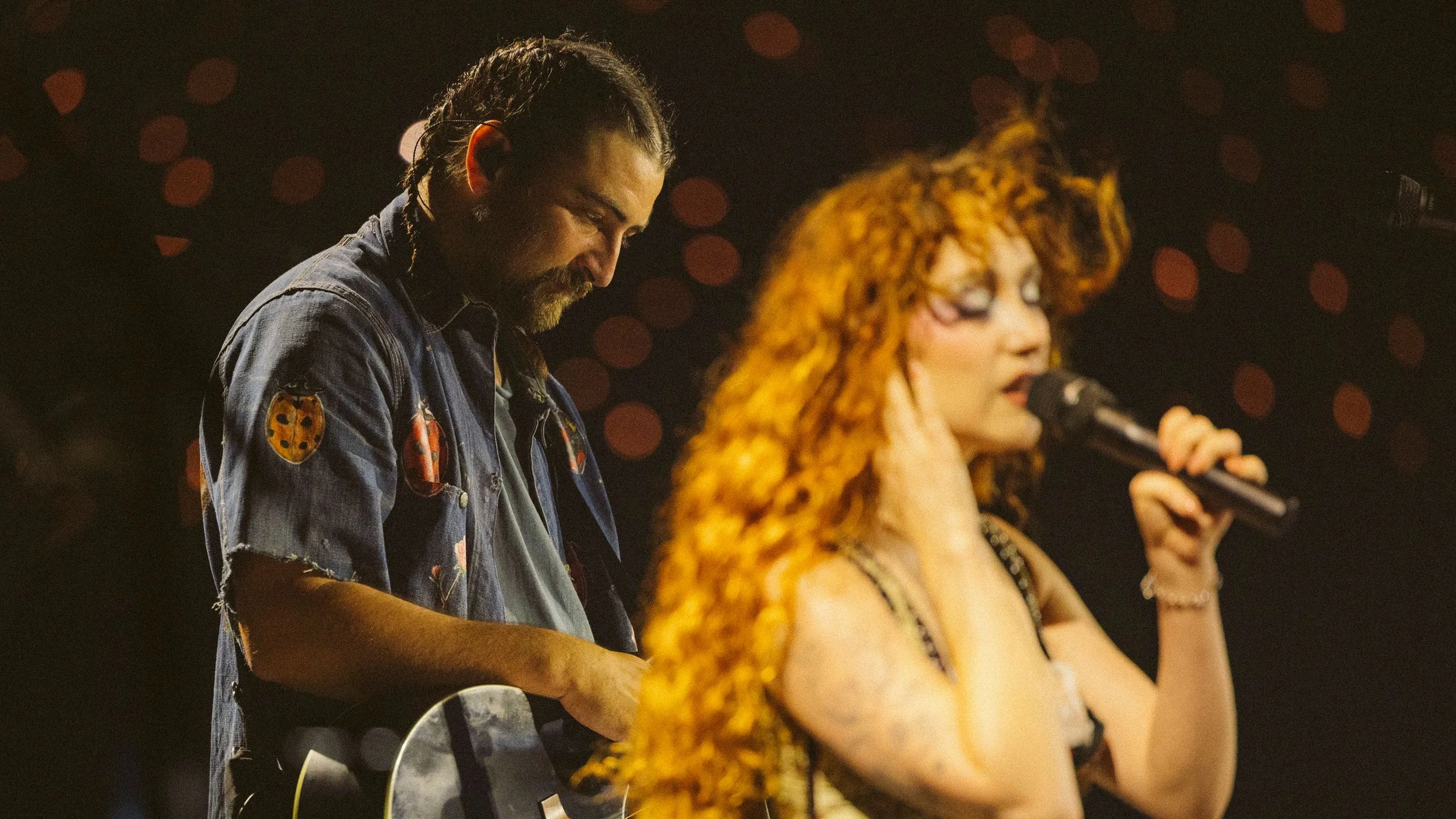
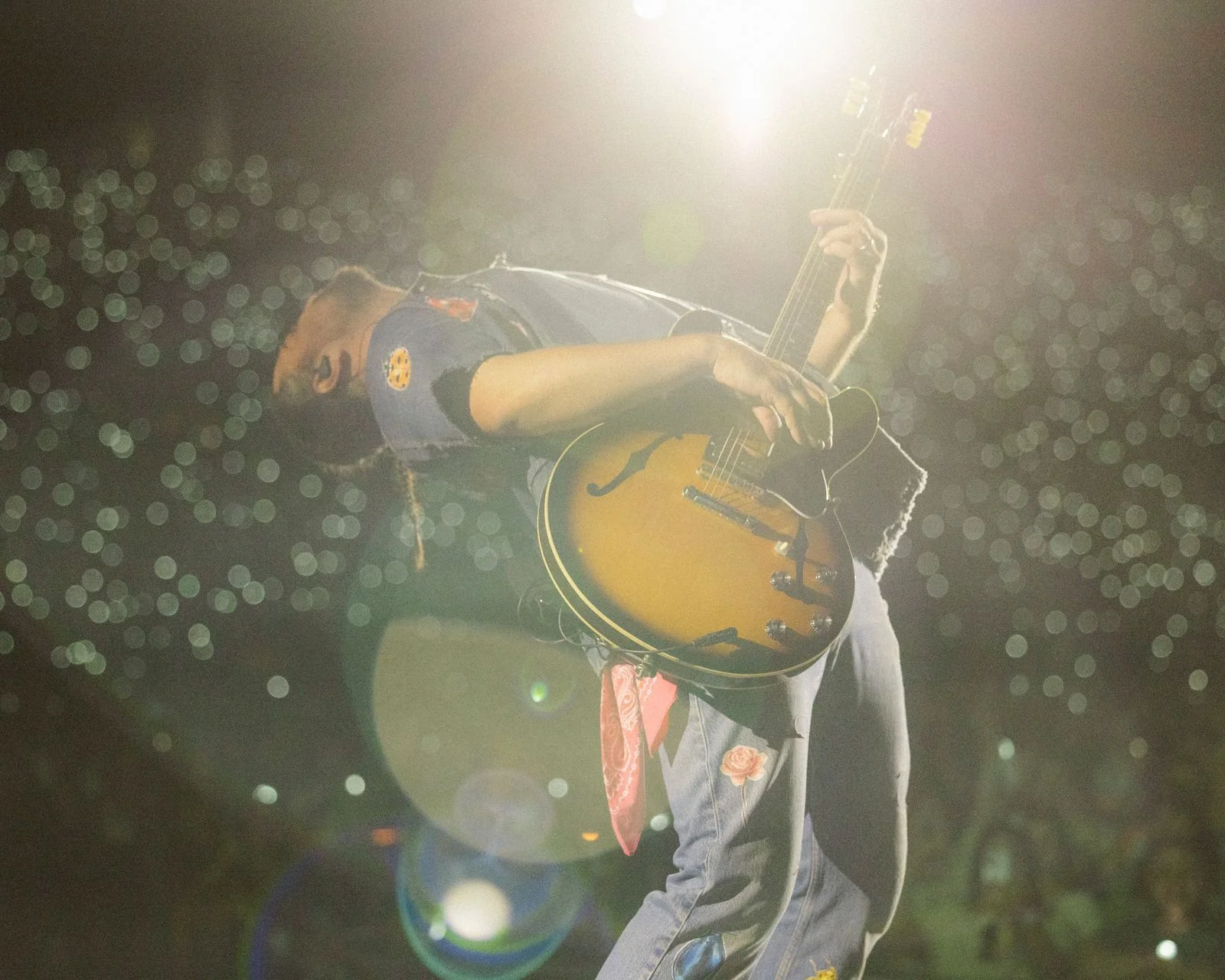
It’s a warm Saturday night in Pasadena and Noah Kahan has already played two songs off his latest album The Great Divide, the summer tour for which has already taken him to baseball stadiums all over this large country, each one filled to the brim with people in white peasant skirts and crocheted ladybug halter tops. Kitted out in a short-sleeved denim shirt covered in insect appliqués, hair woven into his signature French braids, he introduces himself to the 56,000 people in the Rose Bowl crowd: “I’m Noah Kahan, and I’m here to make you fucking miserable.” The audience roars. No other fanbase in America right now is happier to get sad.
This Rose Bowl concert, Kahan’s largest headlining show ever, is a high water mark in the already extraordinary career of the Vermont-born artist. The 29-year-old first captured the hearts of an anxious, homebound audience with his viral hit “Stick Season,” a burrito of a song in which a failed romance is the filling, and the dashed hopes of a frustrated generation the tortilla. Two more conventional previous albums, 2019’s Busyhead and 2021’s I Was/I Am, had failed to break Kahan on the world stage, but when he posted an unfinished snippet of the rustic “Stick Season” to TikTok in 2022, casual scrollers were intrigued, and by the time he released a final version with lots of furious strumming and thumping kick drum—if Gen Z’s confessional pop stars are “Taydaughters,” surely Kahan puts the son in Mumford & Sons—a clamoring crowd was waiting to hear it. Stick Season blew up: number 2 on the Billboard 200, successful follow-up singles “Northern Attitude” and “Dial Drunk,” a bonus album with features from Kacey Musgraves and Hozier, and an army of “Busyheads” who loved his intense songs and pleasant social media aura. In response, Kahan buckled down and hit the road. His last tour, an extended 153-show grind, hit theaters, then amphitheaters, then arenas; for The Great Divide, he’s been selling out baseball stadiums all summer like he’s Billy Joel.
Kahan’s sensitive songwriting and crunchy affability have a timelessness to them—you could imagine him doing a Counting Crows thing in the 1990s, or having a Five For Fighting “Superman”-style smash hit in the 2000s—but the conditions have been simply perfect for Kahan in our current decade: the pandemic kicking a wide swathe of young people from their college dorms and first apartments unhappily back to their places of origin, turning them into involuntary townies; an increasing awareness of and interest in ‘mental health’ as a concept; the rise of a social media platform that rewards clear, sticky, and relatable songwriting, especially from artists who vulnerably make work in front of their audiences in real time; the post-2020 appetite for homespun music that sounds best on porches, patios and backyards; a dearth of appealing male solo artists that left the field wide open for a new star to be born.
Before the show, I was chatting with my husband, trying desperately to find any kind of music history comp for Kahan’s success. Is he a pop-star Willie Nelson? A version of Dave Matthews who makes people cry instead of play hacky sack? A Morgan Wallen for, as Kahan sings on his track “New Perspectives, “liberal rednecks”? At the show, as soon as “American Cars” kicked off, a mallet bonked me over the head and I went, duh—Bruce Springsteen. Bruce churned working class malaise and post-industrial blight into saxophone-blatting bangers, while Kahan makes fist-pumping folk rock about small-town depression (economic) and small town depression (psychological), but both dudes are pros at turning a bad mood, a dry spell, a crushed American dream into a sing-a-long crowdpleaser (and they both have great taste in workwear).
At the Rose Bowl, which was full to bursting with fans in the modern pioneer garb that has taken over festival fashion in the past year or so, the mood was high. People wore pleather cowboy boots, homemade bug costumes (bugs and their seasonal comings and goings are a big motif in Kahan’s music) and crisp new Noah Kahan t-shirts purchased from long, long merch lines. A pair of folk-adjacent artists opened the show: Annabelle Dinda, whose band played with the friendly energy of off-duty camp counselors, and Gigi Perez, a Florida-raised singer-songwriter who popped on TikTok around the same time as Kahan. Perez, whose backing band had a wonderful mall goth aesthetic, was striking—her cover of Lana Del Rey’s “Summertime Sadness” had a powerful delivery that reminded me a bit of Linda Ronstadt.
Kahan took the stage through the door of a clapboard house that was the centerpiece of his set. Over video backdrops of rural scenes (fields, trees, cows, Kahan’s German shepherd), he ripped through newer songs like “Door” and “Deny Deny Deny” with the help of a fantastic, denim-clad backing band, all of whom looked like they would know how to fix your car if it broke down. The crowd was locked in and singing at the top of their lungs from the jump. When a breakout album is so beloved, newer material sometimes gets a lukewarm reception, but it sounded from my zone that people were as stoked on The Great Divide stuff as the Stick Season stuff, if not more so. (In fact, Kahan’s omission of songs like “Willing And Able” and “Staying Still” from his setlist on the first night of the tour apparently caused a bit of grumbling among some fans, after which there was a backlash to the backlash; he put those songs in.) Kahan’s vocals were also impressive—he hit everything from long howls to falsetto croons, and the little flourishes and runs on “The View Between Villages” and “Northern Attitude” reminded me that in a different world, his talent might have placed him in a teenybopper boy band. Though he’s still human at the end of the day—he started “Pain Is Cold Water” over after an epic voice crack that he later said sounded “like a 13-year-old fuckin’ boy on Fortnite.”
In between songs, Kahan was cheerful and chatty, projecting a humble energy in spite of the enormous crowd that was hanging on his every word. He joked that the people in the suites probably shop at Erewhon, introduced “Staying Still” as a song “about how much I hate Logan Airport,” called all the New Englanders in the audience cowards for moving to a place with no seasons (as a Vermonter/coward, I must protest—there’s a winter in L.A., it’s just that 60 degrees feels like 30) and, before playing “Dashboard,” asked if there were any assholes in the audience. As if on cue, a middle-aged couple jammed into the space next to me and started alternately making out and yapping loudly; it was no big deal, as they were mostly drowned out by tens of thousands of people all singing Turns out that you’re still an aaaassshoooole together with church-like fervor.
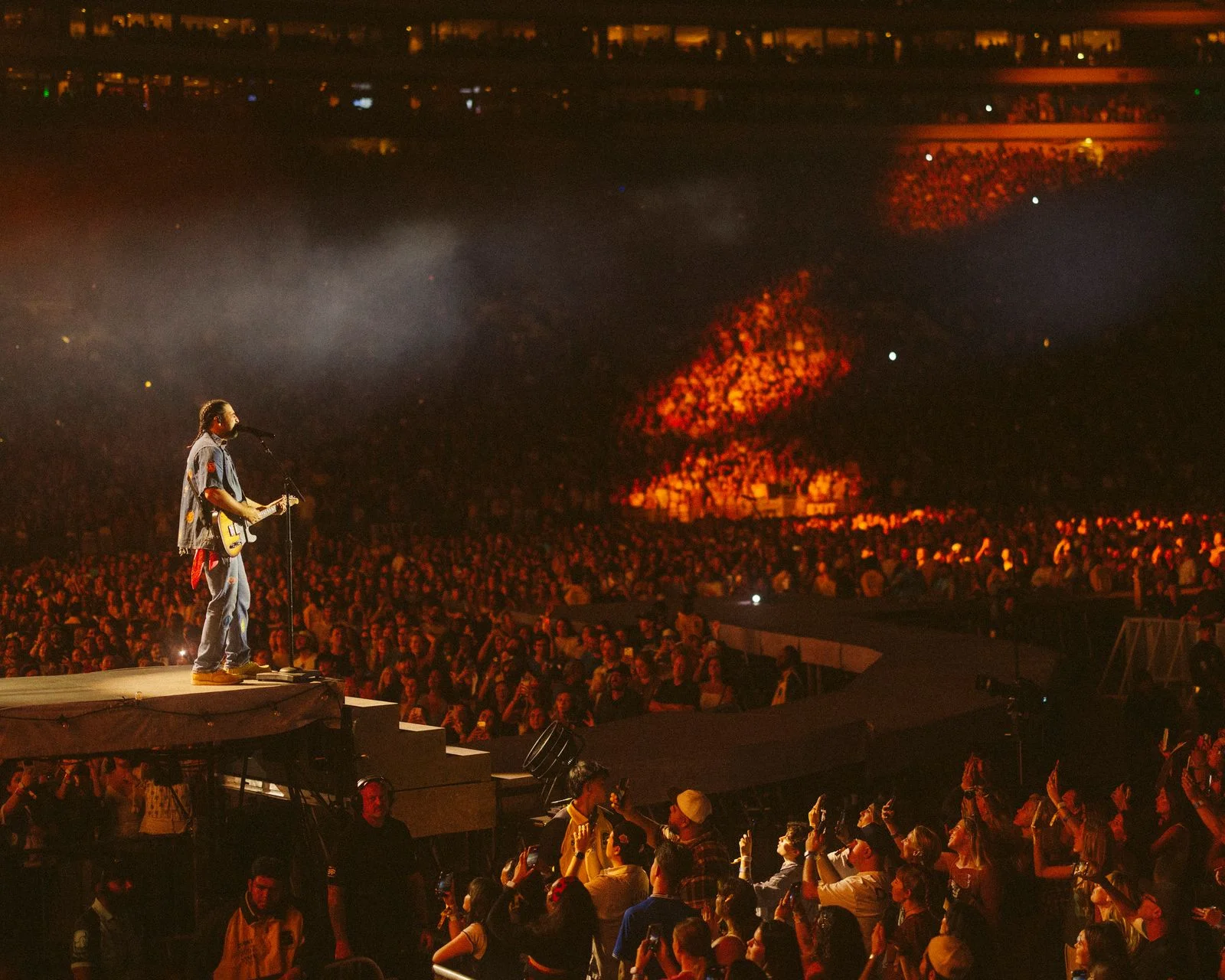
The B-stage set, which started with just Kahan on acoustic guitar, was lovely, particularly “Paid Time Off,” when his band re-appeared to work up a cozy, bluegrass-y jam with all the light-up wristbands of the stadium shimmering around them. (Big shout to Nina de Vitry, a multi-instrumentalist who switched from fiddle to banjo to acoustic guitar and back again.) By this point the crowd was eating out of Kahan’s hand—when he played “Maine,” a cut off his cult favorite EP Cape Elizabeth that starts with an extended bout of humming, a guy behind me hooted and then yelled “Join these hmmmms, fellas!” before humming at the top of his lungs, which is something I was not aware a person could even physically do. Then Chappell Roan, probably the only other artist who can currently relate to Kahan’s meteoric rise, came out for a stirring duet of her song “California.” Looking as understated as is possible for Chappell Roan to look, which is to say she was wearing jeans, she vouched for Kahan’s character: “Noah always stands up for me. He’s a good person, for real.” The encore, a run of “End of August,” “Homesick” and “Stick Season,” whipped everyone into a final frenzy.
Though the concept of ‘the hipster’ is now pretty much dead, hipster mindset is still alive and well, and as so-called “stomp clap hey” music has returned to the pop forefront, lots of snobs will simply move it to trash without a second thought. And I get it—even though I share an 802 area code of origin with Kahan, I am way more indie sleaze than indie folk, and any combination of earnestness and banjos can easily freak me out. But the way Kahan channeled a hardworking humility into his massive songs won me over. Contemporary life is full of flatness, lacking in friction. Sometimes you need a guy with a guitar, goading you into feeling something, anything. The thing about stomp clap music is, somewhere between the stomping and the clapping, you are moved.
Which is why when he introduced himself as someone who was here to make us miserable, it wasn’t quite accurate. Yes, Kahan visits plenty of painful scenarios in his songwriting, and there’s a little something for everyone: people with divorced parents, people with unfriendly exes, people with dead friends, people with mental illness. But for all the melancholy in his songs, there’s just as much rage, bitterness, humor and joy. And despair can end up sounding hopeful when delivered at high volume and maximum intensity. There’s a line on “Dan,” the last track on The Great Divide, that goes, “We’re so alone most of the time/Most of the time, we don’t have anyone.” A sad line when you hear it on its own, much less so when surrounded by 56,000 Noah Kahan fans. As fireworks burst over the stadium after the last notes of “Stick Season” rang out, I turned around to start making my way home. When I looked up in the stands, the explosions lit up a solid wall of faces, all smiling.