
The following article contains some spoilers for Lanterns.
1,001 people live in the tiny blue-collar town of Rushville, Nebraska: it's the kind of place where everyone knows everyone, the sheriff is married to the town's most prominen—maybe only?—lawyer, and said lawyer also runs the main street bar where all the locals congregate for beers and whiskey shots after they've clocked out. So much for rural hospitality, though: Outsiders sure as hell aren't welcome in these parts. Especially not a grizzled intergalactic superhero and his budding protege, whose arrival threatens to upset the apple cart, spilling out all of this town's secrets.
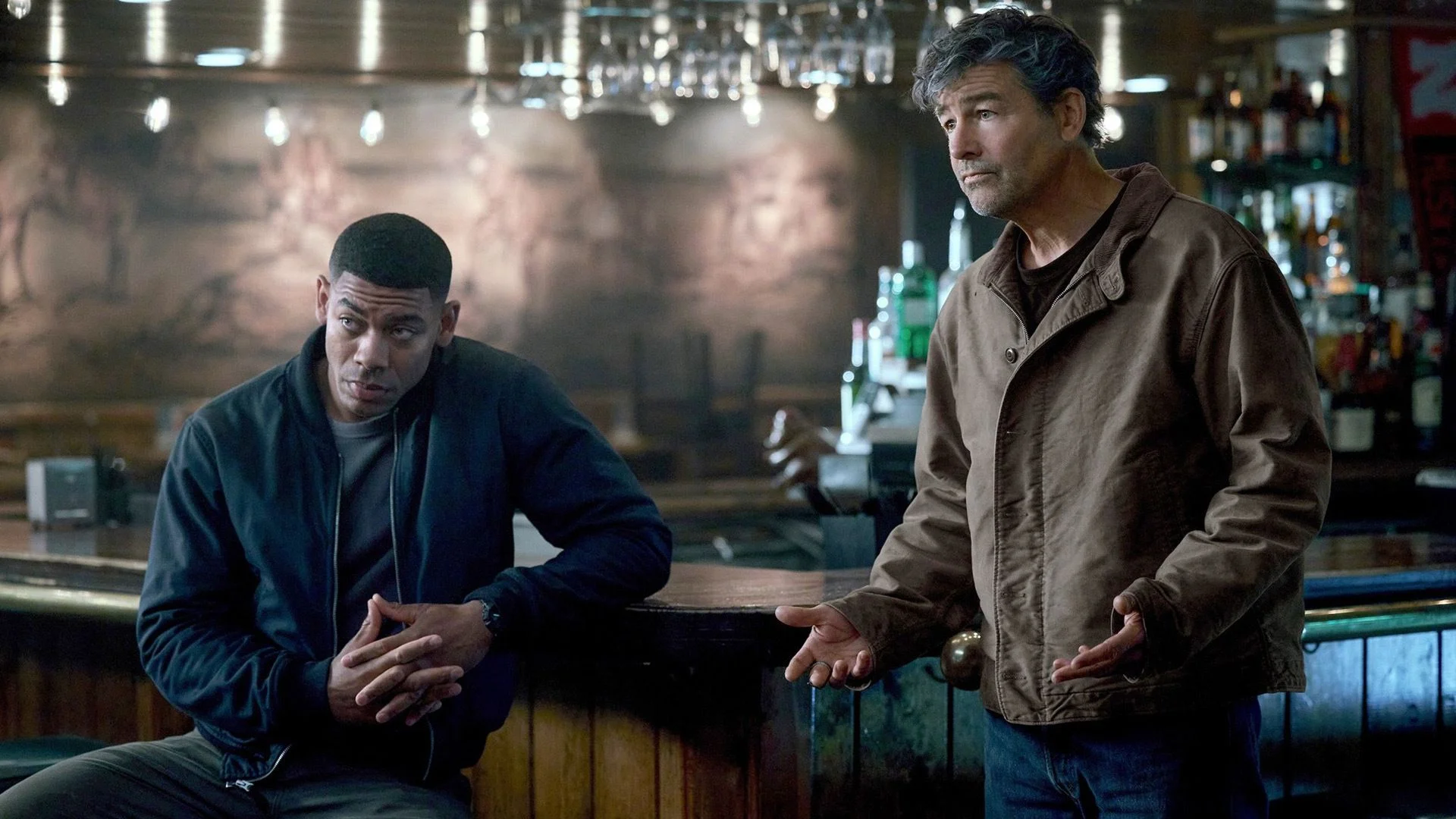
Said superhuman is Hal Jordan (Kyle Chandler), the Green Lantern (space cops, basically) recruited by the Guardians of the Universe (the extraterrestrial bosses of said space cops) some 30 years ago to defend the earth from alien threats. He's begrudgingly aging out of the job, and is being forced to train up his partner, John Stewart (Aaron Pierre), if-and-when he has to retire. They're both measly humans, but are able to wield rings that give them the power to manifest anything at will, limited only by their imaginations, whether it's a glowy green shield to deflect bullets, a gigantic and stupidly sophisticated tunnelling machine, or a dollar bill to stick in the jukebox.
So, an obvious question: why are a pair of space cops concerned with a redneck town in the middle of nowhere? Well, that's all down to a web of mysteries that unravels across Lanterns, the latest small-screen joint in the cross-media DC Universe—rebooted by James Gunn and Peter Safran in 2024 to rejuvenate DC Comics in films and TV, in the hope of giving the Marvel Cinematic Universe an actual rival for the first time since 2008. (The show was created by Chris Mundy, Damon Lindelof and Tom King, its own sort of super-group combining the talents of a True Detective producer, the showrunner behind Lost and Watchmen, and a big-name comic writer.)
The inciting incident is as all-American as Clark Kent himself: a shoot-out between rival fans at a football game, leaving a handful of bodies and a ton of questions as to why everyone started blasting. All the while, Sheriff Kerry (Kelly Macdonald, her performance a few doors down from Frances McDormand in Fargo) is mighty pissed that the Green Lanterns have turned up, flopping their big space dicks all over her very terrestrial jurisdiction. But Hal doesn't give a shit: he suspects, as quickly comes to pass, that aliens are involved. From there, the show jumps between timelines, gradually revealing why everyone in Rushville is so off.
First thing to note is that, aside from all the obligatory nudging references to comic-book lore and the wider DC Universe—and yeah, all the murky green CGI superpower shit, with which the show is impressively restrained, at least to start with—Lanterns doesn't really feel at all like a conventional comic-book show. It's more like a richly character-driven detective drama in the mold of True Detective or last year's Task, teeming with intrigue, twists, and great performances across the board. Not that it's completely reinventing the wheel as Christopher Nolan did with The Dark Knight, but it's very much following that tried-and-tested story-first blueprint. In terms of genre, it's much closer to a gritty Sunday night drama than your cookie-cutter superhero light display. That distinction is felt everywhere, from its bleak tone to the fits: Jordan has already put his comic-accurate costume in storage, so he mostly rocks around in a dusty jacket and beaten-up dad jeans, like a supercharged Joel from The Last of Us. The grit-o-meter is dialled up to 11, far divorced from the sunny, Golden Age stylings of Gunn's own Superman. In proper HBO fashion, every other line of dialogue contains a “fuck” or a “shit” or both a “fuck” and a “shit.”
The other movie that came to mind was the underrated Will Smith vehicle Hancock, in which he played a similarly busted, getting-too-old-for-this-shit super-anti-hero not unlike Chandler's Jordan: a veteran consumed by ego, governed more by pride than the Avengers’ cloying virtue. It's why he butts heads so often with the comparably upright, if eerily robotic Stewart, whom he dubs “junior,” a belittling putdown that does little to mask the fact that, in reality, Jordan knows he is staring in the face of the upgraded model, whose exploding biceps signal just how quickly Stewart could turn him into dust. (In some ways, the younger man is just as experienced as his bitter mentor, as he has been groomed to take over as Earth's Lantern since birth.) Not that “Junior” is himself faultless. He too is dragged back and forth between his desperate desire to fulfill the “destiny” his parents have been telling him about since he was in diapers, whatever the cost, and his reluctant respect for Jordan, plus the little matter of his own moral code. Ultimately, he's unwilling to forcefully usurp a guy who has, yes, hung on for too long—but is still, deep down, doing his best.
That all obviously makes for television that is so much more interesting than a mishmash of cameos and warring comic archetypes, absent dialogue that is just a machine-gun blast of smug quips, like most of the TV spin-offs churned out over at Marvel. (The MCU might be the big dogs at the multiplex, but DC really has their number on TV. Small-screen Marvel has rarely produced anything as this complex, funny, and—well—entertaining as this, Peacemaker or The Penguin.) Even the origin stories are pretty original, and somehow a little darker than Bruce Wayne watching his folks get smoked in that rainy alleyway. From the age of 5, Stewart's father would march him into the back garden and shoot an apple from the top of his head, a scene we are given at the very start of the show. The first rule for being a Lantern is that you can't feel fear, you see. And Stewart's parents, obsessed with making him the next Hal Jordan, did everything they could to destroy fear within him as a basic emotional response. The result? As an adult, he'll bravely face down anything. Oh, and he's pretty fucked up.
Pierre absolutely rips it up with that material, putting in a killer leading man performance rivalled only by the irreverent, smug, gleefully two-faced turn deployed by Chandler. (Poorna Jagannathan is also brilliant, but to talk about her character in any depth would probably land me in hot spoiler water. Come to think of it, acknowledging that in itself might be a spoiler. She's great!) Lanterns is even good when it leans into the comic-book of it all, which does kick further into gear later in the series' run. Either way, its flaws are few and far between. If you had a super-ring that could magically create a perfect comic-book show, it wouldn't be far from this.
This story originally appeared in British GQ.